Monday, February 14, 2011

a thought


One last note before we retreat to the beauty of the butterflies.


Morelia made worldwide news in 2008 with the type of incident most citizens fear -- and resent.


On the evening of September 15, all of Mexico was celebrating the 198th anniversary of its declaration of independence from Spain.


Crowds packed the plaza between the cathedral and the state government palace.  There were rumors that the drug lords were going to place a bomb in the crowd.  But the people of Morelia were not going to be deterred.


Governor Godoy had just finished shouting the traditional
grito -- pulling the crowd into a political high.


Then there was an explosion.  Followed quickly by a second -- four blocks away.  Someone had rolled two hand grenades into the midst of the celebrants.


Eight people were dead.  Over 100 were injured.


This is where it happened.  About in the middle of the photograph.  The governor was standing on the balcony of the building in the background.  (You can see a more detailed view at the top of this post.)


I debated whether to mention this incident.  After all, but for some excellent field work by the FBI, my former hometown of Portland could have had a far more destructive disaster this last November.


I point out the comparison because terrorism can happen anywhere.  But a lot of people have a pretty good idea what is driving the narco-terrorism -- and how to resolve it.


There is violence in Mexico.  Most of it caused by drug prohibition policies that will continue to result in more drug-related murders.


I would love to go through life appreciating only nice things like the pottery displays in yesterday's post.  Fortunately, most of our lives are never touched by the drug trade.  But lots of lives in Mexico, Canada, and the States are.


Maybe the American and Canadian governments will eventually see that drug prohibition is as dangerous to lives and liberties as was the American experiment with alcohol prohibition.


Then we can stop talking about this issue.

Sunday, February 13, 2011

morelia mordidas


Our next stop will be the butterfly sanctuary. 


But, before we head off to the mountains, I want to share a few Morelia photographs with you.


Bus tours have a tendency to drop passengers off at handicraft shops filled with souvenirs indistinguishable from offerings at Import Plaza. 


You could have colored me suspicious when our guide announced the next stop on our walking tour was a center offering handicrafts from each region of Michoacán.


My boredom meter pegged.  But I was wrong.  What could have been a garage sale on steroids turned out to be a cross-cultural cornucopia of writing and photographic opportunities.


The Casa de Artesanias is located in a former convent that ended its religious days when the Juarez government seized it.  It is now filled with all types of handicrafts -- of varying quality.


Most of the pieces were either pottery or carved woods.  Some very simple.  Others extremely complex -- incorporating pottery pieces into huge woven tapestries.


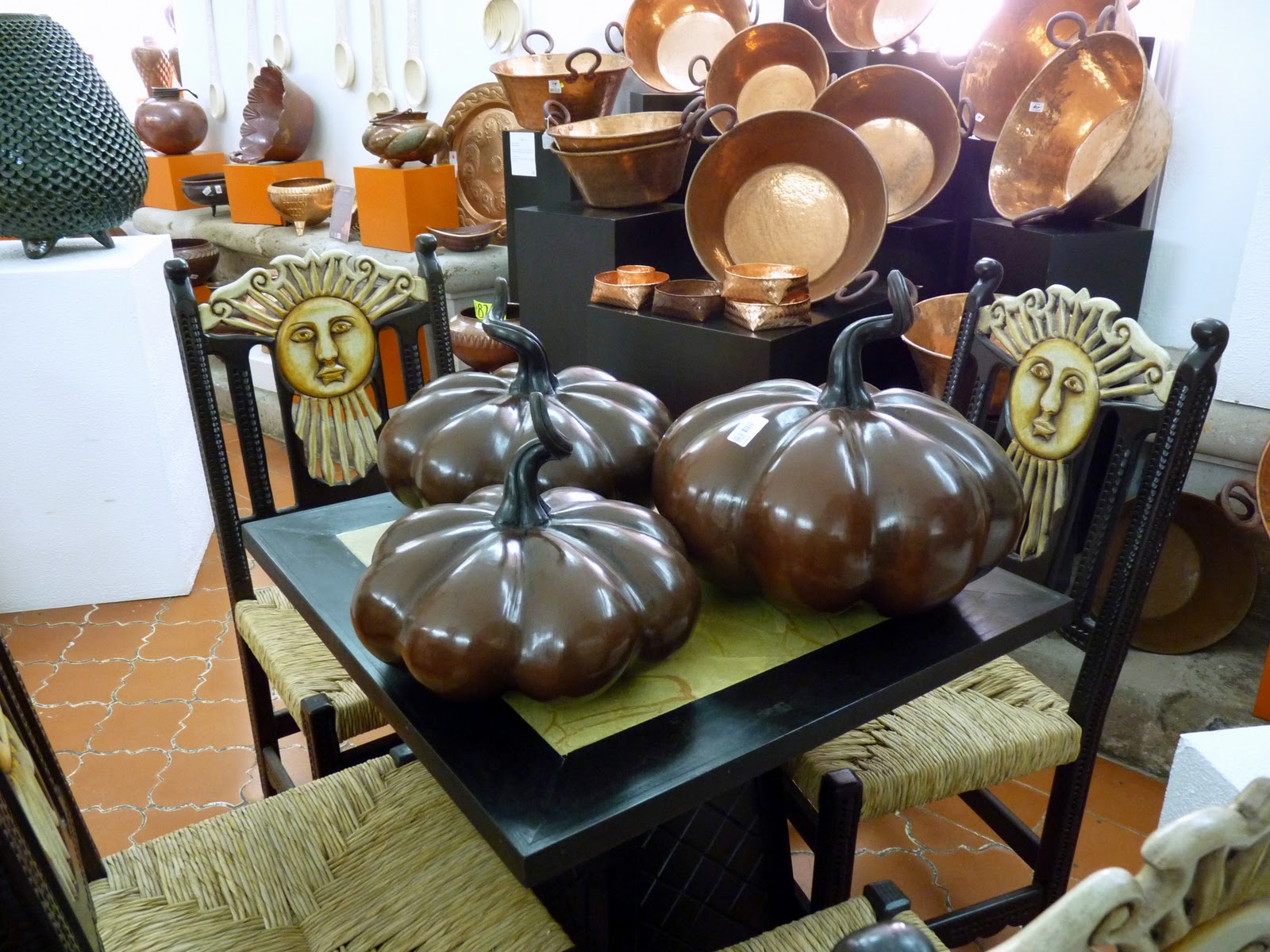
The photograph below is a typical display.  Furniture and pottery.


The tables are carved and then most are painted in primary colors.  I liked this one because it was unique almost as linear as an Italianate bed frame. 


Pumpkin and squash pottery pieces are a common motif.  And very well-crafted.  They manage to be concurrently massive and delicately detailed.


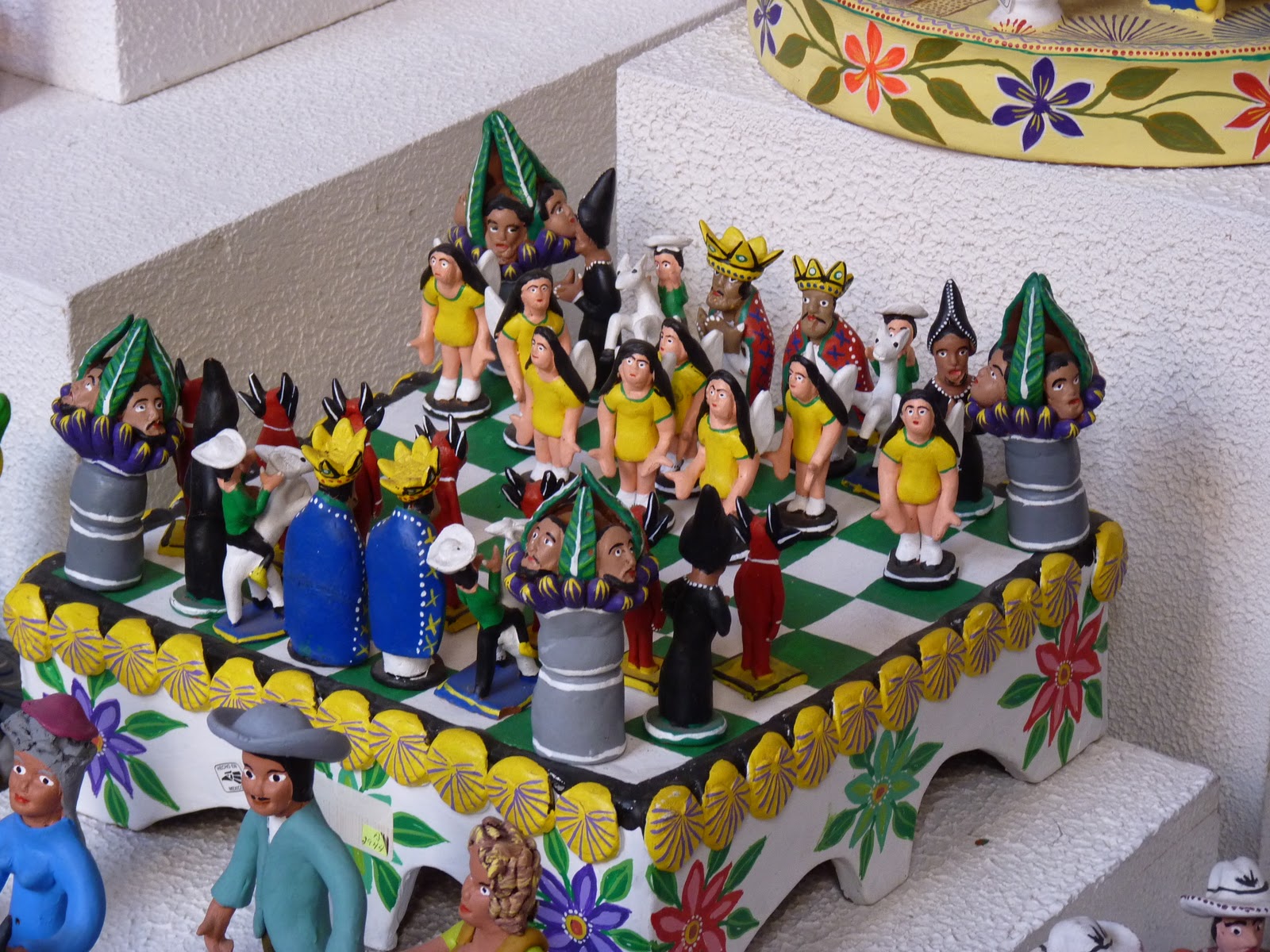
There are a few smaller pieces.  Such as this pottery chess set.  You may want to click on it to see a larger version.  The pieces are quite clever.


Not everything managed to ping my cultural bug.  Some of the presentations looked as if they were masquerading as a Pottery Barn clearance sale.


Or you might considering buying this.  Your very own IKEA crucifix kit.  (I rather liked it -- as a piece of art.)


My cultural association with the next piece is a reach.  But any of you who remember Laura Petrie's infatuation with the Thing she purchased at an auction would be tempted to buy one for your living room.


Now, you will need to excuse me.


I need to get back to assembling my IKEA crucifix -- while watching reruns of The Dick Van Dyke Show.

Saturday, February 12, 2011

morelia on the missouri


Every tale needs a hook.


Something to grab the reader's attention.  To keep wandering eyes on the story.


And when the hook cannot be found, writers are not above writing about the hook -- as a substitute for the real thing.*


That is exactly the problem I am having in writing about Morelia.  I like the place.  A lot.  My problem is finding Morelia's center.  Its soul.


And I think I know why.  I originally started this essay with the observation that Morelia is not Paris.  More like Kansas City of Oklahoma fame.  "They've gone about as far as they can go."


Today's Morelia is exactly what its founders set out to make it -- the political, religious, and social capital of the region.


In the early 1540s, Pátzcuaro wore that crown.  It was a functioning Indian town when the Spanish arrived.  (More of that anon.)  But the Viceroy had a different idea.  He wanted a Spanish town to be the capital, not an Indian "village."


So, he -- and a few favored buddies -- built a city in a beautiful location.  A bowl surrounded by mountains.  A Spanish city with a sweeping geometric street grid.  And, because it was the Viceroy's project, named after his home town in Spain -- Valladolid.


The Spanish were big on symbols.  And never subtle ones.


The outcome was predictable.  Like most proto-socialist Spanish crown projects, the viceroy prevailed.  Within 25 years, Valladolid was the Des Moines of the area.


That is why Morelia (renamed in honor of José María Morelos y Pavón -- another of the long list of independence insurgents who traded their lives in front of a firing squad in exchange for naming rights in Mexico) is now the capital of the state of Michoacán.


The central portion of Morelia still reflects its origins as a model colonial city.


Nothing could better symbolize the historic tension between the Catholic church and the government that was the driving force behind Morelia's creation.


At the very center of the city is a large plaza surrounded by classical style buildings that were once grand homes, but now house shops, stores, and government offices.


One half of the plaza is dedicated to the anti-clerical Lincoln on Mexico, Benito Juárez. 


The other half is dedicated to his equally anti-clerical ally, Melchor Ocampo, who drafted the legislation that stripped the church of its property and perogatives, effectively turning the Mexican government into the church administrators.


 That plaza faces the current State Government Palace.  That seems to be the appropriate setting for a plaza that honors the authoritarian power of the state.  Nothing evidences that power more than the fact that a series of Mexicans were publicly shot in the plaza.


But, to an American's eyes, the plaza presents an interesting bit of architectural irony.  The largest building on the plaza separates the beloved Juarez from his political operative.  That building is the catedral -- the most important religious symbol in the city.


When Pátzcuaro lost its cathedral status to Morelia in 1580, Morelia needed a new church to reflect its new political power.  It took over a hundred years to build, and, as a result, is a hodgepodge of architectural styles.


But it was not built as an architectural project.  It was meant to reflect the reality of the city's majesty -- where lives would be administered with Hispanic efficiency.


And that is the point of Morelia.  It was not built to sate culture vulture tourists.  Its buildings have a purpose.


Shop keepers sell.  Citizens pray.  Government officials pretend to rule.  On the surface, it all has an Iowan efficiency to it.


And because they have a purpose, Morelia's citizens do not have time to put on Octavio Paz's smile mask for outsiders.  This is their town.  If you want to know them, it will be on your dime and time.  Not theirs.


With one exception.  About four years ago, I met Jennifer Rose on line.  I am not certain if it was one of her blogs or on the Morelia message board.  But we seemed to have a common ground in our exchanges.  She even asked me to write a piece for stuff lawyers like.


At the time, Morelia was high on my list of places to retire.  Along with Guanajuato and Pátzcuaro.  Morelia never fell off of the list.  Melaque just happened.


Jennifer is not an expatriate.  At least, not in the sense that most of us use that word.  She came to Mexico from The States and watched four American presidents come and go -- and is now a Mexican citizen.  She knows Morelia.


She ratified most of my first impressions of the city.  Nice place to live -- especially in the surrounding hills -- if you are willing to take the time to know the place.  There certainly is enough post-conquest history to keep a new arrival out of trouble.


And it is cool enough in the summers, even though the residents often retreat to the surrounding mountains to escape the valley heat.


That was the reason for this trip, after all.  To find potential summer refuges.


I will most likely return this summer to see if it offers comfort from the Melaque heat.


If nothing else, I would like to spend time in its museums.


* -- I think I may have stolen this technique from Julian Bond.  In a speech at Portland State University in 1969, he started by pointing out that every speech is supposed tro start with two jokes.  After telling us that, he then told the jokes.  Jokes that cannot be repeated on this page.
 

Friday, February 11, 2011

switch backs


When asked if one of his current theories was inconsistent with a prior theory, John Maynard Keynes responded: “When the facts change, I change my mind – what do you do, sir?”


I am no Keynesian.  However, I am more than willing to change my mind when the facts change.  And they certainly have changed for me when it comes to the livability of the Mexican highlands.


Just two weeks ago, in high and dry, I wrote about my first foray into Mexico's high country: "As we were driving through the countryside (and I must confess I did far more sleeping than looking), it occurred to me that I have seen landscape like this before.  Not only in interior Spain.  But also southern Texas."


The drive between Guadalajara and Guanajuato is the type of land I remember in Laredo during my pilots training days. 


But I have discovered this last week that central Mexico's cities can offer a lot more than cattle ranches and cactus hills.  The area around Morelia and
Pátzcuaro looks a good deal like central Oregon.  Hills.  Mountains.  And, best of all, trees.  Real trees that combine into decent forests.


I am still in
Pátzcuaro as I write this.  But, during the next few days, I want to tell you about Morelia, the Rosario Butterfly Sanctuary, the ruins at Tzintzuntzan, and, of course, Pátzcuaro.


And, I need to do all that before I head off to Mexico City next Tuesday.


I would like to promise notes from the road.  But the combination of internet connection issues and getting too involved in living my trip gets in the way of postings while events are happening.  Even though I wish there had been some way of showing you the butterfly sanctuary while I was there.


So, sit back and, I hope, enjoy.  Over the next few days I will tell you some tales of high adventure in high country.

Thursday, February 10, 2011

the way i was


As you know from my post earlier in the week, I just started reading Donald Miller's  A Million Miles in a Thousand Years.


He relates the following anecdote in his first chapter.

The saddest thing about life is you don’t remember half of it.  You don’t even remember half of half of it.  Not even a tiny percentage, if you want to know the truth.  I have this friend Bob who writes down everything he remembers.  If he remembers dropping an ice cream cone on his lap when he was seven, he’ll write it down.  The last time I talked to Bob, he had written more than five hundred pages of memories.  He’s the only guy I know who remembers his life.  He said he captures memories, because if he forgets them, it’s as though they didn’t happen; it’s as though he hadn’t lived the parts he doesn’t remember.

That paragraph struck me because I have been thinking along similar lines recently. 


We all know we are the sum of our experiences.  But what does that say about personal freedom when we can't even remember how we got where we are?  Almost as if we all are stuck in Alzheimer Cul-de-sac.


I started down this road on my trip back from Puerto Vallarta.  It is just a little less than two years ago that my brother, Jiggs, and I made the drive south.  On Highway 200.  The road from Puerto Vallarta to Melaque.


For whatever reason, I decided I would stop at the same Pemex stations we stopped at on that road trip.  And try to reconstruct what we did at each stop.


It seemed to be a simple exercise.  Delimited in time, place, and circumstances.  Certainly my memory could handle that task.


And, after a bit of thought, I realized we only stopped at one station.  That made it easier still.


The experiment almost crashed on takeoff.  I knew we stopped at only one station.  But I was not certain which.


And then I saw it.  Just north of  the village of José María Morelos.


Just seeing the station reminded me that we had first stopped at a Pemex a few miles north, but there was no grass for Jiggs.


That burst of memory reassured me.  Maybe I would remember what happened when we stopped.


I pulled in -- and nothing came.  I remember letting Jiggs out.  But I do not remember who was driving.  I do not remember where we parked.  Whether we bought gasoline.  Or snacks.  How long we stayed.  Whether it was hot or cool.


I simply could not recall.


And that was less than twenty-two months ago.  How much of our lives do we simply misplace?


I have no doubt, though, that I will remember that station in the future.  And for the worst reasons.


I needed to fill the gasoline tank.  For some reason, I pulled up on the wrong side of the pump.  The hoses in Mexico must be longer than those in The States because the attendants never have trouble getting to the tank.


But I will not do that again.  Out of habit, I have always checked the meter to be certain it is at zero.  In two years, I have never seen anything other than zero.


This time, the truck was between the meter and me.  Just as I stepped out to see the meter, the attendant clicked the trigger. 


"35 pesos" were already registered.


I asked the attendant to stop and showed him the meter.  He said he had put that amount in the truck.  We had a little exchange in my broken Spanish.


It wasn't until I started to leave that he shrugged.  And reset the meter.


It could have just been a misunderstanding.  So, I decided to stop in the Modelorama for a Coke Zero.  When I took it to the clerk, she told me it was "veinticinco pesos" (25 pesos).


"¿Veinticinco pesos?"  I repeated the amount to her.  She said, "Si."


I was aghast.  I have never paid more than ten pesos for a soft drink that size -- even at an Oxxo.


Back on the shelf it went.  She shrugged.


The bad thing about all this is what I will remember.  The memory of Gringo taxing will stay in my head.  But my fonder memories have already faded.


Maybe it has to do with what we choose to remember.  That we do not appreciate the good things as much as we resent the bad.


But I do know one thing, my overall memories of the trip with my brother and my dog are of a great time.


And having written about the more recent incident now gives me the freedom to toss it into the memory hole.  I will let Winston Smith tend it from now on.

Wednesday, February 09, 2011

kidding around


Why are these children smiling?


Maybe I should tell you a little bit about them before I let you start guessing.


For the last three months, I have been working with my local doctor and some resident Americans at the local Indian school.  Not the type of Indian school we think of in Canada or The States -- where Indian children were taken from their parents to be raised as young Europeans.


These are the children of Mixtec Indians from Oaxaca.  The families are migrant workers.  They follow the crops.  In our area, they arrive in early winter and stay through May.  Until the crops need no further tending and picking.


Fathers, and some of the wives and children, work in the fields during the day.  The rest of the families stay home.  Home for most of the migrant workers families are below primitive.


Some are lucky enough to stay at the Indian school.


There are living quarters for sixteen families.  A communal living area.  A kitchen where food is cooked by the school for the children. 


And classrooms where six assigned public school teachers teach the children in the evening -- when they return from the fields.


It is basic living. 


But, at least, they have the basics.  While they are here.  In May or so, most of them will move on.


Lack of education and skin color have kept the Mixtec and other Indians low on the economic ladder in Mexico.  And the Mixtec have had their share of problems.


They were a proud nation before they were enslaved as a vassal state by the Aztecs.  They thought they were going to be delivered by the Spanish when the Aztec were conquered.  But they ended up on the bottom of the social heap as slaves in mines and as peons on haciendas.


Like most Indians, Independence, Reform, and Revolution meant only that someone else ran the show. 


And if Mestizos prayed that their babies would have light skin and the hope of a better future (as they still do), the Indians know how they would be treated because of their brown complexions. 


The pervasiveness of discrimination by skin color seems to permeate world cultures.  Even in bleeding heart Red Cuba.  Mexico is no exception.


The fact that the older children must work in the fields to help support the family is not a good omen for future.  That is why the night school is change they can believe in. 


Children, who could speak next to no Spanish, are learning arithmetic, Spanish, and that amazing door that opens a whole new world of possibilities: reading.


And the reason for those smiles?   Here he is.  A bit of entertainment.


I had stopped by to see my doctor -- the same doctor who volunteers a good deal of her time at the school.  She invited me to come out to the school one evening.  A clown was going to be there.


So, I drove through the back roads on a dark evening -- dodging the usual array of domestic and wild animals.


It turned out the clown was American.  From Portland, Oregon.  Whose Spanish was minimal.  But a young woman was there to translate for him.


He did all of the low comedy magic tricks and pratfalls.  And the children loved every minute of it.  Each corny joke was welcomed as if Oscar Wilde had just flown in from Bloomsbury.


It was obvious he had previously worked with children of mixed ages.  The type of groups where the youngest crush to the front to be part of the show -- and the pre-teens hang around the periphery because they are too cool to be pulled in by the mere presence of an infant-entrancing clown.  And too interested to leave.


So, he started off teaching a young boy the old disappearing ball trick.  Of course, the balls ended up on the boy's nose and ears -- turning him into a mini-clown. 


His friends shrieked with laughter.  And he beamed -- being a star with the clown.


The next group up was a mixture of two girls and a boy -- just a little older.  This girl's eyes say more than my prose could.  Pure wonder.


As does the laughter of all three of them.


Then came the hard part.  Three pre-teenagers, who had been skulking in the back, were chosen to do what every performer knows can be a disaster. 


Not only were they asked to stand in front of their peers.  They were asked to use a wand to catch flying rings thrown by the clown.  It was a great exercise.  They had to trust the clown's throw and their own ability.


They missed some of the rings.  But everyone laughed.  No face was lost.  And when they each caught their respective rings on the final throw, they each looked as if they had just scored the winning football goal.


And then the grand finale.  No clown show is complete without spinning plates.  But, at this show, the clown only demonstrated the technique.  This young girl got to be the star. 


Blindfold.  Three plates.  And a priceless smile of accomplishment.


I had considered skipping the event.  Kids.  Clown.  Driving at night.  Not my favorite mix.


But, like so many other things in life, I need to learn that saying "no" is just another potential adventure lost.


So, who enjoyed the evening?  


It is too bad you cannot see me holding up my hand behind the camera.

Tuesday, February 08, 2011

willie nelson is my co-pilot


I am off on another trip to the Mexican highlands.  The Escape gets to take another rest.  I am bus-bound.


This time, I am going to Morelia, El Rosario Monarch Butterfly sanctuary, the ruins of Tzintzuntzan, Santa Claira del Cobre, and Pátzcuaro.  It is the ultimate Gringo tourist experience.


And all of that in four days.  Even Patton did not move at those speeds.


But, once again, it will give me an opportunity to see parts of Mexico I have not yet seen -- and will undoubtedly want to see again..


After all, I had my sights on a home in Pátzcuaro a mere four years ago.


And who knows?  We may even see a guest or two along the way.


Be patient, though.  Blogging on the road is not something I do well.