There he was at the end of the counter.
On television, it would be the Cheers set. In Salem, it was the neighborhood coffee shop.
Not one of those fancy coffee shops. This was the type of place where a bottle blond waitress in her sixties walks around with a glass pot of Boyd's coffee. A plastic name tag announcing her name as "Maxine."
I have seen Phil there ever since I started stopping in for lunch. That was over twenty years ago. Perched on his regular red pleather stool, he looked old. But he looked old twenty years ago.
"Howdy, Mexi-boy." His favored nickname for me these days.
"See the paper this morning? It looks like the health hysterics are all upset that American young men are killing themselves and each other. From what I can make out, what bothers them most is that it makes our health numbers look bad to the Europeans."
For Phil, that was an inclusive statement. He usually just takes a swipe at the French.
"If I read it correctly, the health guys want government to do something about guns, cars, and drugs. They seem to be shocked that young men tend to end up on the wrong side of the lifeline while shooting, speeding, and shooting up. That was the top of the story.
"You know how the newspapers are. They hide the truth lower in the copy.
"But if you read a little further, there are a whole list of health culprits. Compared to the hoity-toity Europeans.
"Teen pregnancy -- three times higher.
"AIDS rate -- nine times higher.
"If cars, guns, and drugs don't kill us, sex will."
I knew this soliloquy was leading somewhere. It always does.
"OK, Phil. What's the answer? The people discussing guns have all sorts of simple solutions. Confiscate all the guns. Restrict video games. Arm teachers. Limit the news from reporting stories of violence. Require mental treatment for anyone who -- I guess, has a bad day."
"Bah. Stuff and nonsense."
He has always loved doing his impersonation of a character right out of Finley Peter Dunne. Without the brogue.
"No one is paying attention. Take these shootings. What do they have in common? Sure, there were guns. But the guns weren't doing the shooting. Each shooter was a white boy between the ages of 18 and 25. The testosterone kicks in and they go nuts.
"We used to have a social outlet for them. The draft. We gathered them up and shipped them off to some war in a God-forsken place like France. [I knew France would get worked in somewhere.]
"But we don't do that any more. We bumped off the big enemies. The Nazis and the Commies. And we don't have a draft.
"So, here's my idea. You might call it another modest proposal.
"If you only have one X chromosome, and you're white, the moment you hit your 18th birthday, Uncle Sam whisks you off the a camp. Call it a long summer camp. A reeducation camp. I don't care about the details. You might even let them make Nikes and iPads. That would drive the Chinese nuts.
"All I care about is that they stay there until they are 25.
"It would even be good for the teen pregnancy rate. After all, where do you think all those babies and the AIDS distribution is coming from? By 25, any thoughts of sex or violence will be a misty memory."
Maxine walked over to warm up his cup. He took a sip and looked off into the middle distance.
"What I can't figure out is why no one else has thought of this."
I chuckled, folded up my newspaper, and shuffled back to the house.
Why, indeed?
Friday, January 11, 2013
Thursday, January 10, 2013
a novel life
Shakespeare was wrong.
Life is not a stage. It is one giant novel. And you never know whether you are going to end up being written into a Faulkner or, far more likely, a Barbara Cartland tale.
When I joined the Air Force, I thought my fellow officers would be the best that the East Coast Establishment had to offer. The kind of people who thought they owned America -- and the rest of us are just visiting. To cadge from The Good Shepherd.
But they weren't. They were just like me. Middle class kids trying to find the best way to develop the talents God gave them.
All Americans are social climbers. It is our nature. We live in a society where we can be what we make of ourselves. No strict social classes for us. One day, cock of the walk. The next, a feather duster.
That is why falling into a Jane Austen novel can be a bit disconcerting. Especially for a man of the Western United States. But that is exactly how I felt this morning when the photograph at the top of this post showed up in my inbox.
It came from my friend Nancy. You know her. I often travel with her and her husband, Roy.
In November 2004 we were in New York City preparing to join a cruise on the shiny new Queen Mary 2. Because it was Thanksgiving, we decided to have dinner at Le Cirque. Nancy's daughter, Alison, flew up from Washington to join us.
I had never met her. Even though I had heard plenty of stories about her. She was a delight. Young. Beautiful Statuesque. Witty. A perfect addition to our table.
Several months later, I was in Portland for the my nephew Ryan's wedding. I walked into the empty sanctuary to find a place for the box containing my father's ashes. (There was no way I was going to let him miss his only grandson's wedding.)
A young woman followed me in. "Steve?," she said tentatively. I turned around. It was Alison. "What are you doing here?" The words had barely left her mouth before she said, "Cotton. Cotton. You must be related to Ryan. I never made the connection."
She had been the college room mate of my nephew's bride, Sara. Roy had told me plenty of tales of Alison's college ventures -- and her friends. I had no idea that one of those friends was my nephew.
It is from such coincidences that Ms. Austen was able to fabricate an entire series of novels based on human manners. And here I was living my own version.
Alison is now married with two children. Ryan and Sara have a son -- Colin. They get together as often as good friends, who live on opposite sides of the country, can. But they almost always meet at Alison's grandmother's house in Bend at Christmas.
And that is the genesis of the photograph. Taken by my friend Nancy. Of my dashing nephew, his stunning bride, and my genius nephew.
I didn't need to join the Air Force to find my place in society. I just needed to be patient. And it came to me.
Sunday, January 06, 2013
less miserable than other films
"An adventure is, by its nature, a thing that comes to us. It is a thing that chooses us, not a thing that we choose."
So wrote G. K. Chesterton. And, by my reckoning, he was half right.
Adventures choose us. But unless we accept the adventure, it is merely an opportunity lost.
This was an adventure weekend. Well, a weekend of watching movies about adventure.
The first was The Hobbit. (Reviewed earlier in dwarfs and a dragon.)
This time I saw it at a Cinteopia theater with its superb visual and audio quality. And I enjoyed the film as much as I did before. Even though I could have done without the 3-D treatment.
The second film was Les Misérables -- the film version of the 1985 musical.
I was prepared to be disappointed. The musical is a rather overblown melodrama of Victor Hugo's novel. The novel centers around the very personal adventure of redemption that came to the criminal Jean Valjean through the grace of a bishop.
A story powerful enough that Whittaker Chambers believed it would make a reader either a Communist or a Christian. It made him both.
But the film works. It takes advantage of the personal nature of the camera and resurrects Hugo's human perspective from the novel.
The director made a wise choice to use the actor's singing voices from the original takes. Rather than dubbing the voices in post-production. The technique gives the actors -- even those who are not professional singers -- an opportunity to use their voices as acting tools, rather than mere performance.
And the voices are brought forward -- over the music. The music merely accompanies the story. Just the reverse of the stage music-voice mix.
The music is stripped down when it needs to be. Anne Hathaway's interpretation of "I Dreamed a Dream" is a poignant lament of a life that has had highs -- only to end in despair. On stage, it is raw bathos. The film version knowingly connects with its audience.
The film could have benefited from a heavier editing hand. By trying to be too true to the stage version, the film often plods.
But it is a small quibble.
Chesterton would see the film for what it is. An adventure of grace seeking humans willing to accept what always comes with adventure -- an opportunity to find a better part within us.
Saturday, January 05, 2013
evil under the disc
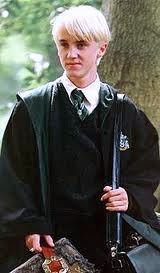
J.K. Rowling has an eye for names.
When she is not lifting characters whole cloth from Tolkien, she can create some interesting pun names. Draco Malfoy, for instance.
The bully of the wizard school carries a family name echoing its obvious Norman past. Mal foi. Bad faith.
It appears my blog may be a cousin to dear old Draco. But the family name is malware.
A reader contacted me this morning to let me know that she gets a momentary malware warning when she opens my site. "May contain malicious content."
Now, I may get testy now and then. But "malicious" is not how I would describe my usual prose.
I believe I have cornered the offending link -- and it does not present a problem to readers. However, please let me know if you receive a similar warning.
You can contact me with the email address at the right by clicking my photograph. The address is under "Contact me."
I would hate to think the name Cotton will join the Tolkien-Rowling pantheon of evil.
When she is not lifting characters whole cloth from Tolkien, she can create some interesting pun names. Draco Malfoy, for instance.
The bully of the wizard school carries a family name echoing its obvious Norman past. Mal foi. Bad faith.
It appears my blog may be a cousin to dear old Draco. But the family name is malware.
A reader contacted me this morning to let me know that she gets a momentary malware warning when she opens my site. "May contain malicious content."
Now, I may get testy now and then. But "malicious" is not how I would describe my usual prose.
I believe I have cornered the offending link -- and it does not present a problem to readers. However, please let me know if you receive a similar warning.
You can contact me with the email address at the right by clicking my photograph. The address is under "Contact me."
I would hate to think the name Cotton will join the Tolkien-Rowling pantheon of evil.
Friday, January 04, 2013
civil lives
That was 2001. He set off an avalanche of biographies of the Founding Fathers. Some were superb. Some good. Quite a few were indifferent.
But America had re-discovered its past -- what it took to create a new nation. In theory, it also gave us a better idea of who we are and how we came to have our political and social institutions.
For me, it was a golden age of reading material. One of my academic interests in college was the revolution and federal era. I had grown up with these men. And it was good to make their reacquaitance -- and to see some of them in a new light.
That flood has ebbed. Partly due to the calendar.
It is now time to celebrate the American Civil War. If "celebrate" is the correct word. My side having won, I will forgo moral equivocations and hand-wringing.
Doris Kearns Goodwin played majorette for the new parade with her Team of Rivals: The Political Genius of Abraham Lincoln. A small portion is currently seen on screen in Spielberg's Lincoln. (Reviewed in driving my lincoln.)
Goodwin's very good book has been followed by a slew of Civil War biographies -- one I have read, another I am reading. Both I can recommend.
The book I have read is Seward: Lincoln's Indispensable Man by Walter Stahr. Goodwin introduced us to Seward in her discussion of Lincoln's cabinet.
Stahr gives us a far more detailed (and interesting) look at the man who thought he would be the 1860 Republican nominee for president, but who then loyally served Lincoln as secretary of state. And tried to keep Lincoln's policies alive during the Johnson administration -- while staying loyal to the new president.
Seward's role in the Civil War -- maneuvering France and Britain to keep them from recognizing the south -- is the major part of the book. As it was of his life. But his purchase of Alaska is probably one of his greatest accomplishments.
I am currently about a quarter of the way into The Man Who Saved the Union: Ulysses Grant in War and Peace by H. W. Brands.
Despite the breathless title, the biography seems to be rather even-handed on the uneven career of Grant.
I say uneven because I am in the early stages of his life. As a young man, he failed at many civilian enterprises. And he considered his early military career a failure -- if only because it centered around a war (the Mexican-American) that he strenuously opposed.
We all know the outline of the rest of the story -- and the reason for the title. The Civil War pulled him back into military service. Where he turned out to be just the general Lincoln needed to defeat the southern rebellion.
But that is a story I have yet to read. And I am certain I will learn new things about Grant -- just as I learned new things about Adams, Washington, Jefferson, Madison, Hamilton, Burr, Jay, and Morris in their respective biographies.
For a reader of lives, it is a good time to be alive.
Thursday, January 03, 2013
letters from william
I met him in 1989 when he was a guest on Jonathan Ross's television interview program.
The theme of the show was Successful Young People. His success? He had just been elected to Parliament in a by-election -- at 28.
But he was better known as the 17-year old who had fired up the 1977 Tory Conference -- assuming that Tories are capable of getting fired up.
William Hague. A young man on the move.
I was in London following my unsuccessful 1988 election. And the fever still ran in my blood.
We started a correspondence acquaintanceship that ran over the next two decades. He, of course, went on to be the Tory opposition leader and is now Britain's Foreign Secretary. I went on to become ab expatriate beach bum in Mexico.
While doing my memory clear cut in the Salem house this week, I ran across a stack of letters from him. They immediately went into the toss pile. And then I had second thoughts.
The historian in me recalled the number of times I have seen entries in biographies that historians cannot answer certain questions because the subject's correspondence had been destroyed. That phrase always leaves me a bit sad. Something once existed, it no longer does, and we are the poorer for it.
Of course, there are often very good reasons to destroy letters. And it is not hard to imagine what those reasons are.
None of them exists in these letters. They are the ruminations of two young men about the future of their parties. With a few personal touches.
But the letters were written in confidence. And private they will remain.
It was nice to run across them. To conjure up some lost memories.
However, like the rest of my correspondence, to the dustbin of history they go.
Tuesday, January 01, 2013
in with the new
I do not make new year resolutions.
But if I had made resolutions in 2012, one of them would have been to finish reading Billie Collins's latest collection of poems -- Horoscopes for the Dead. It is just as well because, as much as I like his poetry, the Collins book remained unread.
Until this morning. I spent a couple of hours in the bath tub as the poet took me on a journey through his world of magical twists amongst life's ordinary objects. All with an economy of words that is the jeweler's eye of the trade.
And I discovered this gem. A perfect New Year's poem. Though it was certainly not written for that purpose.
Thank-You Notes
Under the vigilant eye of my mother
I had to demonstrate my best penmanship
by thanking Uncle Gerry for the toy soldiers --
little red members of the Coldstream Guards --
and thanking Aunt Helen for the pistol and holster,
but now I am writing other notes
alone at a small cherry desk
with a breeze coming in an open window,
thanking everyone I happened to see
on my long walk to the post office today
and anyone who ever gave me directions
or placed a hand on my shoulder,
or cut my hair or fixed my car.
And while I am at it,
thanks to everyone who happened to die
on the same day I was born.
Thank you for stepping aside to make room for me,
for giving up your seat,
getting out of the way, to be blunt.
I waited until midnight
on that day in March before I appeared,
all slimy and squirming, in order to leave time
for enough of the living
to drive off a bridge or collapse in a hallway
so that I could enter without causing a stir.
So I am writing now to thank everyone
who drifted off that day
like smoke from a row of blown-out candles --
for giving up your only flame.
One day, I will follow your example
and step politely out of the path
of an oncoming infant, but not right now
with the subtropical sun warming this page
and the winds stirring the fronds of the palmettos,
and me about to begin another note
on my very best stationery
to the ones who are making room today
for the daily host of babies,
descending like bees with their wings and stingers,
ready to get busy with all their earthly joys and tasks.
____________________________________
Subscribe to:
Posts (Atom)