The three of us decided to play different roles today.
We have tired of playing The Patient and the Support Team. It appears that play will have a longer run that we expected.
But yesterday and today, we are going to play The Awe-struck Tourists. Because that is what we are.
And if you are going to play those roles, the first place to visit is la plaza de la constitución -- or as it is popularly known, the zócalo. Its large expanse of concreted space makes it the center of historic Mexico City.
Under most circumstances, it a great place to see the political and religious power centers of the capital. With the cathedral on its north side, and the presidential office to the west.
But yesterday was not most circumstances. What is normally is just space is now space filled with some sort of Telcel event.

So, there was no opportunity to stand under the giant Mexican flag and take in the grandeur of Mexico -- a grandeur often burdened by its own history.
Even though a strong vein of that history would say that we should first pay homage at some secular shrine, we decided to visit the cathedral or, to use its full name, the Metropolitan Cathedral of the Assumption of Mary of Mexico City.
The Mexican constitution declares that Mexico is a secular country. A majority of Mexicans would disagree. And they often do. Fervently showing their faith.

Today is Palm Sunday. And the cathedral, of course, is in full swing preparing for Easter. That restricted our ability to visit. Access to the main part of the church was blocked off for services.
I am not accustomed to being thwarted. By listening to the tough woman barring our access, I determined she would only let people pass who had preregistered for a mass and a blessing to enter the sanctuary.
That was an easy-enough bluff. I put Lupe and Alex in front of me, and in my most lawyerly voice, I told her we were there for mass and thanked her for her efficiency.
We were admitted. It was not a subterfuge. Not really. And here's the proof. I took Lupe to the rail to be splashed with water by a dwarf priest. (I don't make this stuff up.)
I then made an amateur grifter mistake. I forgot my new role of penitent believer and whipped out my camera. And thus was I exposed as an arrant fraud. And cast out of the First Circle. By then, though, we had some photographs of the forbidden zone.
Anyone who has been to the cathedral knows that the place, as a whole, is sumptuous -- almost hedonistic. The largest Roman Catholic cathedral in the New World. But, even the parts we could view in detail were well worth the visit.
I had to share a very Mexican sight with Lupe and Alex -- the statue commemorating John Paul II's special relationship with Mexico.
The statute is pure Mexico. The rear of the statue is made of keys that tumble down to a cascade of roses.
The roses are the connection to the front of the statue. On the pope's cloak is an image of Our Lady of Guadalupe -- a play on Juan Diego's celebrated cloak. Thus connecting the late pope's Mary cult promotion with Mexico's most sacred icon.
Having filled our spiritual tanks, we pushed our way through the Saturday crowds to visit the center of Mexican political power -- the National Palace, with its presidential office.
I have never been inside the palace's doors. But I am glad we visited. It was well worth the hour or two we spent inside.
Starting with a detailed review of Diego Rivera's mural of Mexican history.
His romanticized view of Mexico's Indians. Such as this depiction of Indians in the Vera Cruz area. Dwarf priests seem to be an unintended theme of the day.
And his interesting take on Cortés, his Indian mistress, and their child -- one of the first mestizos -- shown with his European blue eyes. Even though Cortés had dark eyes. But this is political painting where facts are an inconvenience.
We also had an opportunity to view the restored former Chamber of Deputies.

I continue to be amazed how the custodians of Mexican public buildings treat citizens as responsible adults. We were allowed to meander through the chamber. No one was continually watching. Other than the usual warning from a bored guard of no flash photography, we were treated like responsible adults. And we all acted that way.
A perfect example. At the palace entrance, there was a long list of rules. The one that caught my eye was "no photography on the premises." I understood why. For security. After all, the president works there.
So, I dutifully bagged up my camera. But, at the first sight of a photo opportunity, troops of tourists whipped out their cell phone cameras. Right next to armed soldiers -- who said not a word. Except to say -- "no flash."
Adults dealing with adults.
But back to our tour. We took a walk through Benito Juarez's residence in the palace, where he lived until his death -- embittered that his Liberal dream for Mexico was fading. (Ironically, it is a man, who comes from a party that has spent almost a century as an enemy of liberalism, who is enacting a good deal of Juarez's dream.)

Having filled our plates with scoops of colonial and post-independence Mexico, we decided to take a look at what Mexico City looked like before the Europeans arrived -- and what the Europeans did when they did strut on stage.
History is condensed in the area around the cathedral. In fact, the cathedral itself is built atop, and partially out of, ruined Aztec temples.
One of Mexico's most outstanding archaeological discoveries was excavated only in the 1970s -- the templo mayor. When Cortés arrived, it was the largest of the city's temples. Dedicated to the worship of the rain god Tlaloc and the war god Huitzilopochtli. The Spanish were shocked to discover that human sacrifice was a regular part of appeasing both gods -- especially Huitzilopochtli who had killed and dismembered his goddess sister.
Archaeologists have been as true as they can be in their reconstruction of this magnificent building. It is possible to imagine what it once was while seeing it for what it is now.

The attached museum includes a treasure trove of artifacts excavated from the temple site and the surrounding area. This part of Mexico City sits on a giant potential archaeological dig.
Such as the recurring theme of giant discs depicting the dismembered body of
Coyolxauhqui, Huitzilopochtli's sister. But don't expect a story about Huitzilopochtli seeking revenge. He is the guy who dismembered her.
The disc was usually placed at the bottom of the stairs of a temple. After an honored warrior was sacrificed at the top of the stairs, the priests would throw the body down the stairs -- replicating what Huitzilopochtli had done to his sister. And creating a reverberating cliché for every Hollywood hack writer.
I suppose if there had been unitarian Aztecs, they would have used a plain dish. Or, perhaps, merely the thought of a dish.
The museum is filled with other artifacts found at the site. This elaborate vase, for instance, depicting the goddess Chicomecoatl, the goddess of corn. The piece pays homage to the relationship between corn and rain by depicting Tlaloc's image in three different places -- once on the lid, and above and below Chicomecoatl's face. Proving that it is not always bad to be stuck between Tlaloc and a hard face.
There is also a very helpful cut-away of the various levels of worship accretion the temple acquired over the years, where it is easy to see the havoc the Spanish lavished on the place.
I had placed some additional stops on my tour list. However, when we left the templo mayor, it was past five. Time to call it a day.
Today? We will still be playing tourists. I am just not certain where. But Joanne gave me a great suggestion yesterday.
Wherever we go, we will play our tourist roles with aplomb. Because if the world is not a stage, Mexico City certainly is.
Where else but in Mexico City could I start the morning stuffing pork rinds in my mouth and end the day with kimchi? It is a grand place.
Each day this week, I either walked or taxied over to Lupe and Alex's hotel to join them on our own version of Mr. Toad's Wild ride to the eye clinic. Our usual routine is to wait for the doctor to arrive. She spends about a half-hour with Lupe, and the three of us break for an hour and a half or so for breakfast-lunch. Lupe then spends about two more hours with the doctor while we wait.
We have been eating at a little Mexican diner for each of our clinic meals. The food is nothing special, but it is good. And filling. Not to mention inexpensive. The most we have spent for the three of us is $189 (Mx). In Mexico City.
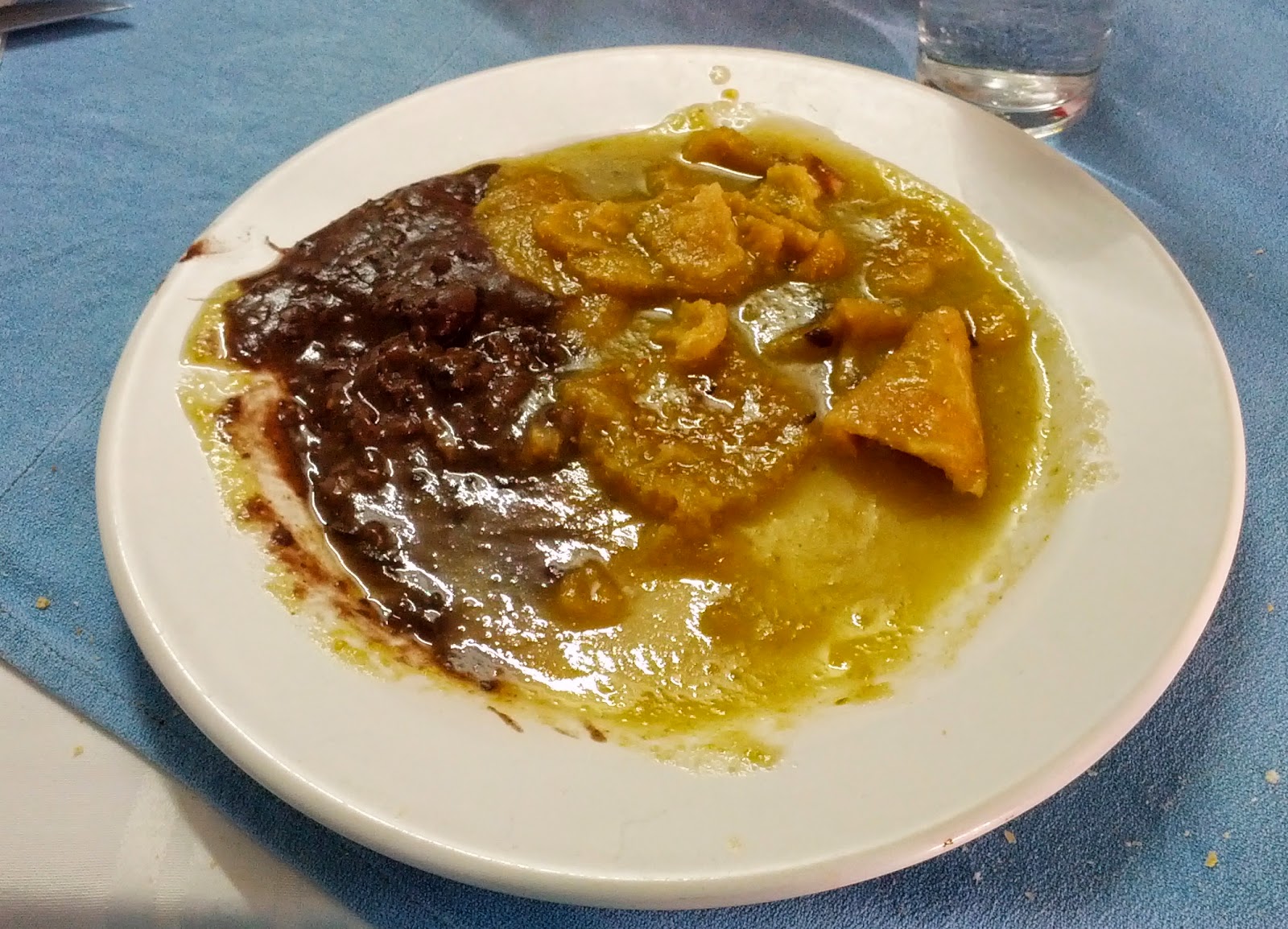
This morning I decided to throw caution to the wind and have a traditional Mexican breakfast -- chicharrón in salsa verde. Put that way, it sounds exotic. Alex's description, though, was far more direct. "Strips of fried pig skin."
Yup. I had fried pork rinds for breakfast. But the sauce does the same thing to the rinds as it does to tortilla chips in chilaquiles -- reduces it to a slightly gelatinous product. Despite that description, it was quite good.
Today, Lupe's second round with the doctor was going to last three hours. The eye has been chosen, but the artist now needs to add personal touches to make the prosthesis look like her other eye.
Alex and I decided to do some guy stuff. There is a museum dedicated to the countries who have interfered with Mexico's sovereignty -- museo de las intervenciones. The big draw for me was to see the throne of Agustin de Iturbide. Mexico's first emperor following independence. But it had been moved -- to the exhibit at the Chapultepec castle.
On the other hand, we did get to see a museum dripping with some of Mexico's worst moments. The museum is located in a former convent that served as a fort during the Mexican-American war. You can still see bullet holes on the exterior wall. Painstakingly preserved I might point out. Some wounds are not designed for healing.

But it did give me an opportunity to greet some of my favorite characters from Mexican military history.
Starting with the turncoat Agustin de Iturbide, who settled for glory and a firing squad rather than retiring to his farm after the war. We didn't get to see his throne, but we did see his saber.
Then, there was that old scoundrel Santa Anna. A man who gave away half of his country to the Americans to save his own hide. Only to end up giving rambling speeches in old age to paid audiences. In this painting, he is probably showing the Americans the best spots for cattle ranching.
As a side note, Santa Anna's artificial leg is exhibited at Chapultepec castle -- probably next to Iturbide's throne.
Or, the man who brought peace, order, and prosperity to Mexico, only to squander it for dictatorial powers. Porfirio Diaz.
I found it a bit odd that Diaz was celebrated in a rather objective way. Usually, he is portrayed as the very essence of evil -- at least, by the side that won the Revolution.
But nothing topped the death mask of the Emperor Maximilian -- fresh from his date with a Juarez-ordered firing squad.

I could have stayed longer, but we needed to get back to the clinic to check on Lupe's progress. And progress there was. Her artificial eye has been painted. It now needs to dry. On Monday, we will return to have it installed. On Tuesday, we will fly to Melaque.
But the day was not done. I had given Alex my guide book to peruse. I wanted him to choose something he wanted to do. And he chose what any 19-year old male would choose -- the wax museum and Ripley's museum.
Ripley's museums are eccentric no matter where they are located. But this one was obviously attuned to the grotesque.
My experience is that most Mexicans are thrilled to see the oddities of life. Like brains being drilled out of Egyptian mummies.
Or a horn growing out of a Chinaman's head.
Or a human bone used as a flute.
But it was the wax museum that we enjoyed the most. Probably because it was set up to allow viewers to not just gape, but to also mingle with the wax celebrities.
Such as Ricky and Frank who greeted us at the door. Not to mention, Alex. (But, I guess I just did.)
Intermingling was a bit unnerving. I almost expected Octavio Paz to rise from his chair to discuss how his co-exhibits were simply wearing masks.
My favorite, though, (because I have never left my teens when it comes to kitschy entertainment) was the Chamber of Horrors. And only in Mexico could grade school children have the times of their lives amongst the gruesome.
And then I was off to dinner at a Kim-recommended restaurant. (From whom other than a Kim would you accept advice about matters Korean?)
My experience in Mexico is that ethnic food does not translate very well. Pizza and Chinese buffets leading the parade. But Kim said it was good.
And he did not steer me wrong. For all I know the place is a front for North Korean intelligence operations. If so, they serve up good grub to fellow travelers. A lot of it. All of this was for me.
There was enough on the table for four people. I left enough for two.
So, there you are. Another full day.
Just wait what we have in store for you tomorrow.
In the early 1980s, I belonged to a gourmet club.
A doctor. A banker. A businessman. And a lawyer. I know. It sounds like the start of a very bad joke. But it was a fun group of food-loving people.
One evening, the doctor's wife asked if any of us had seen a new movie -- My Dinner with Andre. The banker's wife said: "No. What's it about." Mrs. Doctor responded: "Well, it's like having dinner with Steve -- but more boring." Zing!
That lost memory popped up tonight. But my experience was far better than what Mrs. Doctor had in mind. I had dinner with the camera-shy Kim of el gringo suelto.
Actually, I spent the full afternoon and evening with him. We met at Starbucks and then trekked into some familiar and new territory for me.
The familiar was walking down one of Mexico City's grand boulevards -- Reforma. The road was originally built by the unhappy Hapsburg Prince Maximilian, who the French installed as puppet emperor. He wanted a grand avenue from his residence at the Castle Chapultepec to his offices in the historic center of the city.
What he ended up getting was being shot in front of a Mexican firing squad. One of the men who toppled the emperor became president (Porfirio Diaz) and spiffed up the street to reflect a Liberal interpretation of Mexican history for the country's independence centennial. He escaped a firing squad by sailing off to his beloved Paris -- a city that is reflected in Reforma's design and decorations.
But all of that is simply a setting for my meeting with Kim.
Kim was one of my early readers -- leaving intelligent and witty comments on my posts. I knew I wanted to meet him one day. And I did -- twice -- in 2011. In Mexico City in March (continued next week), and in San Miguel de Allende in July (lazarus in san miguel).
He has proven to be a great dinner companion. So, I jumped at the possibility that we could meet up on his road trip through Mexico. And yesterday was the day.
There is a cliché that goes something like this. "I know we are good friends because we can start up a conversation as if we had never been apart."
It is a silly construct -- one that the Hatfields and the McCoys could blast a hole through.
A friend is someone with whom you can discuss any topic with analytical clarity. Where any topic can be discussed without emotional hysterics. A person you can tell anything in confidence and know that it will be shared with no one but you.
Facebook and the television program Friends has sucked the word "friend" dry of any rational meaning. But Kim fits the bill as the real McCoy -- probably the type that shoots at Hatfields.
One of my joys of walking in Mexico City is reinterpreting the Mexican history I have read. After all, history means nothing until it is structured into a good tale. Our walk provided plenty of fodder.
At the head of Reforma, we entered the forest that surrounds Chapultepec castle -- home to two emperors and a bevy of presidents. More history. More wailing over the lack of civility in politics. More personal tales. More laughter.
All of that makes two guys hungry. So, we swung south into the La Contesa neighborhood that several of you have pressed upon me. The food was good. The companionship and conversation was without comparison.
Here's the amazing part of this story. Kim and I did not attend university together. We never worked for the same or similar employers. My background is law. His is finance. If you went down a list of characteristics, you would think we could not possibly have become the chums we have through blogs.
But there we were. Chatting away almost until yesterday was today. Which it is right now.
There is a possibility that I will see Kim in Mexico City again when I return for my final formal costume fitting. If so, I have no doubts the night will be as good as it was tonight. (And, yes, Christine, I will let you vie for that billing, as well.)
But before I close, let me tell you about Lupe's appointment yesterday.
The doctor has determined that she cannot increase the size of Lupe's eye socket. If she installed a normal size artificial eye, Lupe would be unable to close her eyelid. Instead, she will fit Lupe with a smaller eye later today -- and then begin the process of painting it to look like her normal eye.
That means we will stay in Mexico City until at least Tuesday. It will also give me an opportunity to show the historical center to the two of them.

"Why would an eye clinic have an armed guard acting as a doorman?"
It was the first question that popped into my head when we arrived at the clinic on Monday. The guard is the picture of graciousness. But no one gets in and out of the locked door without his helping hand.
But why is he there? I had images of Marty Feldman look-alikes reprising his role in Young Frankenstein. Perhaps, making forced withdrawals from the eye bank.
I learned the reason why. And I will tell you as soon as I tell you about Lupe's appointment. The therapy is going well, but Lupe's doctor is still concerned that a full-size eye may not fit. But the therapy and prayers continue. (And more about that in a bit, as well.)
While Lupe was in her therapy session, Alex and I decided to take a walk around the neighborhood where the clinic is located -- Benito Juárez.
At first glance, the streets look like a mixed residential and commercial area. With the emphasis on commercial. In addition, to the eye, ear, and architect clinic, there is an eccentric mix of businesses.
A barber shop right out of Mayberry RFD.

A whimsical prop for a beauty shop.
A brightly painted building inviting us to indulge in the pleasures of la iguana -- though neither of us could figure out what those pleasures might be.
And lots of restaurants. From sushi to traditional Mexican to French. Including this eye searing pink ice cream parlor. Maybe that is why there is an eye clinic in the neighborhood.
Even the territorial headquarters of the Salvation Army.
Or this formal wear rental shop that has obviously seen better days.
But it was the proprietress who gave me the lead to find my tailor. I stopped by to thank her.
It struck me as odd that a formal wear shop would be tucked in with the other businesses. As if it were a bit out of place.
But a turn down the next corner showed us why the shop is there. This is a solid middle class neighborhood. From what I have been told, there are areas in the borough that are upper middle class.
The houses here show a pride of ownership. With plenty of designer touches.
If I had to live in a big city, this would be the place to live.
And Mexicans concur. Of Mexico City's boroughs, Benito Juárez is reputed to have the highest socioeconomic index in Mexico.
That brings us back to the guard at the door. Where wealth congregates, so do thieves. The borough suffers from a disproportionate number of robberies and assaults. Hardly a statistic to warm the heart of the Chamber of Commerce.
But yesterday was not a day to dwell on crime. And we won't do that here, either.
I had promised a treat for Lupe and Alex -- a trip to the Basilica of Our Lady of Guadalupe. Both Lupe and Alex were emotionally stunned by the complex.
You all know the story how the image of Mary was miraculously painted on an Indian peasant's cloak. No matter what your take is on the icon's creation, it holds an immense hold on Mexicans.
Enrique Peña Nieto may think he governs Mexico. He is just borrowing it; it belongs to Guadalupe. The patron saint of Mexico. The people have repeatedly risen up against politicians who have tried to divest that relationship.
The icon was formerly housed in a Baroque church that began suffering the fate of several stone churches built on dry lake beds. It started sinking.
You may not be able to see it in this photograph, but the left side of the church has sunk several feet.
The icon is now stored in a new basilica. A huge stadium of a church that is as rich in texture as it is in space.
All of that is for this --
The Lady herself. Stripped of any emotional or religious context, it is not much. And, if approached with that mindset, the piece can be underwhelming.
For Lupe, it brought tears to her eyes and prayers to her lips. I am not here to gainsay anyone's relationship with God.
There are additional buildings to visit. My favorite is the Capilla del Pocito.

An oval-shaped chapel built over the spot where the fourth apparition was revealed -- the painted cloak.
The three of us could have spent a full day there, but we had hired a driver for only a limited time -- and I stretched it to allow Lupe to soak in as much of whatever it was she sought.
Then we were off to dinner -- at Don Cuervas's favorite Italian restaurant in Mexico City: Macelleria Roma. You got to see the outside yesterday. We got to experience the place in our insides.
The Don did not steer us wrong. I dropped my carbohydrate limitation to enjoy the feted bread served with a plate of olive oil nestling a pool of butter perfectly spiced. It was worth busting my limit.
I had eggplant parmesan. Alex had ravioli. Lupe had spaghetti carbonara. And we all shared a dish of some of the best creamed spinach I have ever eaten.
All in all, it was a full day for all us.
Yesterday was not exactly a Robert Rodriguez film.
In fact, it was nothing like a Robert Rodriguez film. No vampires. No bikers. No Salma Hayek.
But it did start with a golden angel. And that cannot be all bad. Even though her predecessor fell harder than Satan.
I was up early to watch the dawn's early light spotlight the Angel of Independence. My perch was a shoeshine chair -- letting me feel the same joy Monet felt watching the day's light change the façade of the cathedral at Rouen.
All of that and a shoe shine thrown in to boot -- at a third less in cost than the swells in San Miguel de Allende pay.
I needed to do something about my scuffed shoes. Mexico City is one of those places filed with the People Who Look at Shoes -- and draw their own profiling conclusions. The condition of my shoes marked me as a rube from the beach.
Yesterday was going to be a day of walking. And walk I did. To and from the hotel where Lupe and Alex are staying -- about 2.5 miles each way. And then a side trip of about the same distance.
But before I tell you any more about my shoes and my walks, I am certain you would first like to hear a medical bulletin. And here it is.
Because Lupe has been very conscientious about her eye exercises, the doctor remains optimistic that she can fit an approriate prosthesis. But it is too early to be certain.
The best news is the irritation the doctor noted on her initial consultation on Monday has subsided. That will make the fitting far easier.
We had hoped that the three of us would be on our way back to Melaque by the weekend. That may not happen. There is a strong possibility we will need to stay for part of next week to complete the treatment. But that is why we are here. To get a new eye for Lupe.
And I am here to walk.
On my walk to and from the hotel, I wandered through the Roma neighborhood. A tony place filled with pocket parks -- the type of place an elderly woman dressed in red and black can play Elton John songs on a technicolor piano. Where is Fellini when we need him?

As well as grand houses where the rich once cavorted in their Porfirian French-inspired splendor, and where their young descendants now attend private schools. The type of schools where the boys wear jackets and ties -- and come complete with their bodyguards rushing to queued cars.
Exploring large cities on foot is one of my passions. My treks usually start with a well-defined route. But that usually lasts only until the second or third block when I see something worthy of a detour.
If I had not succumbed to my wanderlust yesterday, I would have missed stumbling across Don Cuevas's favorite Italian restaurant.
And what would my day have been like if I had missed strolling down the art-strewn promenade in the middle of Avenue Álvaro Obregón?
Every city needs its trendy neighborhoods. Roma had its heyday during the dictatorship of Porfirio Diaz. It is so French, you can almost see the escargot trails.
The promenade is populated with more nude statues than a San Francisco bathhouse. Most of them indifferent copies of classic European works.
For some reason, I found the juxtaposition of one of Porfirio Diaz's nude golden boys against the backdrop of the socialist party headquarters to be a bit amusing. But I am easily humored.
He appears to be mooning the politicians. Right out of Braveheart.
The area is not resting on its laurels. It is once again trendy. Trendy enough to require the services of a dog walker to exercise the dogs of the wealthy.
Or to tart up an old French mansion to look like one of the painted ladies of the bay.
And trendy enough for Steve to find a tailor to construct new formal wear. I divested myself of all bourgeois trappings when I moved south. Who needs white tie on the beach?
But my cousin talked me into a 22-day cruise this spring that includes at least six formal nights. The cruise line is one of the few dinosaurs that require formal wear in all public areas during formal nights. Anyone with a libertarian streak would be confined to his cabin as an enfant terrible. So, I conform.
I certainly could not find a tailor in Melaque. But Mexico City has come to the rescue.
Babs mentioned two days ago that this huge city is almost an English-free zone. As it should be. This is the capital of a Spanish-speaking nation-state.
My tailor's shop fits the mold. Spanish is the currency of commerce. Even with my niño español, I was able to choose fabrics, cuts, and accessories. As is true with all tailors, by the time of the fitting, I was fully in his hands.
The full kit will be ready when I return to Mexico City before flying off to Barcelona. "Full kit" was a term the tailor had not heard.
All in all, I walked just over ten miles yesterday. And I feel better for it -- other than for some giant blisters. (Darn cheap Costco socks)
I saw what I would have missed sitting in the back of the hotel limousine. And I know a bit more about Mexico City than I did when I got up. I call that a successful day.
We will put one of those hotel limousines to good use this afternoon when I treat Lupe and Alex to an afternoon and evening on the town.
I am certainly glad I got those shoes shined. For me, it was an angel of a day.
This is the last photograph of Lupe with her old prosthetic eye.
It is not particularly flattering. That is the fault of the photographer. But it is an historic shot.
I wish I could show you a photograph with her new eye. But that will have to wait for about a week or so.
As is so often the case in these situations, there is good news and there is bad news. Let's get the bad news out of the way first -- because it was not unanticipated.
I told you in the eye of the beholder that Marie, one of the residents of the hotel where Lupe works, noticed that Lupe's eye did not fit well. In Marie's experience, that meant that the eye socket had changed -- making the prosthetic a bad fit.

The dcotor who examined Lupe concurred. Like any hole in the body surrounded by bone, the bone will begin to close in on the space that was once filled. You have probably experienced the same sensation following a tooth extraction. Eventually the bone heals, and there is no hole.
That is what has happened to Lupe's eye. The bone at the top of the socket has tried to close the hole. In effect, her prosthetic was ready to be pushed out.
That is the extent of the bad news. If it were truly bad, the doctor would have simply told us that the socket could not accept a prosthetic. And poor Lupe would be left looking like the Hathaway shirt man.
But the news is not totally bad. In fact, there are two options. The first -- and easiest -- was to fit Lupe with a much smaller prosthetic. She would have an eye that fit in the socket. But it would not quite fit with the rest of her face.
The other option is a week of treatment and exercises to allow a larger prosthetic to be installed. That means regular out-of-the office exercises for Lupe and about two hours each day of what amounts to occupational therapy to attain as much flexibility as possible.
The doctor was quite frank in her assessment. Each patient brings enough individual factors into the office that she cannot guarantee this course will be successful. If it isn't, the smaller prosthetic is always an option.

After considering her choices, Lupe chose what I thought was the correct option. To, at least, try to loosen up the socket enough for a larger prosthetic. Her first course of treatments began today.
The doctor also noted that the interior of the socket has suffered some wear damage. She will also work on that this week.
Lupe now has a bandage over the eye where her prosthetic once reigned. When we went to lunch today, she donned a pair of large sunglasses. We teased her that she looked like a telenovela star.
As for me, I walked a portion of the length of Reforma back to my hotel. I needed something other than another taxi ride.
But I will keep that tale for another day. This week is for Lupe.