Thursday afternoon I re-entered one of my favorite cities -- London.
Most travelers would be regaling their listeners with tales of wonder after being here five hours. Not me.
My adventures were of the commercial sort. I headed off to Harrods to purchase a wing collar, single cuff formal shirt; some very specific underwear; a lens cover for my camera (don't ask); and a backup storage card for my camera (I told you not to ask). Of that list, I now own a camera storage card (plus one for my telephone). Items I could have purchased in Mexico -- and for about half the cost.
But no one likes to hear about someone else's shopping trip. And I am not going to write about it. Well, other than what I just did.
However, I have an interesting tale -- my last major trip with Julian on Wednesday. He asked me if I had any interest in trains. He wasn't aware that I have long been fascinated with them. Not like the fanatic trainspotters, mind you. More like a trainpeeker.

Powers, the little logging town where I lived off and on for the first eight years of my life, relied on trucks and trains to move the large tree corpses that fed my family. The roundhouse was about four blocks away from our house. My friend, Mike Pinson, and I would steal over to the yard to watch the diminishing rail operation. An operation that would soon dissolve like gossamer mist.
So, I was more than pleased to accompany Julian on a visit to the Didcot Railway Centre. It is quite a place. There is a small indoor museum with all sorts of train memorabilia from the Great Western Railway.
But the major museum is outside. Stretched across the wide grounds dedicated to the memory of primarily steam travel.

A couple of days ago I touched on the topic of how England's rivers allowed it to develop commercially. Rivers have limitations, though. They do not always extend where they are needed. So, canals were dug.
The crane on the barge at the top of this piece is part of what is needed to keep rivers navigable.
This is what replaced the need for the river crane.

The steam engine came along just in time for the Industrial Revolution. Or, a better way of saying that, is the invention of steam engines is what brought on the Industrial Revolution. With track and steam-powered engines, new enterprises could receive raw materials from far away and then ship their finished goods even further.
The earliest market for trains were passengers. Country gentry could now catch a train to London for shopping and lunch and be back home for dinner.
Those early engines and wagons often ran on extremely wide gauge tracks to provide a smoother ride. To the modern eye, they seem more charming than practical. But they certainly had their beauty. To me, they look more like boats than wagons.
Quaintness soon gave way to the brute strength of the huge steam engines some of us can remember from our youth. Such as this beauty.
The engine shed at Didcot is filled with perhaps a dozen of these giants. All of them in varying states of repair.
Most of them have enough restored gadgetry in the cab to give a good idea what it must have been like to control one of these behemoths. Control is the word. For all of its size, the engine could only efficiently use about 5% of the chemical energy contained in the coal it burned. About the same ratio a tungsten bulb uses in creating light from electricity.
It was not a job for a man (and, yes, they were always men) who did not want to get his hands dirty. Between the coal dust and the grease, I imagine clothes soon lost any hint of their original color.
While the engineer and fireman were busy up front dirtying up their bodies, the British elite were being pampered in carriages that could easily be mistaken for a middle class parlor.

But this is no middle class carriage. It was built in the late 1930s to transport members of the royal family. A certain unpleasantness in Europe kept the car from entertaining the blue blood bottoms. But it did see wartime service ferrying around members of the government.
Remember those diagrams when we were young predicting what cars would look like in the 21st century? Flying cars always played a part.
Railroad inventors had similar fantasies. I chuckled at this vision of a propeller-propelled carriage using the railroad's associated infrastructure. It was never tried -- even though other fantastical ideas were.

It was the Victorian and Edwardian eras. Where all things were possible.
That optimism was soon to die in the trenches of the Western Front. Ironically, it was railroads that kept the forces on both sides of that unnecessary war well-supplied to slaughter one another.
Maybe that is why these railroad museums still exist and why we spend so much money on restoring locomotives that will never again take families to town on shopping sprees. Maybe we are seeking what has been lost. That sense that technology can be a symbol. That things actually will be better.
I found myself walking through the exhibit getting as giddy as some children do at Disneyland. Peeking into windows that allowed us to see something that may never have been. But, we have the power to wish they did exist. Nostalgia is funny that way.
And, in this world, that imagination may be good enough for me. Knowing that the switches exist is hope enough that good people may one day actually operate them.
When I chose the option of a "room with a view," I had no delusions of wide vistas over the Thames or Hyde Park. The hotel is sandwiched in the blocks in between. But I did not expect an eponymous F.M. Forster experience, either.
What you see is what I see for $230 a night.* It is probably as good a view as the courtyard served up to Lucy and Charlotte in Florence.
Maybe I am not looking in the correct direction. To the left, I have an alley view. To the right, it is an obstructed street view.
But it is London. And that is good enough for me. After all, last night was simply transitional -- from my visits with English friends to my stay in London with American friends.
At noon I am catching a taxi to the London hotel where I will be staying with Ken and Patti for the next three nights. Before we head off to Spain and France.
It has (and will be) a great time.
* -- Even though the room is small and the view is mundane, the internet is the fastest hotel connection I have experienced in my recent travels. Without an additional charge -- unlike the next hotel. We count our blessings.

Julian dropped me off at the train station in Didcot this afternoon for my trip to London where I will join up with Ken and Patti tomorrow. A cruise is in our future.
And I may even have a surprise blog guest for you tomorrow. But we shall see.
The past four days with Julian in Abingdon have been exactly what four days with a good friend should be. He went out of his way to show me parts of England I have not seen. Yesterday it was the Didcot Railway Centre -- an outdoor railroad museum. I wanted to write about it in the train this afternoon. No writer could avoid the temptation of the parallelism. That is, until I heard the small voice of Serin.
Some voices carry across distances. Even it it is only three rows of train seats. I heard Serin announce: “We saw a play about Juliet. It was very sad.” An adult voice responded. I assumed it was Serin’s mother. “Why was it sad?”
Serin was not about to be sucked into the danger of a wrong answer. “Have you seen it? Didn’t you think it was sad?”
Her mother did not relent. “I want to hear why you think it was sad.”
The timorous voice of a child summarized perhaps the greatest of William Shakespeare’s tragedies. She spoke of families who hated. Their children who loved -- even though she kept forgetting Romeo’s name. Two deaths whose love could not transcend hate. One by poison. The other by a dagger -- or, as Serin put it, “Juliet touched Romeo’s blade.”
And all the way through the recitation, Serin’s mother prodded, re-directed, and teased out not only the text, but also the sub-text, of this tale of star-crossed lovers. I am not certain I have heard a better conversation about the meaning of the play.
Both of them are fortunate to have one another. A girl filled with intelligence and empathy. And a mother who cares and nurtures her daughter’s intellectual talents.
I commended the mother when I walked by to toss some tradh. I was shocked to see that Serin. She was tiny. I expected a girl of about ten. She was five.
By the time I was back in my seat, she had moved on to the more age-appropriate Tinkerbelle and Wonder Woman. But I suspect the tragedy of Juliet will always live with her. Along with the lesson of what family hatred can do.
In twenty years, I expect to read an essay by world-renowned Shakespeare expert Serin Somebody. "A Theory Born on the Didcot-London Line."

Mexico was not my first choice for retirement.
Once I had decided to hang up my barrister robes, I started looking around for a place to spend those much-vaunted golden years. The retirement books include lots of lists of considerations -- most of them based on personal tastes. They were all a bit too logical for me.
So, I started with what I knew. Living overseas had always been high on my list. That made Britain and Greece natural candidates. I had lived in both places in the 1970s.
The last time I visited Julian and Andrea in 2007, we stopped in a Cotswold village. There was a little stone cottage with a thatched roof for sale -- similar to one I had lived in during my two years here.
The memories started flooding back. Narrow hedgerow roads. Misty fall days. Roast beef and trifle. I could live here.
That is, I could live here if I had an extra one million pounds rattling around in my pocket. Even though the cottage was outside the usual commuting distance to London, City lawyers and financiers were vying with one another to buy up these pieces of bucolic splendor. I put the idea aside. It was out of my price range.
Yesterday, Julian took me past several estate agents to get an idea of current house prices in the Oxford area. It was an act of mere curiosity. After all, I am in the process of becoming a Mexican homeowner. Or, at least, the owner of a house in Mexico. They are not quite the same thing.
You can see the first candidate at the top of this post. A semi-detached (think duplex) home listed as 4 to 5 bedrooms. The rooms will inevitably be small in American terms. All of that for 300,000 pounds. Or about $495,000 (US).
I particularly liked the qualification of "offers in excess of." Bargain hunters need not apply.
My family has a strain of trailer living in its DNA. My genes might be a good fit with this Britished-up mobile home in a trailer park. Just 150,000 pounds. About $250,000 (US). Just a bit too dreary for me.

Or, I could live my own version of Coronation Street in this tiny two-bedroom row house (terraces, here) that looks as if it may have once served as public housing. For a mere 250,000 pounds. $410,000 (US).
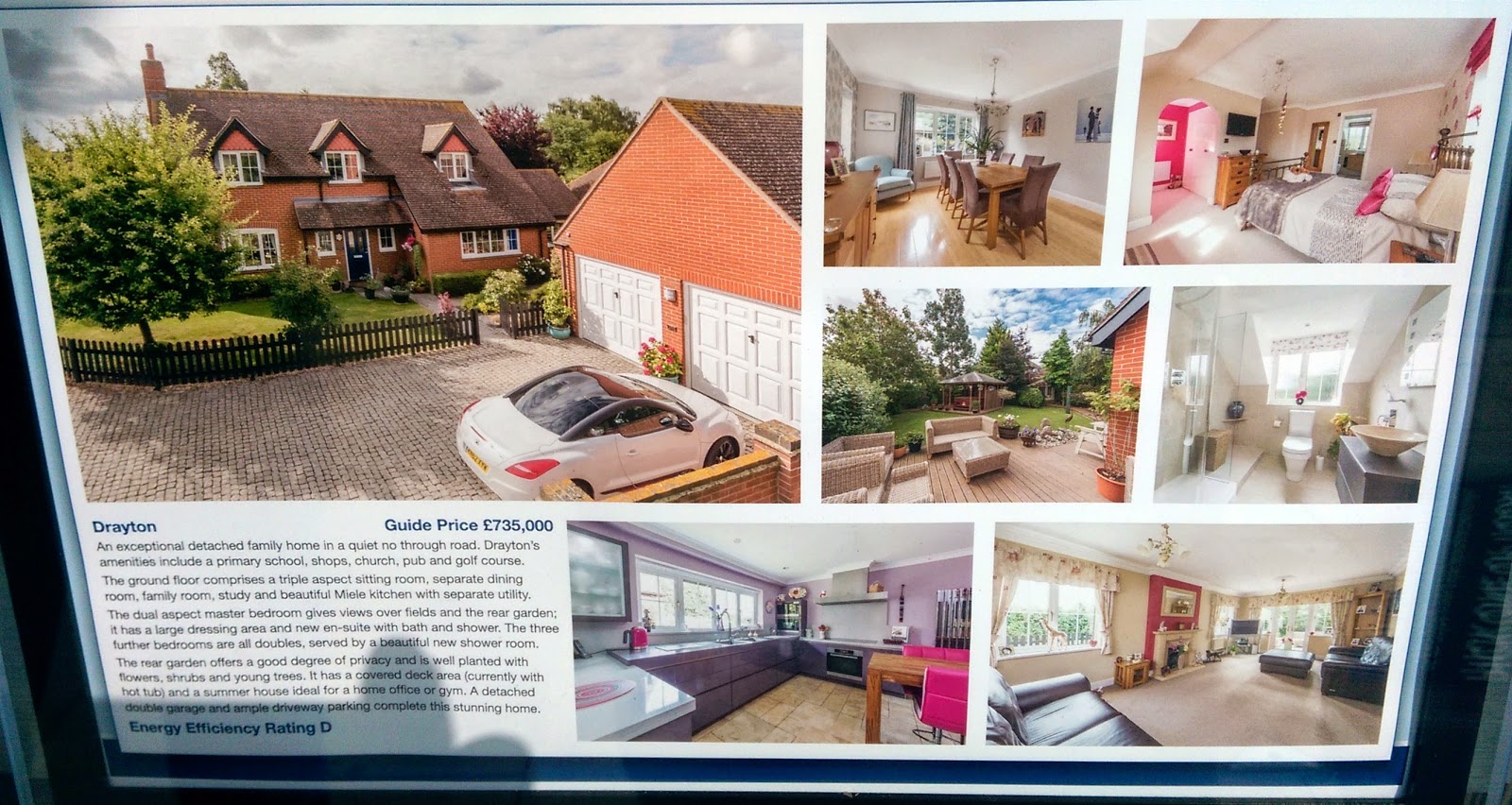
And, if I wanted to live in a house styled more like those found in American suburbs, there is this "stunning home" (as the brochure describes it) for the equally stunning price of 735,000 pounds. $1,210,000 (US).
You get the drift. To my former Oregonian eyes, now acclimated to home prices in Mexico, the listed prices are knock-me-back high. And, if I had looked around in London, as was my plan at one point, the prices would be astronomical.
Rent, you say? Yes, I did look at that possibility. After all, I am a renter in Mexico right now. Have been for the last six years.
I looked for a place similar to mine. Duplex. Two bedrooms.
In Abingdon, I could rent an unfurnished place (my Mexican rental is furnished) for just under 1,000 pounds a month. Over $1,600 (US). Plus utilities, fees, and taxes.
My place in Mexico is one-third of that -- and includes most utilities.
Looking back on what I might have done is always instructive. If only to reassure myself that there is wisdom in the paths I have chosen.
There may be a cottage in a Cotswold village that has my name on it, but there is little chance I will be living in it.
And that is fine with me.

No visit to England would be complete without a float on the Thames and a meander through one of the country's splendid Victorian museums.
So, that is what we did yesterday. On each of my prior visits, Julian has introduced me to new sections of Abingdon. The Thames was yesterday's theme.
We often forget that a lot of towns grew up around rivers because the water was a primary form of transport and trade. As a result, a town's civic life thrived on these liquid highways.
Between Oxford and Abingdon, the river is now mainly a thing of recreation and beauty. As a result, the long boat we took to Oxford is simply a tourist plaything. The rush of contemporary life has sped past these ancient boats. The two-hour float is a method to slip back into a slower pace of life.
The Thames seems like a very still river. That is primarily the result of a series of locks that tamed the river's natural rapids. The locks are not a new phenomenon. Because the river was so important to commerce, the medieval monarchs installed a series of locks that essentially created long lakes on the river -- lakes that also act as a flood control system.

But the boat ride was only part one of the day's journey. When we arrived in Oxford, we hiked over to the Pitt Rivers Museum.
In my years of visiting Oxford, I had never visited this Victorian grandmother's closet of natural history. It is a wonder to behold. And truly a product of its times.

Augustus Henry Lane-Fox Pitt Rivers was one of those fascinating characters who populated Victorian Britain. A military man, he took an avid interest in archaeology -- and changed its methodology.
He was a collector. Not in the sense of Addison Mizner who collected merely to collect. Pitt Rivers was fascinated with the history of humans and their condition. He snatched up pieces of culture throughout the world -- and then systematically categorized them.
To our modern eyes, some of those categories seem a bit eccentric. Such as "Items Related to Death." In the process, though, he took archaeology from grave robbery to the scientific method.
Even the Victorian building that houses the collection betrays its logical, industrial structures. The shape of dinosaur bones are reflected in the iron bones of the ceiling.
And, yes, there are dinosaurs. Many of them unearthed in Oxfordshire or other surrounding counties.
But there is also a much-beloved display of the famously extinct Dodo.
I always thought the bird was wiped out as a source of human food -- a perfect example of man's direct destruction of his environment. In fact, I am almost certain that is what I was taught in school.
But that is not what happened. It turns out that humans could not eat the birds due to their foul taste. Instead, the birds were wiped out by other animals brought to Mauritius by Europeans. Rather than a story of direct destruction, it is an even more ominous one of secondary extinction.
Some f the more interesting exhibits are not housed in cases.
At first, I thought this
was an exotic bird display. Julian and I could not quite figure
out if she was simply another example of English eccentric exercise or
if she was on her way to work.The heart of the collection is in the back of the building -- a three-tiered jumble of cases and drawers that would warm the heart of Indiana Jones. Some of the pieces would have made perfect movie props.
Such as this severed and preserved head of an enemy used as a ceremonial tool. Note the small hand-written card cataloging the piece along with the number on the forehead. What could be more Victorian than that?
Or this shrunken head with its well-coiffed wig.
Pitt Rivers also collected folk art. Quite a bit of it from Africa. Such as this Ikam masquerade mask that was thought too African for European collectors and too European for African buyers.
Being a military man, Pitt Rivers devoted one full tier to weaponry.
He had a true affection for guns. No British collection would be complete without a Walther PP. Even though it was German-made, this is the gun that Ian Fleming eventually placed in 007's hand. (I'll bet you are humming the Monty Norman theme right now.)
For those of you who are not fond of guns, the exhibit reminds us that humans have been committing mayhem on each other long before Samuel Colt put equalizers into their hands. And they can sometimes be things of beauty.
Close up, this Pacific islands club looks like a piece of art -- almost like some fort of exotic nut. But it is a death-dealing weapon.
This bird-shaped battle axe is even more beautiful. And just as deadly.
But, for ancient weapons, I found this spear to be the most fascinating. Each of its multiple points is a human bone. But, unlike the shrunken heads, these bones were from honored family members of the spear carrier. The belief was that the deceased member's spirit would strike a true blow.
To make the blows more efficient, the bone points were smeared with poison. Years of experience created a series of rules on how this mini-WMD was to be carried -- to minimize self-inflicted wounds or prevent, as we would say, friendly fire casualties.
I would be most remiss if I did not share every young person's favorite exhibit in museums of this nature.

Mummies. Well, one mummy. Julian told me the museum had several. There had been an outcry of political correctness against displaying the dead in such Barnum-style exhibits that the number has been limited to this rather mundane example. Mundane or not, it is better than none.
Even more so than most museums, Pitt Rivers is not a place to be fully consumed with one visit. In the afternoon we were there, we barely scratched the surface. And, considering the warnings on that spear, it may have been a good thing.
This is the type of museum that needs to be visited repeatedly -- similar to the Smithsonian. When I return, I intend to stick with one display case and its associated drawers. There are hours of experience just waiting to be enjoyed.
It was not until I was writing this piece that I realized we had a full river day. Partly on the Thames. Partly in the Pitt Rivers.
And both were fun. Especially, when shared with a friend.

Yesterday I awoke to a familiar sound. Tires on wet pavement.
For a moment, I thought I was back in the Salem house on Summer Street. And I almost was. Or the next best thing.
Instead of drizzly Oregon, I was in drizzly Oxford. Or, more accurately, drizzly Abingdon, where my friend Julian lives. This was my first opportunity to visit him since his wife Andrea died almost two years ago.
I met the two of them at RAF Upper Heyford, just outside of Oxford, in the mid-1990s when I was there to assist in shutting down the base. Andrea worked for the Crown Prosecution Service. She and Julian were there for one of the occasional social functions between the Service and the base legal office.
It was the start of a great friendship. They came to visit me in Salem. (Being dog people, they became fast chums with Professor Jiggs,) And I stayed with them in Abingdon when I would visit England.
Yesterday we had grand plans of taking the boat into Oxford, doing a bit of sight-seeing and shopping, and taking the bus back. But those singing tires on the pavement provided anthem enough that an alternative plan would be a good idea.
I lived in this area of the kingdom for two years in the mid-1970s. There is always something to do and see. And we did.
We were off to Tewkesbury in western England, primarily to see its massive church. To get there, though, we passed through some of the country's most beautiful countryside in the Cotswolds. Before I moved to Mexico, I had seriously considered retiring to a cottage in one of the hamlets tucked into these softly-rolling hills.
But retirement was not our destination; Tewkesbury was -- the site of one of the most important battles in the War of the Roses in 1471. That was the battle that finally decided (at least for that round of battles) that the Yorkist contender, Edward, would sit on the throne of England until his younger brother Richard frittered it all away in a manner that would give Shakespeare great fodder for one of his propaganda pieces to appease his Tudor queen.

The prize tourist stop in town is the abbey church. To look at it, you would think it was a cathedral. After all, it is the third largest church in England. But no bishop sits here. So, the place serves as a parish church.
A huge parish church. When the Normans conquered England, they peppered the countryside with massive buildings that could easily be mistaken as fortresses. This place was consecrated in 1121 and is mainly Norman in style -- with a central tower reputed to be the largest Romanesque tower in England.
Walking through the church is to literally walk through medieval history -- and Shakespeare's plays. Which may be the same thing.
Edward, the last Lancastrian Prince of Wales, who fell at the Battle of Tewkesbury, is buried here. As is the Duke of Clarence -- the benighted, murdered brother of the first York king. There are Warwicks and Despensers and Beauchamps and de Clares. Enough extras to populate sufficient productions to amuse generations of groundlings.
I am never too impressed with massive churches. The notion that God can be housed in stone simply does not comport with my view of him.

But it is undoubtedly a lovely building. Not only is it worth a visit; it is the type of stop that needs hours to fully enjoy.
And I am better for the stop. Reacquainting myself with this era of history and its attendant beauty helps to put some context in our rather troubling, but still beautiful, world.
As was true in Blackpool, though, visiting this part of England has been an opportunity to put another row of bricks on my friendship with Julian.
It was also my opportunity to remember Andrea. I will miss her.

Sunday was supposed to be a mixed travel day.
You know the type. You need to get from one place to another, but you want to spend as much time with your friends as you can before boarding your choice of transportation to a new chapter of your life.
Well, it was that. But it was much more.
I have already told you my friend Dr. Bob is married to Fon, a Thai citizen. As you probably suspected, there is much more to the relationship than that declarative sentence allows.
Bob and Fon spend half of their year in England and half of it in Thailand -- with a large dose of world travel whipped into the mix. (It was his retirement in Thailand where he met her.)
Their life model may sound a bit familiar to Mexpatriate readers. I was not going to pass up the opportunity to talk about the similarities and differences of our respective situations.
Bob has retained a bit more northern personality than I have when it comes to planning. He spent some time yesterday morning planning on where we would go. A castle. A forest. A Roman camp.
But he shares my sense of flexibility when plans crumble at their first application. As they did. We made it to the Roman camp. And we had a pleasant drive near one of England’s most scenic little corners -- the Trough of Bowland.
The sights and history were very interesting. However, the best part of the trip was swapping tales with Bob and Fon. I was not the least bit surprised that the aspects of Thailand he finds invigorating and frustrating mirror almost exactly my own. Both of us are the products of our cultures. Rather regimented cultures.
We expect life to be orderly, logical, and efficient (at least, by our definitions). Apparently, Thailand falls short of those northern standards in almost the same ways that Mexico does.
In turn, the cultures of both Thailand and Mexico are based far more on relationships with people. Often to the extreme -- making situations seem inherently unfair or corrupt to we northerners. And often they are.
Both Bob and I have learned to live with our golden nuggets and to, at least, start moving away from our anal responses. Fon, of course, just as my neighbors, was more than willing to share how often she finds us outsiders to be almost unfathomably silly. I rather enjoy the idea my antics can bring a smile to the faces of other people.
(Just before I left Melaque, I had a conversation with a northern expatriate. When I told her how often I had heard from Mexicans that they think we are silly people, she became indignant. While she was venting steam, I realized she was doing exactly what my neighbors find so humorous.)

I thought of my conversation with Bob and Fon while riding the rails from Preston to Oxford. Sundays are always busy train days. Even though I had a first class ticket, there were no seats available.
That is not quite true. There were seats, but they were not going to be given up by a large family from Doha who had occupied about a third of the carriage.
A rather short-tempered Englishman tried to sit down on the seats occupied by the feet of two of the women. Their husband jumped up and announced, in a voice as if he were auditioning for the role of Tevye: “It is forbidden for you to sit with my wives.”
The usual cross-cultural exchange ensued with the Englishman retreating to the authority of the conductor, who told him: “I am not getting involved in any religious dispute. I have a job to protect.” The Englishman wandered off muttering about writing a letter to The Times.
The whole thing could have been written during the “Writing in Clichés” class in screenwriting school. That is, until wisdom appeared in the persona of a soft-spoken man with skin the color of a fine latte. He was looking for a seat for himself and his wife.
It took him no time to sum up the situation. He walked over to the husband of the lounging ladies. “Is this beautiful family yours? Have you traveled far?” That is how I knew they were from Doha. The Arab husband was smiling.
The latte man also smiled. “My wife and I have been traveling all day, and we are tired. Would it be possible for you and your handsome son to sit with your wives and allow my wife and me to share in your comfort?”
It was like watching an intricate social ballet. Both men knew they were manipulating one another, but both were receiving the benefits of the first rule of etiquette from each other -- respect.
The family re-arranged itself upon the husband’s barked commands. When everyone was seated, the mood in the carriage changed. One of the wives saw that I was still standing. She ordered a daughter to move over with the rest of the children, and invited me to sit. If she had had a bowl of figs, I am certain she would have offered me one.
For some reason, I thought about my neighbor Lupe. She would have shared the same wisdom as the soft-spoken man -- as would have Fon. Respect and formality would have trumped confrontation. I know what the Englishman thought; I could hear his mutters.
He considered the family from Doha to be rude and illogical. And he was correct by English standards. What he did not understand, or, at least, show, is that a bit of respect could (and did) resolve the issue.
Now, I am not naive. There are evil and thoughtless people in the world. Showing them the same respect will not budge the mountain to Mohammed. Usually. But they are not the norm. Most people, when approached with respect within the context of their culture, will react positively.
It is a lesson I need to re-learn often. I am glad Fon and Bob shared their experiences with me. It was a perfect fit for my role as an audience member in the train-board passion play.
Even on a travel day, life continues to teach.