Sunday, July 08, 2018

blowing up jiminy cricket


It is cicada time in our neck of the jungle.

But you would not know it just by listening for them. Usually, the neighborhood is abuzz with the love calls of one of nature's oddest-looking insects. With their oversized eyes, Lane Bryant bodies, and disproportionate diaphanous wings, it is no wonder they have to sing so incessantly to find a mate.

I know they are out and about because I run into them (literally) every night on my terrace repurposed as an exercise track.

They are attracted to the light at night. When they are not mooning away staring into the light (which must be far more attractive than a mate), they are battering their bulky bodies against the sconces.

The sconces win. In the morning, the bodies of the cicadas are scattered across the equivalent of the Little Big Horn. And that strikes me as a rather odd way to conduct a reproductive cycle. Suicide rather than procreation.

Two weeks ago, I received an email from a friend in Salem. Like me, he loves playing with words.

"I am reading the memoir of Zora Neale Hurston, Dust Tracks on a Road.

"Ms. Thurston, a black woman, grew up in Florida in the early 20s, amid people of great simplicity and little nuance.  As a child she would go out into nature, talking to trees, birds, and lakes.  One day she returned home and told her mother about having spoken to the lake, which allowed her to walk upon its surface without being drowned.  She recounted how she was able to look down upon the fish below and to see the life in the lake.

"Her grandmother overheard her stories and cautioned the mother that the child was lying and that if she didn't beat the lying out of the child now, it would only get worse."

I often meet people who confuse the use of the poetic with lying. And who are impoverished by their inability to see the world through different eyes.

When I visited Colombia with my cousin and his Colombian wife, she told me of a cricket that would sing one last song and then explode.

I knew she was referring to cicadas because we had been listening to them. But I had never thought of describing their life cycle as singing and then exploding. Like something from a Monty Python skit.

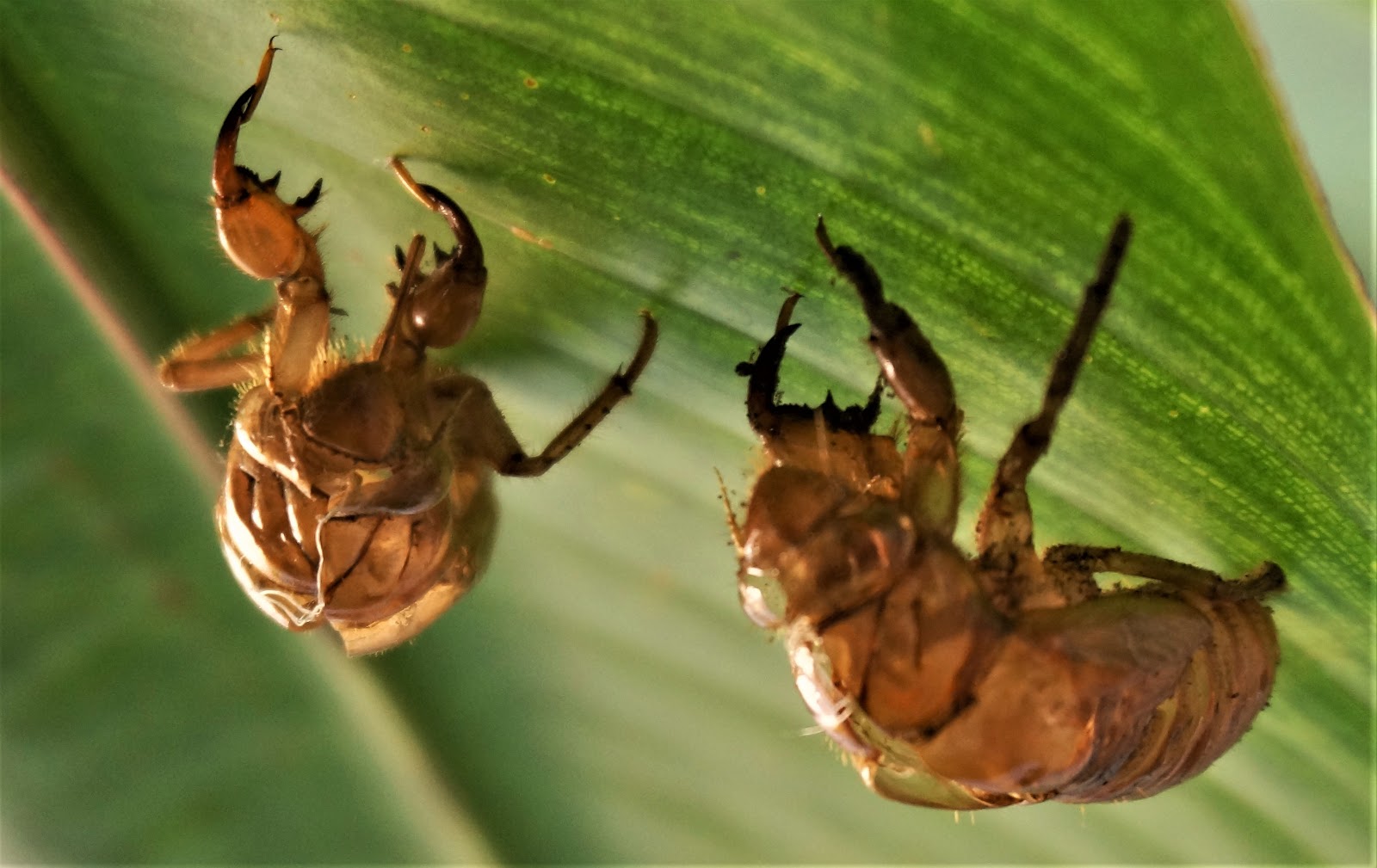
The genesis of the tale is obvious. After cicadas dig out of the soil where they have spent most of their life, they go through several stages of molting. My planters are currently filled with the husks of cicadas who have flown away to mate.

Sons of the enlightenment see the remnants of a life cycle. A poet sees an insect whose joy at being alive cannot be contained. It dies in one last burst of song. It is a very Latin view of life. Joy and death walking together toward the inevitable.

I probably scoffed when I heard the Colombian myth. I shouldn't have. There are things in life that are better explained by the music of poetry than the sterile language of facts.

Saturday, July 07, 2018

a paul harvey moment


Some stories are simply not ripe to write.

So it is with my essay on Thursday (not minding my own business). Had I waited one day to tell you the story, it would have had a completely different ending. That is, if any story really has an ending.

On Thursday, we left off with me slinking away from the door of my neighbor, who had rejected a chicken peace offering in way of apologizing for getting angry at her children. When I learned of her immigration status, her reaction made far more sense.


Yesterday, as I was returning from a medical trip in Manzanillo, I drove past our neighborhood grilled chicken stand. Something down deep told me to stop and buy two chickens. One for each of the mothers involved in Wednesday's passion play. My head said: Why bother? But that little voice -- the one that talks to us in whispers whenever we are about to do something we know we should not -- said: Try again.

And, so I did. I bought two full chicken meals and took them next door. My knock on the Central American mother's door was a mere tap. Her son was out in the hall with what has become his game face when I show up -- pure disdain and anger. I asked if his mother was home, and he just glared.

When I turned around, she was standing in the door with a perplexed look. I apologized again for my anger of Wednesday. And offered the meal as a reconciliation gift. (Yup. I used those words. In my overly-practiced Spanish.)

I could not have anticipated what happened next. She started sobbing softly looking at the food I had given her. "We have nothing to eat. Thank you." She started to give me a hug and thought better of it.

The other mother, hearing the exchange, came out of her apartment and asked if she could have the other chicken. I chuckled and told her I had brought it for her and her family.

Now, I do not believe that the rift I created has been healed. Transactional gratitude seldom works that way. Just ask any husband who has given his wife a guilty gift of flowers.

But, it is a start. Had I taken the time to get to know them when they moved in (as I usually do), the fallout would have been minimal. It is very difficult for me to get angry with people I know. Certainly over some torn plants.

Every church I have ever attended has a weekly magazine filled with stories to inspire congregants in exercising Christan virtues. They have their purpose. But, most of the stories have a similar story arc.

I lived next door to a grumpy man who hated me. The only thing he loved were his roses. One day, he fell in his garden. I helped him into his house and nursed him for a week. The day he was better, four dozen of his prize roses were on my porch.

Those "I was kind and received gratitude" stories have always grated me. First, because that is not how life usually works. And, second, because we are not virtuous in hope of praise. We are virtuous to soften our hearts to the needs of others.

Had my Central American neighbor refused my chicken a second time, it would still have been the right thing to do on my part. As it turned out, she had a need unknown to me -- and a need I would probably have missed had this tale not started in anger.

I am not certain if this really is a Paul Harvey moment or not. Because there may be more to this story in the future. I hope there is.

But for now, it is sufficient to say this is the rest of the story.


Thursday, July 05, 2018

not minding my own business


Boyé Lafayette De Mente needs a new chapter for his book. That is, if he were still alive.

You have probably read it. There's a Word for it in Mexico. De Mente wrote it is a dictionary to assist northern businessmen in their Mexican dealings. He not only defined the word, but did yeoman work in putting the word (or phrase) into a cultural context.

Such as the importance of properly executing the abrazo (embrace). Or why dignity comes first and the law last with personalismo. I always hear echoes of De Mente in Jorge Castañeda's writings about Mexican culture.

I wish De Mente had included a chapter on "No es asunto tuyo" (It's none of your business) -- a phrase I hear often and experience more frequently.

My neighbors are very private people. When I explain to some of my young Mexican friends what I write in my essays, they are surprised I would be so open with my life. (I usually retort that some of their Facebook postings are far more personal than what I write. They retort Facebook has a purpose -- to attract girls.)

I ran into the privacy attitude yesterday afternoon and today.

Last evening I was heading to a Fourth of July party when I noticed four children outside of my house. When I came out the front door, there was a pile of plant leaves. I did not think much of it until I noticed the children were pulling up my landscaping and tearing it into pieces.

And here is where I made mistake number one. Instead of stopping the car and asking the children not to molest the plants, I jumped out in my angry old white guy mode and asked what they were doing.

They are kids. They immediately lied claiming they had done nothing with the plants even though they were each holding the evidence in their hands.

I marched them to the apartment building next door where we ran into the mother of two of them. I told her what happened. She slapped the oldest boy across the side of his face. It was not the reaction I expected.

When I returned home, I had calmed down enough to realize I owed the children an apology for my outburst. So, again I went next door. The other older boy was there. When I started talking with him, his mother came out (not the slapping mother) and asked why I was talking to her child.

I explained what had happened earlier and that I was there to apologize. I told her, the children are free to play in front of my house, but they should not bother the plants.

I asked the boy if he would agree to that. His mother glared at me and told her son that he was to avoid white people because they will steal his organs. He immediately ran away. When I protested to her, she told me to leave.

Later that day, I talked to another of the apartment building's dwellers. I had heard that people in Central America believed that Canadians and Americans came to their country to take the organs of children for transplant. But I had never heard that calumny in Mexico.

Then it was clear. He told me she is from Central America and is living here illegally. She was afraid I was there to arrest her and her children and to deport them south.

There was so much to unravel in that story that I did not know where to begin. But I do know that food is often the universal language of reconciliation. I bought a dinner for her and her family today.

I showed up at her door with a grilled chicken dinner in my hands and a smile on my face. The only thing missing was a white flag.

I am not certain what I was expecting, but I was caught off guard when she pushed me away from her door and slammed it. I did get that message.

Not every story has a moral. But this one does. Had I minded my business and ignored the children's activity (my brother and I were guilty of far worse at that age), I would have had a different detente with my neighbors.

The unslapped boy now watches me with a combination of contempt and fear. My attempts at greeting him are met with stares that bear the seeds of revenge.

Is there anything particularly Mexican about this tale? Not really. Personal relationships do not lend themselves to syllogisms -- or even inductive reasoning. What happened here could probably happen anywhere (except for the odd organ thief motif).

In the future, I am simply going to take "No es asunto tuyo" to heart.


Wednesday, July 04, 2018

happy fourth


This has been a week to show off the best patriotism of the NAFTA Three (as they will undoubtedly be known come the revolution).

Mexico held what may be a landmark election on Sunday. Canada celebrated the origins of its evolutionary birth on the same day. And, today, of course, is the day Americans have chosen to celebrate its Independence -- even though John Adams preferred the second, when Congress actually approved the resolution.

It feels a bit odd celebrating national days outside of the country that gave them birth. Election day here was the exception. It was easy to share in the excitement of choosing a new government just by watching the voters as they lined up in some very unforgiving heat. But it was an event taking place in the borders of the celebrating country.

The Canada and American holidays were the days with the odd vibrations. I have celebrated the Fourth of July in several foreign countries. The strangest was in Britain where touting a divorce while living with the other partner in the marriage had its sardonic moments.

There is always something of a colonial feel about tooting the horn of one's country while living or visiting in another. Or of celebrating Mexico's national days.  Especially when singing the Mexican national anthem:

But should a foreign enemy Profane your land with his sole, Think, beloved fatherland, that heaven gave you a soldier in each son. 
That "foreign enemy" was my country when the lyrics were written. And soon came to include Canada at the time of the Mexican Revolution.

I am prone to playing pranks on the Fourth of July. In Salem, I would fly the British flag merely to make the neighbors lift an eyebrow.

But, today there will be no pranks. Partly because flying foreign flags in Mexico without permission is a law violation.

Instead, for various reasons, I am reverting to my exercise and revised diet that I started a couple of years ago. I was supposed to attend a party this evening, but, for reasons of my own, I cannot.

Instead, I made a good start at putting together two healthy meals today.

For lunch, I made a sardine pâté of sardines, onion, serrano pepper, sweet pickle, tarragon, and olive oil. It was quite good on a bed of leaf lettuce.

For dinner I made an egg concoction. My nutritionist had recommended two poached eggs on a bed of sautéed spinach.

That struck me as something I would be fed in one of those old people holding pens just before being stuck in the ground. Instead, I 
sautéed onion, serrano pepper, tomato, kalamata olives, and spinach in olive oil along with two eggs mixed with marjoram. Because it sounded very Greek, I added some feta cheese along with a splash of balsamic vinegar.

I have been quite successful with my revised diet (more vegetables, fewer simple carbohydrates) whenever I am cooking for myself. My son, Omar, is a good cook in his own right. He has the choice of joining me or making his own. That will also mean far fewer trips to restaurants.

So, that is how I am celebrating the Fourth of July. No flags. No political speeches. No hot dogs.

Instead, I am celebrating the birth of a nation that I will honor as the place of my own birth. Where generations of citizens have had the great honor to bask in what Jonah Goldberg calls the Miracle -- 
the utterly unprecedented explosion of wealth and freedom that accompanied the emergence of liberal-democratic political arrangements and capitalist economic arrangements.

Let me lift a toast to the Miracle. Long may it thrive despite what successive governments have done to it.

Tuesday, July 03, 2018

i'm not an actor; i'm a movie star


I have been stuffing fistfuls of pâté down my nostalgia gullet the past few weeks while I recover from a stomach disorder.

Movies are a favorite personal pastime. I brought over 300 with me on the trip soutn, and I have accumulated more during the past ten years here. But, they were not apparently sufficient for my home theater.

So, through the graces of Amazon and DHL, I now possess a score more. All purchased during the past two weeks. (And, I should add, all delivered far more efficiently that my Telmex modem. Telmex could learn a lot from Amazon's customer service.)

My purchases have been a mixed bag. Star Wars VIII: The Last Jedi has proven conclusively that Disney is capable of sucking the life out of any film franchise -- even when it is doing nothing more creative than slapping together a remake of the most popular first three films in the series. It was painful to watch. Especially, since it now a purchased edition to my collection.

But, there have been true hits. From Russia with Love. Chicago. The Stuntman.

Tonight, though, was my favorite of the lot: My Favorite Year. If not my favorite movie, it is certainly one of my favorite comedies.

The film is set in 1954 -- the narrator's "favorite year." He is the junior writer for one of television's golden age comedy-variety shows -- Comedy Cavalcade -- starring Stan "King" Kaiser. The narrator's favorite movie star -- Alan Swann -- is the show's guest star that week.

If you hear echoes of Sid Caesar, Your Show of Shows, and Errol Flynn, it is no accident. Good nostalgia pieces are always derivative.

What makes the movie a success is turning what could easily be two-dimensional characters into real people with real problems and talents. And you care. There are at least three scenes the direction of Richard Benjamin catches right on the edge of emotion -- without indulging in bathos or sentimentality. Well, maybe a little sentimentality.

The narrator's hero worship of the dashing hero Swann gets a full shellacking. When Swann is faced with some relatively small inconveniences, he melts. And melts in just the same manner as many of us would.

When Swann confesses he is afraid and he is not the hero he portrays in movies, the writer responds: 

To me you were! Whoever you were in those movies, those silly heroes meant a lot to me! What does it matter if it was an illusion? It worked! So don't tell me this is you life-size. I can't use you life-size. I need Alan Swanns as big as I can get them!
And let me tell you something: you couldn't have convinced me the way you did unless somewhere in you you had that courage! Nobody's that good an actor! You are that silly hero!
I think of that line whenever I hear someone rattle on about how their favorite politician will make all the difference in their lives if he is elected. And it is always a setup for failure. I was just thinking today about how much expectation some Mexicans are placing on their new president's shoulders. No man can bear that burden.

Nor can Swann. Being an American movie, he gains redemption by becoming a true hero. Putting himself second.

"The way you see him here. Like this. This is the way I like to remember him. I think if you would ask Alan Swann what was the single most gratifying moment in his life, he might have said this one right here."

And you would have to have a heart of stone to not feel a catch in the throat accompanied by a recognition that indeed we all have the potential to be heroes. Especially, if we are flawed.

I also relearned a cultural lesson. I had turned on the Spanish sub-titles to assist my son in watching the movie. But fully understanding the words did him no good in understanding what is a quintessential American movie. A realization that makes all the time I spend on my Spanish lessons  seem just a tad ironic.

This trip down the nostalgia cul-de-sac got me thinking about the type of things I brought with me to Mexico. When I sold my house in Salem, I left 98% of the possessions that had accreted in the 60 years of my life either at the Salvation Army, Goodwill, or the dump. Now, there is symbolism writ large.

What I brought with me fit perfectly into my Ford Escape. And it was an odd lot.

My coffee mugs are perfect examples. I tossed a full cupboard of them. What I brought was one each from my nephew Ryan, my friends Ken and Patti, my friend and co-worker Beth, and the inimitable Linda. Each one is important not for the ceramic, but for the memory.

For years, only I used them. Now that new people are using them, they are no longer quite as pristine as their memory might suggest. They are stained. Chipped. Cracked.

And that is the way they should be. I long ago decided I would no longer keep anything that needed museum care. If it could not be put to use by anyone at anytime, it had no place in my house.

That is the utility of nostalgia. We are not its slave. It is our servant -- to be trotted out when we want to think of those who cared enough to share their lives with us.

I guess, that, in itself, would make it my favorite year. 


Monday, July 02, 2018

the sun also sets


I am amused at what will change my daily cycle.

Back in December I had a regular routine. I would get up at 6:30. Complete my DuoLingo lesson. Read the newspaper. And make certain that my son was out the door on time to get to his job.

I would then take my morning walk. But you know that already. I have written about it before.

What I enjoyed most was watching the sun come up over the laguna where Spanish galleons were outfitted for their world-changing voyage in 1542. The cruise that finally realized Christopher Columbus's dream.

For the past month, my walking has been on hold due to what could be politely called "stomach difficulties." I cannot venture far from the security of porcelain. That means no sunrises to admire in the morning.

And, because I am pretty much confined to my compound, there are no sunsets, either.

My house was designed in the style of the Mexican contemporary architect, Luis Ramiro Barragán Morfín. Barragán houses have a notable feature in common. Like their Moorish progenitors, his houses are inward-looking. I have no windows that look out onto the world. It is a house with a huge narcissistic problem.

Last night, I went out to pull my car into the garage just as the sun was setting. Most people here claim sunsets are the best here when viewed at the beach. And I do agree the ocean always acts as a good stage for watching the sun drown each night.

But, sunsets can also be appreciated from afar. The photograph at the top of this essay is from the street in front of my house. Just under a mile from the beach.

I have seen the view before. Or a similar one. Sunsets are like snowflakes. No two are quite alike.

Last night, with the combination of the palms and technicolor, the sunset reminded me of the feel that Hollywood tries to capture for itself. And, as Hollywood does in most everything visual, it cheats at sunsets with the addition of urban pollution.

Yesterday was an interesting end to the week. Canada Day for my northern acquaintances. And an election for my Mexican neighbors.

By the time the sun was setting, Mexicans had elected a new president, who will take office in December. And, today, it appears as if his new party has also taken the majority of seats in the federal senate and chamber of deputies. That means AMLO will now have a free hand to enact the policies he said he favors without the need for any compromise with the opposition.

It also means that AMLO has just a few months in 2019 to get some of Mexico's problems sorted out before Mexicans start indulging in the "I really dislike this guy" game.

And, for those of us who do not allow political obsessions to rule our lives or conversations, there will be another sunset to enjoy.

I intend to do that tonight.

Sunday, July 01, 2018

happy 151st something, canada


Happy Canada Day to my Canadian acquaintances. Or Dominion Day, if you have trouble turning loose of things.

151 years ago today, Queen Victoria allowed her North American possessions that had stayed loyal to her German family to unite as the Dominion of Canada. Well, at least the colonial parts we now know as Ontario, Quebec, New Brunswick and Nova Scotia. The other provinces joined later. Newfoundland and Labrador held out until after my birthday in 1949.

Even though the date is often mistakenly called "Canada's birthday" or "Canada's Fourth of July." It isn't. Canada was still a colony controlled by Britain (a legal reality that remained until two acts of the British parliament in 1931 and 1982). Its status was simply upgraded to being a kingdom within the empire. Of course, that monarch was a Hanoverian.

Unlike its southern neighbor who gained its independence in an 8-year war, Canada's independence was evolutionary. And, even now, Canada's head of State is Queen Victoria's great great granddaughter, who appoints a governor-general, her viceroy, to act on her behalf.

All of that regal flummery (as British prime minister Charles Fox called it) is a bit perplexing to American eyes. But we know a good party when we see one.

And parties there will be today in this Canadian colonial outpost. 
It appears I will be sharing a picnic of hot dogs, corn on the cob, potato salad, and french fries with the few expatriate Canadians who are here in the summer.
We may be in Mexico (where displays of national anthems and flags are severely restricted), but there will be plenty of both. Including today's essay. 

I have shared this recording with you twice before. But it is one of the most dignified (without being mawkish) that I have heard.

So, happy Canada Day. Wherever you are.