Thursday, June 18, 2020

shooting on the beach


My camera habits have changed.

Each iteration of my smart phones has had an improved camera. So improved that I find myself shooting primarily with my phone camera rather than my Sony NEX-6.

I bought the Sony on the recommendation of fellow blogger Gary Denness, who, at the time, was living in Mexico City. He has now moved back to England and continues to publish some of his photographs at Mexile 2.0.

His recommendation of the Sony was a perfect fit for me. But I do not take it out as often as I once did.

That is a shame because as good as the camera is in my Samsung Galaxy S10 Plus, it cannot capture the depth that the Sony can with its interchangeable lenses.

Last week I took the Sony out of the backpack, where it spends most of its days, and wandered off to the beach in west Melaque to see if I could find anything interesting. To me, "interesting" is a shot that catches the essence of what I am shooting without becoming cliché.

My first shot is at the top of this essay. What could better encapsulate being at the beach than a shot of fishing boats in the foreground and the ocean behind them?

Of course, that is about as cliché as a photograph can get. That exact coupling can be found on post cards around the world -- whether in Greece, on The Seychelles, or even in west Melaque. It was definitely not the shot I was looking for.

When I looked at the ground, I saw what I thought would be a far better shot. If I wanted to capture the essence of a fishing village, what better way to do that than with a shot of a fisherman's tool?

Nets almost always make good subjects for photographs because of their depth and detail. But this one had the added value of looking as if it might be a sea creature -- some sort of Irwin Allen jellyfish plotting the downfall of western civilization.

But all of this is mere musing. What I need to do is take the Sony out for other strolls.

And I am going to do that right now. I need to wander down to the immigration office to get a shot to accompany my essay about the process of obtaining a replacement permanent resident card.

We will talk again then. 

Wednesday, June 17, 2020

my roommate the snake


Last night was one of those nights when sleep was a stranger.

I finally drifted off around 6:30 this morning, but I thought I heard construction going on in the house. It turned out I was not delusional. Omar had decided to clean the solar panels on top of the pavilions on his own.

I had not yet figured out what he was doing when he knocked on my bedroom door and excitedly told me to come. On the way, he told me there was a snake in his bedroom. My first thought was that the adult coachwhip snake that has visited us three times was putting in an encore (slytherin patio).

I was wrong. There was something sitting on the ledge behind the toilet seat. But it looked more like a long worm. Almost like one of those Guinea worms that work their way out of human arms on the Nature Channel.

Omar was correct, though. The moment it saw our movement, the snake was on the run. In its fright, it kept getting further and further from the bedroom door.

Omar grabbed the squeegee he had used to clean the panels and I grabbed a plastic bucket. Between the two of us, we managed to corral it in the bucket. I then freed it in the lot across the street.


I have looked at the photographs several times trying to identify what type of snake it might be. My best guess is that it is a very young coachwhip snake. For a moment, I thought it might be a young green vine snake, but the head is wrong. Snakes are one of the few animals that have their life-long shape the minute they crack out of their eggs.

Omar is not as fond of snakes as I am. But I imagine even I would have been a bit startled if I had discovered a snake on (or in -- because that does happen) my toilet.

If you have any identification suggestions, please add them below.
  

Tuesday, June 16, 2020

sign of the times?


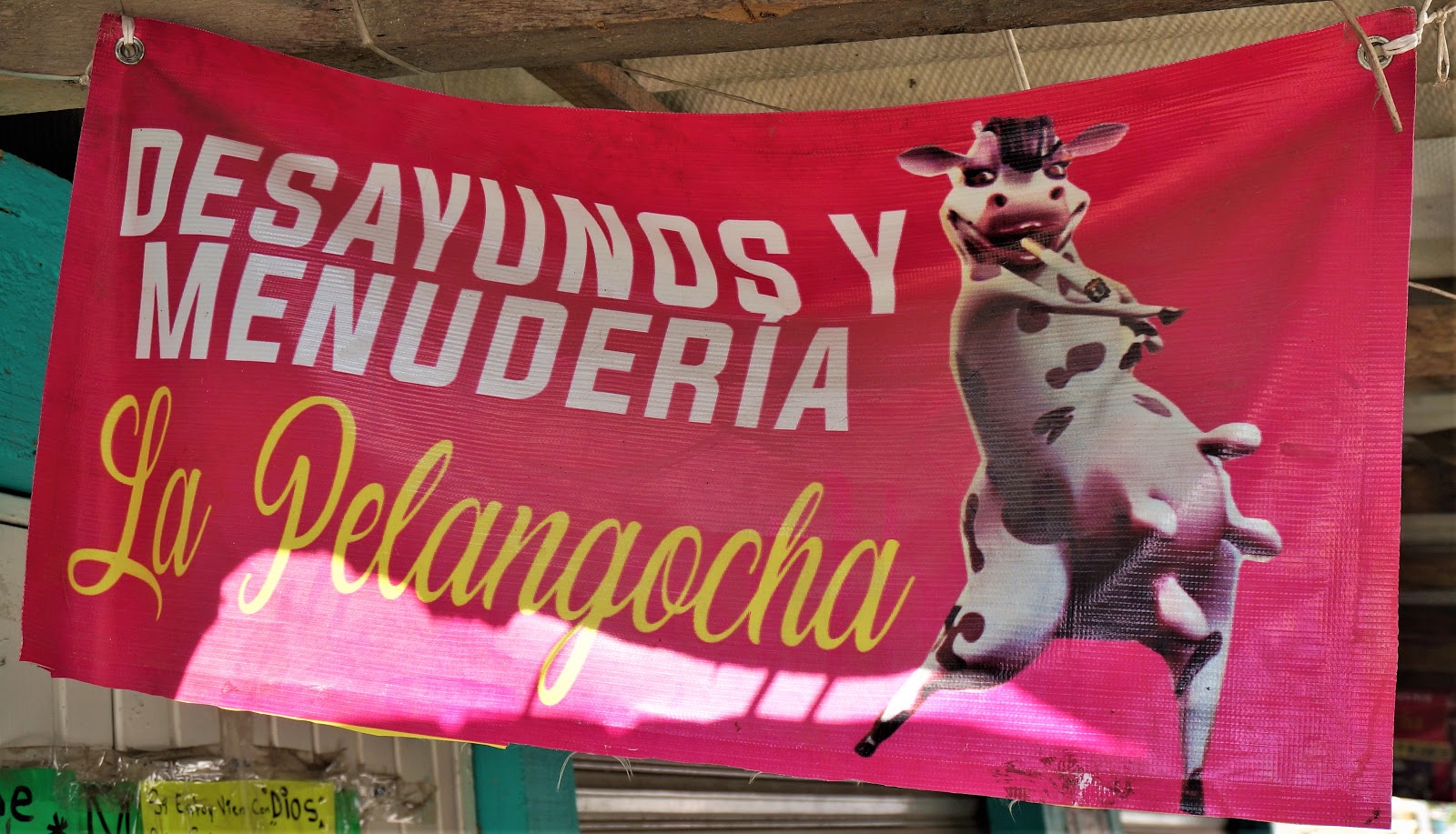
Some signs are simply funny on their face.

Or is it a subtle social comment?

Monday, June 15, 2020

what's your point?


One of the challenges (and blessings) of driving in Mexico are direction signs.

They are simultaneously a challenge and a blessing because getting lost on long-range journeys is almost guaranteed. And any journey that does not include at last a few minutes of being lost is not an adventure.

Before the state of Jalisco built the ring road south of Guadalajara, on my journeys from Barra de Navidad to San Miguel de Allende, I had to drive into the central part of Mexico's second largest city. That was not too bad because most of the trip was on thoroughfares.

That was true as long as I did not miss one very important turn. Using the Mexico red guide map and direction signs should have made transiting Guadalajara a snap. On the advice of a fellow blogger, all I had to do was follow the "Mexico City" signs.

On my first trip, I learned to my cost that the sole major shift from one thoroughfare to the other held no clue where the Mexico City route went. It did give me an opportunity to get acquainted with a portion of the city I had not planned on touring. When I switched over to GPS, I dumped the red guide and was happier for it.

We do not have any major route choices like that in Barra de Navidad. But all small beach towns everywhere in the world seem to have their own idiosyncratic traffic eccentricities. One of ours is the street on the sand bar that gives Barra de Navidad its name.

The malecon access road is a one-way loop. When drivers enter the loop, they have a choice to make -- continue driving straight or turn to the right. Even though driving straight is the more intuitive choice, drivers who choose it will come front-bumper to front-bumper with oncoming traffic. Turning right is the correct option.

There is a small arrow tacked high on a building at that corner. I am willing to bet a large number of driver do not see it. Why do I say that? Because on most of my visits to the malecon, I will see at least one car obstructing the bowels of the loop. Or maybe the driver is doing his best impression of a Copper River salmon.

Someone with apparent authority to do such things decided the intersection needed more clarity in providing guidance. A street-yellow arrow now adorns the intersection, guiding traffic up the hill.

It is a good idea, and one I heartily endorse. The lack of a large arrow certainly was not the worst local problem, but it is still helpful.

I am just not certain how long the arrow will survive. Now and then, yellow paint shows up on the streets here. Topes (those denture-jarring speed bumps) are a common canvas.

But the paint fades faster than my memory of popular music. Within weeks, sometimes days, the paint will wear through from the friction of tires. If you take a close look at the new arrow, it is already wearing through. It may survive for some of the early summer tourists (who are starting to arrive in noticeable numbers), but the winter tourists will have only this and similar photographs to know that once upon a time a yellow arrow lived below a big tree.

My snarkier side cannot help wondering if someone's brother-in-law owns the Temporary Paint Company.

Unless the arrow is re-painted in November, I doubt many of you will get to see it.

Enjoy a good idea before it fades.

Saturday, June 13, 2020

a beautiful day in the neighborhood


I need to make a change.

For the past couple months I have been starting my day by catching up on posts in Facebook. It is a bad habit. I come away from the process feeling sad and no better-informed.

Yes. I do recognize the irony in that statement since most of my readers seem to read the Facebook edition of Mexpatriate. But, there it is.

Today I made a deal with myself. Rather than start the day by reading Facebook, I would go out for a walk. It was a good idea.

I have mentioned before that tourists are starting to make their way back to these little fishing villages by the sea. Most seem to be either day-trippers or weekenders. But they are here.

To some people on Facebook, they are nothing more than dangerous, marauding hordes of Goths bringing their viral death to our pristine shores. This morning, all I saw were small knots of families walking on our malecon on a particularly pretty morning. Hardly the stuff of the next Tarantino film.

Sun. Soft breeze. The scent of the sea. Children swimming on the remnant of our once-grand beach. A far better composition than anything Facebook offers.

People move to Mexico for a lot of reasons. But I have discovered each day brings its own reason for why I moved here.

If you are in Mexico, turn off Facebook and go outside -- even if it is only to your patio. Life is far too short to spend it in the clutches of fear.

And if you do venture outside the confines of your wall, you will enjoy what the day has to offer. There is plenty of social distancing space and you can always disguise yourself as Billy the Kid.

Friday, June 12, 2020

water water nowhere


The title is not quite Coleridge.

His point in the "The Rime of the Ancient Mariner" was that the sailors on a becalmed ship were surrounding by water, but none that they could drink. And that is an analogy that would fill a book, let alone the small confines of an essay.

Our problem here is just the reverse. We have no water. Or, at least, we have no water in the form of rain, and our hills are beginning to show it.

There is a spur of the Sierra Madre Occidental that marches off laterally into the sea just west of Melaque. It serves as a perfect rain gauge.

At the close of the rainy season (around October when the northern tourists start drifting back), the hills are decked out in almost every shade of green imaginable. But the next six or seven months will be almost without rain. By June, the hills are a shade somewhere between gray and brown. Taupe or dun, perhaps.

Our skies lately have been teasing us. A couple of days ago at sunset, I went outside to shoot some sky shots. Looking up over the edge of my house's lines, the skies had been drained of all color.


That shot is in color, not black-and-white. The sky looked just like that.

There is a famous photograph of a civilian Frenchman in Marseilles watching the colors being trooped out of France to northern Africa after the Germans invaded in World War Two. It would be easy to imagine the sky I saw was witness to those tears of humiliation. Certainly, they were the harbingers of much-needed rain.

But they weren't.

Last night I woke up to the sound of rain Bojangling on the sky window at the top of the heat chimney in my shower. It must have tapped me to sleep, but when I woke up this morning expecting to see at least a few puddles in the patio, there was nothing.

We get these teases just before the rainy season sets in. I have an acquaintance here who believes the rainy season does not begin until enough rain falls to short out the electricity. When I first came here, that took only a few drops. I suspect that test is not very helpful now that new electric lines have been installed.

So, we wait for our hills to be alive with the sounds of raindrops. Until then we need to keep conjuring up new adjectives to describe the hills.

Dapple-gray, anyone?

Thursday, June 11, 2020

crossing the lines


In almost every saga, at one point the way will  be barred.

Roland in the pass. Horatio at the bridge. Gandalf before the locked doors of Durin.

San Patricio is having its own "the way is shut" moment.

Yesterday I drove into town to drop off my laundry and to pick up some groceries at Hawaii. I usually park on a one-way street in front of the funeral parlor. At least half of the cars were parked facing the "wrong" direction. I had never seen that happen before.

The reason was Holmesean elementary. The connecting street -- the street that runs through the middle of San Patricio -- was closed. For only a block. But it is a long block.

Street closures here are an informal matter. In this case, three small cones were placed to stop vehicles from driving down that portion of the street. Some cars simply ignored the cones and drove right through until they encountered the reason for the closure.


CFE (our government-owned electric company) has hired contractors to replace aging electric lines. The main lines get replaced regularly following tropical storms or hurricanes. The lines to houses do not get replaced with the same regularity -- unless something falls on the lines. The result now is of lines to residences and businesses.

I know very little about electric lines, but watching the installation is fascinating. It is a bit like watching a rodeo cowboy deal with a very unwieldy lariat. But these guys seemed to know what they were doing. And I am a sucker for watching any job done well.

I tried to get some additional information from the men installing the lines, but my accent defeated the possibility of sharing details. I must be really slipping because on two other occasions I made a joke in Spanish and what I said had to be repeated by people I know. A joke explained is an opportunity missed.


But back to those cones. San Patricio has a street grid that is mixed with two-way and one-way streets. Because street closures usually have no warning of the closure until the driver arrives at the blockage, improvisation is required.

Up north, a sign would announce a detour, and, if traffic needed to be re-routed, the streets would have signs announcing the driving path. Not here.

Cars driving south coming to the cones would appear to have only one option. The cross street is one-way to the east. Drivers wanting to drive west can do so legally merely by making three left turns and driving around the jardin.

No one was doing that. If drivers were driving west, they simply turned right -- right into oncoming traffic. Fortunately, the street is not well-traveled. But it is crowded. Drivers park on both sides of the street even though parking is prohibited on one side of the street.

I have always been amazed at the Mexican ability to improvise when circumstance change. Turing a one-way street into a two-way is simply an example of the economic theory of conservation of resources.


The only downside is when buses need to use the street. In the past two days, I have seen two mirrors on parked cars become victim to the choice of illegal parking. It is probably more expensive than a parking ticket.
     
As for the new electric lines, they certainly look sturdy. But I have nothing more I can tell you about them. Maybe the residents of the block will be able to tell us in the future how valuable the new infrastructure is.