Wednesday, March 07, 2012

ripples on my life

I have said it before.  I will say it again. 

Steve Cotton is not a person of place. 

I have never been the type of guy who claims a bit of soil as The Place Where I Belong. The sentiment is a bit too funereal for my taste.

But we are all a tribe of contradictions.  And that lesson came home to me yesterday.

Since my return from China, I have spent a few afternoons on the shore of the laguna pulling out vegetation.  Mainly water lilies.  Their stems are strong enough to restrict the underwater movements of the crocodiles.  Green anti-submarine nets.

But there is plenty of other flotsam to be hooked out of the pond, as well.  Water bottles.  Beer cans.  The occasional pelican skull.

The most difficult are the coconuts.

The Spaniards brought the coconut palm to Mexico from The Philippines in the 1500s.  For plantations.  So they thought.  As far as the palms were concerned, it was a great new land to colonize.

And colonize they did.  Spreading like dandelions.

Some of the coconut palms around the area are cultivated.  But there are plenty of volunteers.

The trees spread through an amazing nut.  The seed is covered by a thick husk that is water-resistant.  Water-resistant enough that the nuts can travel long distances on water.  That is why there are coconuts on some of the most isolated Pacific islands.

For the cleaner of ponds, they present a problem.  I could just leave them bobbing in the water like some reminder of a tropical Titanic.  But they do not fit into the Monet landscape.

My usual vegetation remover is a pitch fork.  And it is not the best tool for coconuts.  Think peas and fork.  Same issue.  The nuts just roll off of the implement.

And once I successfully toss them on shore, they have a tendency to do as nature intended.  They roll back down the bank into the water.

Yesterday, I managed to fish out the last of the coconuts.  Exhausted, I wandered into the garden to sit down and bathe in a nice shower of hubris.

No more than thirty minutes passed before I heard splashes in the pond.  My first instinct was that one of the crocodiles had nabbed a feline snack.  But I was wrong.

Standing on the shore of the pond were two teenage girls.  Tossing the coconuts into the water.

My first instinct was to admonish them.  Until it hit me.  The pond is theirs as much as it is mine. 

I can hear the economists amongst you.  Smugly mumbling: “Ah, yes.  The Tragedy of the Commons.”  And that would be correct.  Whenever something belongs to everyone, its responsibility belongs to no one.

But my error was more basic.  I have come to think of this portion of the laguna as mine. 

It isn’t.  The public pathway around it is proof enough of that.  The work I do is not merely for me.   It is for everyone who passes this way.

And so the pond teaches me, as Walden taught Thoreau, that we are mere sojourners in this world.  We enjoy.  And then, like the Moving Finger having writ, we too move on.

Tuesday, March 06, 2012

tripping to the mountains -- maybe


The China tales are at an end.  But my travels may not be.

Yesterday Abandou asked: "Where will we be tagging along to next?  Has that been decided?"

I may have an answer.  Possibly two.  The photograph at the top of this post is a good clue for the first possibility.

Early last week, Dan of Mex-Eco Tours saw me in town and told me there was a possibility that he and Ruth would be putting together a trip to Guanajuato.  It is getting rather late in the season, but he hoped enough NOBers would still be in town to fill a tour.

True to his word, an email arrived announcing a four-day trip to Guanajuato, Delores Hidalgo, and San Miguel de Allende starting on 20 March.

You may recall, I went on a similar trip in January last year.  You can read about it at: putting it together, visiting frog mountain, little gto, to see -- and observe, the tax man cometh, and shangri-la goes missing.

I enjoyed that trip.  Enough that I signed up for two additional trips with Mex-Eco Tours that year.  And the Copper Canyon tour this year.

But here is the rub.  I talked with Ruth on Monday.  Only eight people have signed up.  Twenty are needed for the trip.

So, if you are in the Melaque area and want an interesting diversion, give serious consideration to coming along.

If the Guanajuato trip does not pan out, I am looking at the possibility of a 30-day cruise from New Orleans to Dubai (through the Suez Canal) later this spring.  But more details on that later.

For now, I will wait to see if here are enough adventurers left in town to head off to Guanajuato.

Monday, March 05, 2012

silk and canals

On our last day in China, we headed off to Suzhou -- the canaled "Venice of China" (according to Marco Polo) and the land of silk.

I should also mention its modern product.  Suzhou is a major computer manufacturing area.  If you use a mouse, there is a 90% chance that it came from Suzhou.

But we were not there on a technology hunt.  We had come to ride the canals and buy silk.

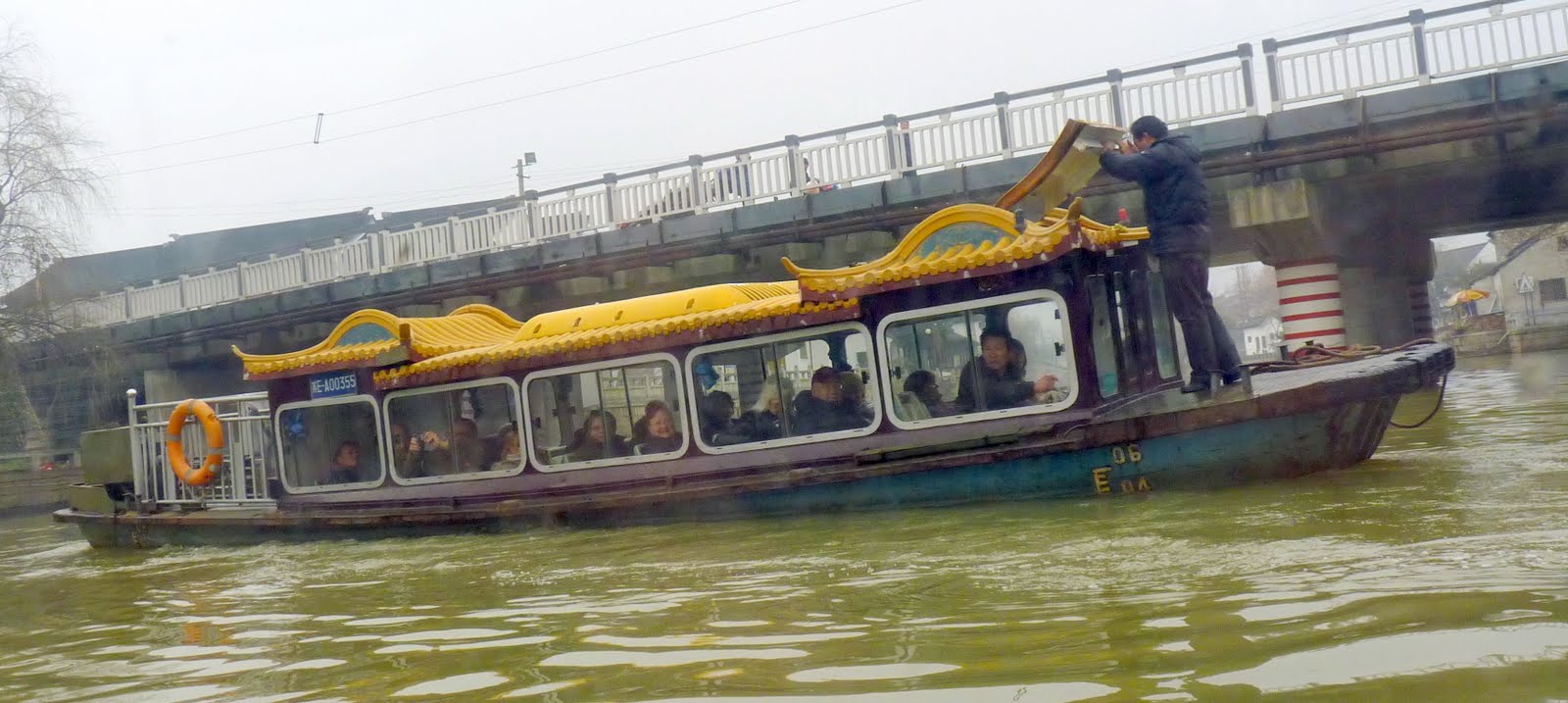
To be fair, the canals of Suzhou bear very little resemblance to Venice, other than the fact that they contain water.

And our boat was no gondola.  Most of my fellow travelers and I shared a common trait.  We carried a bit of heft on our frames.  I am not certain how low the boats usually ride in the water.  But, once we boarded, the waves were lapping the gunwales.


It has been some time since the canal area of Suzhou was trendy.  But people live here in a bit more like what I had anticipated when I came to China.  Like using the space available for parking.  (This would be a tough parking job for a drinking driver.)


Or doing the laundry.  Or gathering water for the home.  Or simply washing out your paint equipment.  In the general purpose canal.


Suzhou was the first opportunity we had to see a traditional market.  In this case, a "wet market" where live animals are sold.

The lady on the motorcycle had just picked out the fowl she wanted.  The vendor (in pink) wring its neck and started plucking feathers.  Rather like picking out your own lobster from the tank.


After our little canal cruise, we headed off to a silk "factory."  First our guide gave us a talk on the life cycle of the silk moth, its caterpillar, and the valuable cocoon it spins.  Complete with the unusual Puritanical language of Communist China referring to Mr. and Mrs. Moth.


Like most of the sales rooms we visited, there was a Potemkin Village factory that was designed to give us the feeling that the entire silk process was performed on the ancient machines set out for our amusement.


The descriptions were interesting, if a bit deceptive.  But there was no doubt where the tour would lead -- into a warren of sales room where everything that could be made of silk was on offer.  Bedding.  Table clothes and napkins.  Art.  Coats.  Pants.  Shirts.  And miles of scarves.


After a couple hours of silk shopping, our guide helped us to relax with a visit to a garden known as Master of the Nets.  The owner's daughter was rescued from drowning by a fisherman's net.  He built the garden in 1140 in honor of the event.

In this mosaic, you can see the squares of the fisherman's net with knots at each corner.  This portion of the net includes a shrimp and a fish caught in the net.


Standing at this point, the garden did what is was designed to do.  I reflected.  I relaxed.


And appreciated the beauty of a simple window that seemed strikingly modern and ancient in its composition.


So ended the trip to China.

It was a bargain in many ways.  It certainly did not cost much.  But I gained much for little money.  Including a desire to one day walk China's roads again.


Sunday, March 04, 2012

racing through the culture

Fellow blogger Babs commented recently: "It appears to me that you saw China from a political perspective and not an aesthetic one."

She hit on a point that is perhaps my sole criticism of my China trip.  Our tours were weighted toward a presentation of China's place in the past and in the future.  An emphasis that made me wonder if the bargain price on this trip was subsidized by the Chinese government.

I love seeing the detailed culture of the countries I visit.  That almost always means spending time in museums.  Lots of time.

On this trip, we whizzed by several museums.  One of the greatest, of course is the Chinese National Museum on Tiananmen Square.  We had no more time than to snap a quick photograph of the exterior.

The only museum that we visited was the beautiful contemporary Shanghai Museum.  As beautiful inside as it is outside.


As beautiful as the building is, its collections are breath-taking.  And I mean that literally.  Not in the Joe Biden way.

There are ten permanent galleries: bronze, sculpture, ceramics, jade, paintings, calligraphy, seals, currency, furniture, and minority arts and crafts -- all spread over three well-designed floors.

It was like being offered a month's worth of gourmet dining.  Our guide then told us we had just over one hour to see the museum.  One hour to see an ancient culture.

She then offered to, at least, give us a specialized tour of the bronze gallery.  Her tour was helpful, but we could only see each bronze for a few seconds. 

I then did what I hate to do in museums.  I put on my culture vulture sneakers and raced through each floor trying to see as much as I could.  Here are a few pickings.

Bronze cauldrons were very common in China.  Just as they were in Europe and the Middle East-- and for the same purpose: cooking and storage.  Some of the pieces we saw were nearly 4000 years old.

This is the museum's prize piece.  Not because there is anything unusual about the construction or decoration.  It is an artistic piece, but not particularly unusual.


It is what is inside that makes it unique.  There are two prayers in Chinese characters.  This is the earliest use of Chinese characters currently known to archaeologists.  It gives anthropologists some evidence on the age of written Chinese and how it developed.


The sculpture gallery had a small collection of stone and wooden sculptures.  I really liked this equestrian piece.  It contains that unique combination of realism and expressionism that gives Chinese art its vitality.  The sculptor's ability to capture the essence of the horse makes the piece compelling.  At least, to me.


I headed upstairs to the minority arts and crafts gallery.  A vast majority of people in China are ethnically Han Chinese.  Over 90%.  But there are at least 55 recognized minority groups.

The minorities gallery includes masks, boats, and clothing from the various groups.  There was something that drew me to the clothing for a minority in southern China.


The label used the term "salmon" in describing the clothes. I thought that was odd because the clothes were distinctly yellow, not pink.  Then I saw it.  The texture of the clothing.


If you look closely you can see scales.  The clothes are made from leather of salmon skins.  Pretty unique, I thought.  It set me wondering if other tribes throughout the world use fish skins in a similar manner.

I have never been big on furniture as an art form.  But the museum has an interesting exhibit juxtaposing Chinese furniture from the two dynasties that were the height of furniture as art.

The first is the Ming Dynasty with its simple lines -- almost Danish Modern.


And then there is the other extreme.  The Qing Dynasty with its heavy Victorianesque pieces.  The type of furniture that tends to show up in American Chinese restaurants.


You might get some idea by those descriptions which style I prefer.

There was also a collection of Nuo Opera masks.  This one caught my fancy.  I seem to see him from time to time in my writings.


I wish I could have stayed longer in each of the galleries.  But the gallery that contained the most fascinating pieces was the jade gallery.  Some of the finest jade I have seen.  Including these jade pieces from a funerary mask.  The pieces are about 3500 years old.  It almost makes you want to be Indiana Jones.


But no visit to a Chinese museum would be complete without at least one classic vase.  Or two.  So, here they are.


Babs, I am sorry that this is the best I could do.  After doing my culture race, I am convinced I could spend a week in this museum.  Or at least a day in each gallery.  And learning would be easy.  The exhibits are fully described both in Chinese and English.

One of the most difficult things in learning a new culture is learning the various eras and how each cultural piece relates to each time period.  But that takes time.

And, on this trip, we spent far more time in establishments selling silk, pottery, medicine, jade, and pearls than we did in learning about the history behind them.

I suspect that was not exactly an accident.

Saturday, March 03, 2012

night and day


Shanghai, like most big cities, has a day face and a night face.  But in Shanghai’s case, the two faces seem as if they belong to two different cities.

Even though it is China’s largest city by population (23 or so million people), it is not an ancient city.  It was a market town for most of its existence.

When the Chinese opened Shanghai as a sea port in 1684, the town began to thrive.  The British Empire seized the town during the opium wars, and grabbed a concession in 1842.  Soon to be followed by the French and the Americans.  And, of course, the Japanese, who took over the whole city in 1941 until the end of the Second World War.

During the Cultural Revolution, Shanghai was the center of leftist radicalism under the Gang of Four.  It is hard to believe that current Shanghai, a monument to capitalism, once was the poltical base for Madame Mao and her allies.

What is far more apparent is the British connection with Shanghai.  The Huangpu River runs north to south in Shanghai.  On the eastern bank is modern Shanghai.  On the western bank, in an area called the Bund, is the former British concession with its European-style collection of buildings.

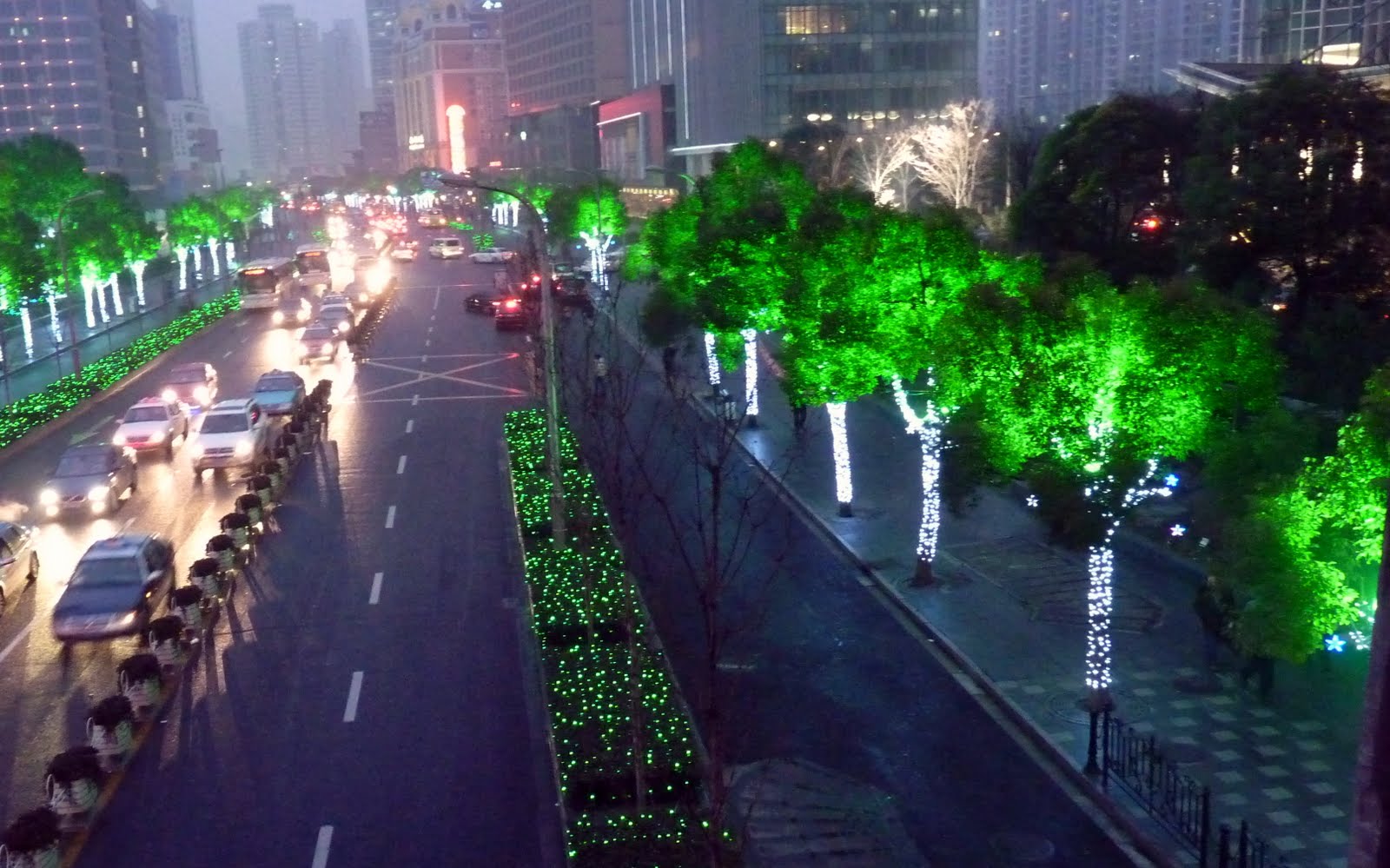
But when the lights go on at night, Shanghai takes on the look of a potpourri of Las Vegas, Disneyland, and a Blade Runner set.  We took an hour-long boat trip to see the city at its best.


To ensure it looks its best, the government turns on all of the external lights from 7 to 10:30.  And a shiny face it is.

On the east bank, each building vies for attention.  But the Shanghai Financial Center (second tallest building in the world), the futuristic Oriental Pearl Tower (looking as if it was sired by the Space Needle and a minaret), and the LED screens that cover the full side of two riverside buildings.


And because Shanghai has suffered its share of political intrigue, the People's Liberation Army (PLA) decided to build its own snappily-titled Monument to the People's Heroes in Shanghai.  Its three concrete spires commemorating the defeat of feudalism, imperialism, and capitalism.  The last is ironic because the PLA is the largest business owner in China.


The monument has an alternative meaning not often used within earshot of foreigners.  Commemorating the defeat of the Japanese, British, and Americans.  Such matters are best left unsaid to not scare off those tourist dollars.

But Shanghai is not just imperialist and modern buildings.  Unlike Beijing, Shanghai has retained quite a few of its traditional neighborhoods.


And, of course, there are gardens.  Before dropping us off at a tacky market for a two-hour shopping spree, our guide took us to a traditional Chinese garden nestled in the heart of Shanghai.  I never recognize how stressful touring cities can be until I have an opportunity to be surrounded by the peaceful harmony of a garden.

That harmony, of course, was the result of the hard work of a staff of 30 gardeners.


This garden had the four traditional elements: water, buildings, plants, stone.  But the arrangenent was masterful enough that I could feel the day's tension draining out of me onto the mosaic walkway.


Friday, March 02, 2012

count de money

One aspect of traveling I have always enjoyed is learning to use a new currency.

That experience is getting less challenging as time goes by.  I can still remember the thrill of using the non-decimalized pound system.  But the demise of shillings and pennies has homogenized the experience of learning new currencies.

China is no exception.  The Republic decimalized the currency in 1914 in an attempt to pull China's culture out of its feudal past.  The currency system is divided into yuan and jiao.  There are 100 jiao in a yuan.  Just like Mexico with the peso and centavo.

But the number of coins are very limited in China.  And easy to remember.  They are 1 yuan, 5 jiao, and 1 jiao.  As a result, jiao coins have a  tendency to accumulate.  Just like American one cent pieces.

Language and currency have a common cultural connection.  In language, the old adage is that when you start thinking in your new language, you will be on the way to mastering it.

The same is true with currencies.  As long as a visitor to China keeps thinking “that translates to $5 (US); and that is cheap in my Walmart back in Des Moines,” the currency will never be mastered.  It then is a mere arithmetical exercise. 

You know you understand  the currency when you can say: “20 yuan?  No.  That is too expensive.  It should only be 15 yuan.”

After all, currency is merely an exchange of value.  And that value always has a cultural context where the currency is used.  Thinking in dollars in China is as limiting as expecting street vendors to be fluent in English.

At best in China, I got to the point of understanding which pieces of paper and metal I needed to take out of my pocket after reading a sign.  And that I could master.

I did not get close to mastering whether the amount was culturally appropriate.  My one clue was looking at my fellow shoppers.  Whenever they were far better dressed than I was, I knew I was probably spending too much.

Thursday, March 01, 2012

dim sum iii

This water man could have been delivering bottles of water in almost any Mexican neighborhood.


And there is a reason he is peddling his wares.  This sign was pasted on the bathroom mirror in our hotel room.


A lot of the architecture in Beijing is designed to reflect the modern image China so desperately wants to show the world.  (Wait until you see what Shanghai has to offer.)  This is a hotel.


Or evocative.  This building (with the IBM crest) is designed to look like a dragon.


This is another example of an aluminum shell turning a motorcycle into a small car.