Monday, March 21, 2022

on the back of the snake


Tolstoy had it partly correct.

All happy trips are alike, but every trip is special in its own way.

That was certainly true of our trip to the Yucatán peninsula. The three of us (my cousin Dan, his wife Patty, and I) have a certain fondness for the peninsula with its history that makes it feel almost like a country separate from Mexico.

That may be because it almost became a separate country -- twice. Due to its Maya cultural heritage and its isolation from the rest of Mexico, it was almost inevitable that the people of the peninsula would seek their own national destiny.

The first time when it declared its independence from the Spanish empire in 1823; the second when it declared its independence from Mexico in 1841 following Texas's example. Had it not been for the unfortunate Caste War, those dreams of independence may have been realized. Politically, the peninsula is part of Mexico. But, to this day, its residents see themselves as a people apart.

There was a second reason, though, why this trip was special. Dan and Patty ran a business and lived on Cozumel several years ago. As a result, they have formed some long-lasting friendships. Around September they are making a permanent move (or as permanent as wanderers who are not lost can be) to Mallorca. For them, this trip took on the aura of a farewell tour, where my family's wish of "next year in Jerusalem" was replaced with "next year in Mallorca."

Our first stop was to set up our base camp in Valladolid for the first eleven days of our stay at La Dichosa, a bed and breakfast owned and hosted by Carlos M. Gonzalez and Teresa Castillo, friends of Dan and Patty during their days on Cozumel. Dan told me to be ready to be amazed -- and I was.

La Dichosa is not so much a bed and breakfast as it is a functional piece of art. Carlos is a wood craftsman. No. That does not do his work justice. He is an artist who works in wood -- and soil -- and stone -- and ceramic.

La Dichosa currently consists of two buildings. The main house that offers a master suite, and three bungalows. Each room is decorated with Carlos's creations.

The lamps. The tiles. The furniture. Carlos created each piece to give the rooms their own character with all of the furnishings echoing the uniform theme. It is like living in a disciplined artistic mind.


Rooms are always an important consideration at any bed and breakfast, but Carlos extended his artistic theme into the surrounding pool and garden. One of the great Maya myths is Kukulkan -- the War Serpent, who is probably best known these days in his depiction of a shadow that undulates down the stairs of El Castillo at Chichén Itzá each equinox.


Carlos incorprated the myth into his design of the garden that joins the bungalows with the main house. The three levels are divided by undulating walls echoing Kuklkan's serpentine shape. A pool tops it off.


The overall effect is similar to a secular monastery. Time runs at its own pace. The effect is complemented by the shifts of birds that visit the trees on the property each morning. Each with its own colors and song.

I am not so naïve as to believe that the birds were there for my pleasure. Most birdsong, if translated literally, would go something like: "Hey, birds. Get out of here. This is my property. Go -- or I will peck out your eyes." Sometimes it helps to be monolingual.

Maybe that is one reason I am an advocate of bed and breakfast accommodations when I travel. There is no better way to know an area than to sit down with your hosts and fellow guests during the day to discuss respective discoveries.

Valladolid is not a traditional tourist destination. It is best known as a central point to see the sights of the peninsula. That is how I used it on my prior two visits in 2010 and 2014. But that is changing. And our fellow guests were examples of that. They had come to see Valladolid as much as they had come to see reconstructed Maya cities.

And a cosmopolitan lot they were. Most of them young. Primarily European -- two French couples, two young women from Switzerland, and a young couple from Chile. And all spoke multiple languages, with the exception of an older Canadian couple. 

Carlos may have provided the artistic integration of La Dichosa, but it is Teresa that keeps it running with the loyal assistance of Alonso. Food and drink magickly appear. Dishes are whisked away. All of that is as much of an art as are the individual tiles in the bathrooms.

We have all had the experience of tagging along with people visiting their friends -- people we have never met. For shy people like me, that can be a recipe for social disaster.

Carlos was going to have none of that. Even though he was not my years-long friend, he made me feel a part of every conversation and gathering. He has raconteur's ear for ferreting out interests and avoiding social landmines.


Of course, food is the great leveler. Yucatan food always interests me because it is different than Jalisco food. For Carlos, that meant a meat-fest.

The same thing happened when we visited Cozumel. On one of their last extended visits to the island, Dan and Patty stayed at Rancho Chichihualco, a 77-acre bed and breakfast owned and operated by José Qunitana Ahedo and Adriana Barrena. Her grandfather, while he was the commander of the nearby Air Force Base, had acquired the property. She and José have developed it into a bungalow-oriented bed and breakfast.

Even though we were not guests, they invited us over for an afternoon-long barbeque that drifted into the evening. There is something magic about cooking that much meat for a group of people. Almost Mexican alchemy that turns a pleasant few hours into hours that pass unnoticed amongst the company of people with backgrounds I do not encounter where I live.


Tales were told in a mixture of Spanish and English. Large portions of meat were washed down with ambiguously-described beverages. And people, who did not know one another well a few hours before, were now unwilling to break the circle of fellowship.

I will write about the sights we saw and the journeys we took because they are an integral part of the trip. But it was the relationships that we recreated and extended that will have the longest-lasting effect on me.

To share my life with my cousins, with Carlos and Teresa, and José and Adriana, with the young people from France, Chile, and Switzerland who I suspect I will never see again, was an experience I dd not anticipate, but one that I thoroughly appreciated.

And what could be better than that?

Maybe we will find out in the next installments.
       

Sunday, March 20, 2022

feliz cumpleaños, benito


No. Not that one. 

The birthday we celebrate this three-day weekend is not that of the late and not-lamented Il Duce, but that of President Benito Juárez.


The beaches and restaurants are filled with Mexican tourists. The orange juice guy on the highway has abandoned his customary post. And Dora messaged me that she would not be in today because she and her family are on their way to Manzanillo to celebrate the man known by some as "The Lincoln of Mexico."

The Mussolini-Juárez connection is not one of my inventions. Benito Mussolini's father was an avid socialist, just as his son would be, and admired Benito 
Juárez's commitment to humanism. So much so that he named his elder son Benito. Juárez most likely would be horrified at both comparisons.

There was much to respect about 
Juárez. He was the only full-blooded Indian (Zapotec, in his case) to serve as president of Mexico. Ironically, he would have disliked the label. As a leading liberal, he railed against what we now refer to as "identity politics." He found his blood line to be irrelevant. Like Martin Luther King, Jr., he believed people should not be judged by the color of their skin, but by the content of their character.

So, how did a young Zapotec overcome the class restrictions of early nineteenth century Mexico to climb to the top of the greasy pole? As is true with so many of these Horatio Alger tales, it was through the beneficence of one man.

Antonio Salanueva, a Secular Franciscan recognized that the young Juárez was intelligent and motivated, and assisted him in entering school to become a priest. That career did not happen because Juárez felt he had not been called to the priesthood. Instead, he became a lawyer. 

Even though Mexico gained its independence from Spain in 1821, the country was divided over an existential question. How Mexicans would identify themselves.

There was a major political split between conservatives (who looked to Spain and Europe for political inspiration and favored a strong central government) and liberals (who looked north to the United States and to a mythical Aztec past for social and political ideals; they also favored de-centralized power). Each group argued their position was the true Mexican identity.

These battles were not merely intellectual. They were also physical fights for political control finally breaking out in the War of Reforma (1857-1861).

Prior to the war, Juárez married well, and became active in the liberal cause in his home state of Oaxaca where he joined forces with other liberals in challenging the power of the Catholic Church -- the very institution that had provided him with the opportunity to advance in Mexican society.

And rise he did. To become the governor of Oaxaca, where he came into conflict with one of Mexico's true scoundrels -- President (and dictator) Antonio Santa Anna -- the man who lost the northern half of Mexico to the United States. In fear of his life, 
Juárez went into exile in New Orleans in 1853, where he fleshed out several liberal principles that he would support when he returned to Mexico: that all Mexicans should be equal before the law and that the powers of the Catholic Church and the Mexican Army should be restricted. His activism eventually led to his election as Chief Justice of a newly-constituted Mexican Supreme Court.

When liberal President Comonfort was forced to resign in 1858, the constitution designated the chief justice as interim president. The "interim" label did not last long. Juárez would be elected to the office three times in his own right.

His terms as president were responsible for much of what we know as Mexico today. The church was stripped of its income-producing lands and some of its church buildings. The land was then distributed to the Indians from whom the church had taken the land.

Unfortunately, the reform did not last long. The new landholders eventually sold, or were forced to sell, their land to large landholders. When the next great land reform happened after the Revolution, the law entailed the Ejido holdings to prevent a similar failure.

Juárez also survived the years when a French emperor (Napoleon Bonaparte's nephew) put an Austrian archduke on the Mexican throne as Maximilio I -- forcing Juárez to flee for his life. Once again, he was in exile. This time in the portion of northern Mexico the French had not conquered.

Events in Europe and active opposition from the United States forced the French emperor to withdraw his troops from Mexico, leaving Maximilio to defend his throne with the support of Mexican conservatives. Juarez’s liberal Mexicans prevailed, Maximilio was executed, and Juárez resumed his position as president and continued the liberal reform movement.

Like far too many politicians who have faced tumultuous careers, Juárez probably stayed in office too long. He eventually turned on one of the defining elements of the liberals (decentralization of political power) and created a highly-centralized government in Mexico City.

Eventually, a young liberal general by the name of Porfirio Diaz revolted against him when 
Juárez declared he would once again seek reelection. Juárez put down the revolt, but he died soon after. The next 40 years of power would belong to that young liberal general (Porfirio Diaz) who also outstayed his worth becoming a notorious dictator.

For 
Juárez , it was a rather tragic ending to a career that held so much promise.

But it is not for the dreams that were not realized that we celebrate Benito Juárez's birthday. It is because he set Mexico on the modern path that we recognize today.

And certainly that is good enough to pause in our work week, to take off a Monday to thank and remember him.

Saturday, March 19, 2022

there and back again


So, there I was in the final stages of booking my Lufthansa reservation to Kiev for early February when I received an email from my cousin Dan.

"Would you like to join Patty and me on a two-week trip to Yucatan?"

The answer was easy. And you know why. My last two trips with Dan and Patty for a month touring southern Mexico in 2015 and two weeks of Colombia coffee country in 2017 were some of the best travel days I have experienced. They have a jeweler's eye for life well-lived. So, I immediately cancelled Ukraine and switched to the more-sybaritic expectations of Mexico.

There are very simple ways to get to Yucatan from the Pacific coast of Mexico. Airplane. Bus. I even considered driving. In the end, though, I drew a Steve option. That means my choice was far more complicated than it had to be.

Because I had already cancelled two flights that would have kept me on track with my mileage program, I booked a flight on Alaska. That meant that I had to fly to Los Angeles, spend the night there, and fly to Cancun the next day -- with all of the testing and immigration nonsense that accompanies treks across international borders these days. And, when the trip in Yucatan was over, I would reverse the process staying in Los Angeles for three days because of the limited flight schedule to Manzanillo.

Considering how Alaska's mileage program has been degraded now that it has joined a new alliance, I am not certain the choice had even a grain of wisdom. But it did add to the adventure.

The only fly in the ointment was the Cancun airport. Several airplanes had arrived in the same time slot discharging what appeared to be one of Attila's auxiliary hordes into the immigration lines. I had forgotten it was Spring Break season.

Living in Mexico has taught me a little about the rewards of being patient. I did not need to exercise it in the immigration line. It was as efficient as entering Europe through Frankfurt. Customs was another issue.

I smugly skipped waiting for luggage because I was traveling with a small carryon. That did not keep me from lining up with the rest of the luggage-burdened passengers for over an hour to have my luggage x-rayed. Hundreds of people. Two x-ray machines.

But, soon enough, I was disgorged in the Cancun sunlight to be greeted by my cousin traveling companions -- Dan and Patty -- who whisked me off to Valladolid. Where we will meet Carlos and Teresa, our hosts for the next two weeks

That is where our tale will take up tomorrow (or some day in the near future).

And I hope you will enjoy the trip as much as I did.

Monday, March 14, 2022

the lost hour


There was something odd about my flight from Cancun to Los Angeles this morning.

It took an hour less than when I flew the opposite direction two weeks ago.

There were two possibilities. 1) The jet stream was more favorable in one direction, or 2) the cumulative effect of covid, Putin, and people who insist on salvaging the subjunctive had finally formed a rip in the time continuum. I immediately eliminated option one because my flight from Los Angeles to Manzanillo on Wednesday is an hour shorter, as well.

The clue, of course, is that consistency in the differences. One hour.

It is that time of year again -- when the countries get all uppity and think they understand time better than Mother Nature. The shifting sands of daylight saving time are upon us. And because it is primarily a political question, the time change will happen at different times in different places.

This morning Canada and America jumped an hour forward. Mexico did not. Daylight savings time will not come to Barra de Navidad until 3 April. That means that for the next three weeks, the usual time calculations between Mexico and its two northern neighbors will be off by an hour.

For most of us, that is, at best, the foundation of a good bar bet. But, not all. International flights into Mexico will arrive and leave an hour earlier because the airlines use their own national time.

One year in the spring, I arrived at the Manzanillo airport at what would be my customary time only to discover the check-in counter was closing. I was operating on local time instead of Alaska's Los Angeles time.

For those of you who conduct telephone business between countries and for the others who might be flying or picking up friends at the airport, this is simply a public service announcement.

And, for once, I got all the way through the essay without once bashing the very notion of daylight saving time. 

The next hour is on me.
 

Friday, March 11, 2022

on the yucatan road


It is the small things that count.

When I stay in hotels while traveling, a lot of things matter. The bed. The size of the refrigerator. The presence or absence of a bathtub.

But what will peg my meter are the bathroom amenities. Particularly, the soap and the shampoo containers.

There must be a special engineering degree for designing soap wrappers that are impossible to open without using a shiv or a shampoo bottle's top where no finger can obtain purchase if even a hint of moisture is on your fingers. Somewhere Allen Funt is green with envy that shower cams were not readily available in his era.

Fortunately, I have not experienced that frustration on this trip. For the past three days, my cousin Dan, his wife Patti, and I have been staying in the Hotel Plaza Cozumel on, as you may guess, Cozumel. The hotel is far from a luxury all-inclusive. But it makes up for that in character and its pure utilitarian nature.

Take a look at the photograph. Someone deserving of a Nobel Prize has actually designed a soap wrapper that is both attractive and functional. A readily-recognizable perforation with plenty of packaging allows an adult to open it under a running shower. The same goes for the little shampoo bottle. Its top twists off even with the soapiest of hands. Why a $60-a-night hotel can solve this simple task while $400-a-night luxe pads can't is a mystery.

But even the best of bathroom discoveries come to an end. Tomorrow we fly out. Them to Fort Lauderdale -- and eventually Mallorca. Me to Los Angeles, where I will lay over for three days before I return home.

It has been almost two weeks since I left Barra de Navidad to fly to the Yucatan -- a part of Mexico I always find interesting. I had intended to keep you informed each day on our adventures. But, I did not have time to sit down and think. While I am in Los Angeles, I will update you on the past two weeks. I hope. 

Here is a short list of what may or may not show up in future essays:

  • Our stay at La Dichosa, a bed and breakfast in Vallalodid, owned and operated by Carlos and Teresa, friends of Dan and Patty. A place with a changing cast of international guests that would make a perfectly-serviceable remake of Grand Hotel.
  • Visits to the archaeological sites of Ekʼ Balam and Mayapan -- two of the smaller Mayan city-states that are far more interesting than the over-hyped Chichen Itza.
  • A reprise stop at Mani, one of Yucatan's magic towns that I last visited in 2010 with fellow-blogger Wayne Jahr.
  • A quick trip to Mérida, the state capital of Yucatan, to drop off a family memento to Joanna van der Gracht de Rosado, another fellow-blogger.
  • No trip would be complete without a wildlife segment. Ours was to see the pelicans and flamingos of Las Coloradas.
  • And, of course, our three-day stay on the island of Cozumel, where Dan and Patti lived and ran a business.    
I usually wait to pass on my bottom-line of the places I visit until I share the experience with you. I am far more deductive than inductive. The seductive I will leave to the younger crowd.

Of course, the purpose of this essay is to let you know that I have not been kidnapped by Somali pirates. Any kidnapping has solely been a family affair.

And those details will soon follow.


Saturday, February 26, 2022

shrapnel in my pocket


Everything turns out well in the end. 

Or, at least, it turns out.

That has proven to be true of the Bank of Mexico's announcement that the 20-peso note would be withdrawn and replaced by an expanded supply of 20-peso coins. That announcement was four years ago (bienvenidos, benito -- y adiós
). What has happened since?

Not much. The workhouse blue note featuring Benito Juarez face is still circulating, but very few 20-peso coins are. That has been my experience in our little backwater on the coast. I have received only one 20-peso coin in change.

This week I withdrew some pesos from my main bank. The bank seldom has any change. My wallet was filled with 500-peso notes that are not extremely easy to use at most businesses. The gas station. Hawaii (my preferred grocery store). A couple of high-end restaurants. Tour companies. That just about exhausts the list of places where a 500-peso note can be presented without feeling a bit ashamed that you are exhausting the resources of the business.

To avoid the awkwardness, I usually take my big bills to Banamex and change them into denominations that are a bit less-economically heretical. When my number finally popped up on the you-are-next screen, I asked the teller for a mix of notes. Twenties. Fifties. Hundreds. Two hundreds.

She started counting out the latter three in neat little piles. She then told me something I have been waiting to hear for four years. The bank did not have any 20-peso notes. Would I like coins, instead?

Because I like anything new, I took her up on her offer. Otherwise, I would not have had any 20s. The denomination is handy here -- even with Mexico's current inflation resulting in higher consumer price.

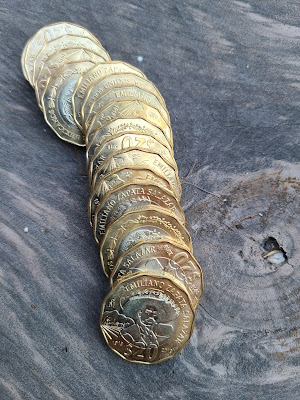
What I received is what you now see. I almost feel like a pirate having liberated Spanish doubloons from the Manila Galleon. Except the portrait is not of Carlos II, but a hero of the Mexican revolution -- Emiliano Zapata.

When I originally wrote about the note withdrawal, a Canadian acquaintance and an English friend shared their personal woes with the withdrawal of the 1- and 2-dollar notes, and the switch from paper to metal of the 1-pound note. Both bewailed the weight of the "shrapnel" in their pockets.

We Americans have had a couple of brief encounters with governments attempting to enforce a metal dollar on the public. The Eisenhower dollar in the early 70s. The Susan B. Anthony dollar in the late 70s. The Sacagawea and presidential dollars in the early 2000s.

None of them caught on with the public -- even when vending machines started dispensing them as change. They were either too large or too heavy. That is why Americans elected to stuff their wallets with one-dollar notes.

Of course, notes are becoming a vestige of the past almost everywhere in the world. Most commercial transactions are now conducted electronically. When I go north, I never use cash. I either use my credit card or the credit function on my FitBit. Before long, I will even forget which president (or other worthy) is on which note.

Even though credit card usage is far more common in the little villages where I have immigrated, most small business do not offer that option. This is a cash economy.

I suspect I will be memorizing the faces on the Mexican notes for some time. And Mexico will continue to do its part by printing a new series every five years or so. Or minting coins of ever-larger denominations.

As the old saying goes, it all spends the same.

Friday, February 25, 2022

the blind curing the blind


I am not a doctor -- though I have been known to play one in the courtroom.

That, of course was in a time long ago in Oregon. I now restrict my medical practice to me.

Writers have a tendency to ignore the aphorism omnes similitudines claudicante -- all analogies limp. But here comes one right now hobbling down the lane.

Our bodies are like cars. At least, mine is. As bodies age, we tend to think of them as eternally being what they were when they were new, and we are shocked -- shocked, I say -- when the suspension does not ease the bumps of life as it once did.

I am now in my eighth decade of life. And that means plenty of maintenance is required. Or needs to be ignored.

When I last was in Oregon, I received some bad, but hardly startling, news from an optometrist. My right eye was in the early stages of developing a cataract that would eventually need surgery -- and the blood vessels in my left eye were enflamed as the result of the elevated blood pressure I suffer whenever I visit the high desert.

Because it was more a precautionary warning than a matter of alarm, I tossed it onto the deferred maintenance list. After all, if I needed surgery, I could get some of the best care possible here in Mexico.

Until Sunday a week ago. While walking to church, I noticed what looked like a long strand of hair over the corner of my left eye. Even though I knew it was not an errant lock (I have not worn my hair that long in decades), I still brushed my hand to move it out of my range of sight. Not surprisingly, it was still there. And unless I had magically developed Mother Eyes, no hair on the front of my head was going to get in the way of my eyes.

A quick research on-line indicated the symptom could be the onset of macular degeneration or a detached retina. Both possibilities included the same warning: seek medical help immediately.

So, I did. On the next morning. But my doctor's waiting room was full, so I decided to use my time more productively by adding some more walking to my life.

And that is where everything stayed until Tuesday this week when I had dinner with my pastor and his wife (Al and Sue) at Papa Gallo's. I had noticed that whatever was wrong with my left eye was more apparent whenever I was in direct sunlight.

The conversation turned to matters medical, and I told them about my latest concern. When telling tales, I tend to use my hands for emphasis. Recreating my futile swipe to free what I thought was a non-existent tress, I felt something odd. A long hair. Not from the top of my head, but from the left corner of my eyebrow.

I did not have one of those exotic eye diseases that would require medical intervention. It was not even a strand of hair from my receding hairline. It was merely another one of those afflictions that seem to come to old men -- Andy Rooney eyebrows.

I have noticed that during the past year or two that my eyebrows have become the croplands for what can only be described as mutant eyebrow hairs. My eyebrows were the only bit of hair on my head that did not need any maintenance. They were always as orderly and uniform as the Queen's Life Guard.

Now, there are always several on the playing field that take off in any direction. The only thing they have in common is their horse-hair consistency and their absurd length. If my hairline recedes any further, I have the option of using my eyebrows as a comb-over.

When I discovered the genesis of my faulty left eye, I simply plucked out the offending hair. Al and Sue joined me in laughing at the absurdity of it all. I am just glad that I left the waiting room on Monday.

I was going to write that it would have been embarrassing if my doctor told me I was concerned about something that was just another Old Man problem. But I tend not to get embarrassed about anything these days. Another Old Man problem.

I suppose there are better roles for me on the stage of life than playing a doctor. Being an Andy Rooney impersonator may suit me far better.