Wednesday, March 22, 2023

to bee -- or not to bee


Those of us who live in la casa sin nombre are constantly on the alert for stinging creatures. Especially, when my brother is in residence.

He does not have a bug phobia. He is essentially fearless. Our vigilance is medically-based. He is highly allergic to almost anything that stings. Deadly allergic.

Christy, my sister-in-law, and I keep a close watch on the upper terrace. Wasps seem to find the area as amenable as retired condo-buyers from Moosejaw find the beaches of Puerto Vallarta. I knock down at least two nests each week in the breeding season.

I try to catch them in the foundation stage before the wasps spend the effort to lay their eggs. I am not anti-wasp. I just do not like them congregating where they can turn a pleasant dinner of carnitas into an emergency dash to the hospital. 

That is why Christy sent me into DEFCON 1 at breakfast about four weeks ago. She looked up from the breakfast counter and saw a large black spot on one of the eaves of the pavilions on the second-floor terrace.

"How could the wasps have built a nest that big in the last hour?"

She had a good question. One that I shared.

I grabbed my de-nester stick (what the less-creative might call a long-handled squeegee) and set off to do battle before the nest got to a critical point. But it was not a wasp nest. It had nothing to do with wasps.

It was a group of honey bees.

At first, I took it for a swarm. I know the behavior because of past experience.

A queen has left a hive and has taken an entourage of workers with her. Fattened up on honey, they will alight here and there surrounding her en masse until they find a new home. Under most circumstances, they move on in a day or two.

Apparently, this lot have not read the "How to Make Swarms and Influence Your Neighbors" manual. They have now been hanging out on the same eave for almost a month. Always in the same place.

During the day, they form what is best referred to as an apian icicle. At night, they flatten out into a disc -- one bee deep. Bees come and go from the formation. But the formation, in its various forms. stays in the same place.

No new bees seem to join the first lot. And no construction is taking place. At first, I thought they might try to create a honeycomb to at least produce honey for themselves. But it is just the bees and their proverbial knees.

In one of those strange coincidences, the obituary in last week's The Economist was about Justin Schmdt, a scientist who devoted his entire career to studying the sting of insects and developing a four-point index of those stings. His title of "King of Stings" was well-deserved. (A fact I had forgotten is that only female insects sting. Make of that what you will.)

Even though he was fascinated with the different level of pain associated with stings, he discovered that there was not a direct correlation between the pain of the sting and the toxicity of the associated venom. The honey bee, for example, has one of the mildest stings, but is highly-toxic. And it is toxicity that matters most to the stingee.

I have not molested my bee colony. My brother has returned to Oregon, so the medical justification for removing it has ebbed. I am more fascinated by its behavior.

They are honey bees. I will do what I can to protect them. Unfortunately, I have heard the whirring of the vector control sprayer near the house the last two nights. So far, it has not passed by. Balancing out the danger of the ever-increasing population of the dengue-carrying Aedes aegypti, I would still opt for protecting this small hive of honey bees searching for sanctuary.

We will see which force ends up winning.
  

Tuesday, March 21, 2023

the crucible of neighborliness


Life's lessons show up on our doorsteps at some of the most inopportune times.

Friday afternoon I was preparing for visitors when I heard a commotion in the street in front of my house. Rushing feet on gravel. Shouts of concern. A scent in the air that something was amiss.

But that was not the only scent. When I opened the front door, the street was filled with smoke so dense I could barely make out my neighbor's house across from me.

Another neighbor, who owns one of the better taco restaurants in San Patricio and who lives just a block east from me, ran by shouting for the young woman and her three children to get out of their house. I offered sanctuary in mine.

He was correct. Even though her house is concrete and brick, the smoke was quickly filling her house. The cause? The empty lots next to her place are part of an old coconut plantation. Because they are unimproved, they are the natural habitat for vegetation -- and other people's gardening debris.

That is not necessarily bad. But we are now at the end of the dry season and the grass, weeds, and trees are a shade of gray that could be best described on a paint chip card as ash tinder.

Somehow, a fire had started on one of the lots. It appears it was started by the owner of one lot who was preparing to put it on the market. However, it happened, the fire (essentially having no regard for property lines) quickly spread to the other two lots. When I stepped outside, the flames were not only lapping at the side of my neighbor's house, they had also raced through the trees, climbing high enough to damage a couple of coconut fronds.

I am accustomed to these small fires. For those of us raised in northern forests, the scent of smoke is enough to cause concern. Here, the fires usually burn out on their own without endangering anyone.

Not this time.

While the woman of the house tried to summon help, I reeled out my hose and offered up my pool as a reservoir for a bucket brigade formed by the neighbors who showed up to help. At first, it appeared we were not going to be able to contain the fire. It just kept spreading. The tide finally turned in our favor -- even though a persistent breeze threatened to breach our fire lines.

Our area recently joined the 911 system for emergency calls. While we were fighting the fire, the woman across the street tried calling 911, the bomberos (fire fighters), and the police. She could not get through to anyone. Nor did anyone other than the neighbors respond to the fire.

I make the last point because I have recently talked with some northerners who believe they were told that 911 is available to solve all of their emergencies. That may be true. But I would not count on it.

If someone has a medical emergency, relying on 911 as your sole resource is potentially obituary bait. If the emergency is bad enough, I hope people have an alternative plan to call a friend who can drive them to a hospital in Manzanillo with far more dispatch than 911 could (or will) ever respond.

Mexico, or at least this area of Mexico, reminds me a lot of the rural area where I grew up in the 1950s. And a lot of the infrastructure feels as if it is from that era. It is one chief reasons I live here.

A place where you can count on a neighbor, rather the government, when you are in need.

To raise a barn -- or to keep it from burning down.

Monday, March 20, 2023

celebrating virtue


There are certain signs that something special is happening in our little villages.

Buses of tourists. Lines of SUVs at the Pemex. Full beaches. No parking.

They all usually add up to some special event in the works. And all of the elements are on the streets this weekend. But what is the event?

The Feast of San Patricio was last week. Semana Santa will not be here until next month.

Then it hit me. Today is a federal holiday -- Benito Juarez's birthday.

Well, not really. He was born on 21 March. In 1806.

But, Mexico, like The States, has decided that voters like having their holidays on Mondays. All the better to lump them together with the weekend. The result, of course, is that citizens are far more interested in the time off instead of the man they are supposedly honoring.

In the case of Juarez, at least, that is a pity.


Far too many people mistakenly think that Juarez is the father of his country; its George Washington. He isn't.  That honor probably belongs to that scalawag Agustin de Iturbide. And the less said about him in this context, the better. (Though, I do confess, I have a soft spot in my head for him.)

Juarez's name and image are ubiquitous in Mexico. On the 20-peso and 500-peso notes. Street names. Schools. Cities. Parks filled with his diminutive form.

F
or good reason. Even though he was not Mexico's first president, he is its most memorable from Independence up until the rise of the dictator Porfirio Diaz. Maybe that scoundrel Antonio Lopez de Santa Anna, one of Juarez's many enemies, is almost as memorable.

But people remember Juarez for the good he did. He helped to put Mexico on the road to its national identity. He is probably better known as the Lincoln of Mexico. Liberator of the slaves. And, in that sense, he is the father of his country. The very symbol of Mexican nationalism and the protector against foreign invaders.

He came to power during one of Mexico's interminable civil wars. This one the War of Reform, and then resisted and survived the French invasion that put the Austrian Archduke Maximilian on the Mexican imperial throne.

Even though many of his reforms were revolutionary, he was not a revolutionary. He was a wily politician with Liberal (in the Mexican sense of the word) instincts.

Those instincts allowed him to strip the Catholic Church of both its revenue-producing property, as well as its churches and convents. He then used that land as a resource for Mexico's first land reform program. A program that eventually left the poor in a worse state. (But that is another story.)

He is the only full-blooded Indian (a Zapotec) who has served in the presidency. But he did not define himself by his blood.

In that sense, he was a classical liberal. He believed that if he had made his way up the slippery pole, other poor Mexicans could do that same. All they needed was a fair opportunity to advance. That was the intellectual basis of stripping the church of its financial and political power and for his land reforms.

He was also a ruthless politician. He had to be to survive in the political and social environment in which he operated. A lawyer, he played games with the Mexican Constitution. Ruling by decree for a period as an effective dictator and then running for re-election in violation of constitution term limits. Lincoln was accused of the first, as well.

He had the honor of dying in bed -- even though it was a close call. An insurgency had risen against him led by a man whose name would be as familiar in Mexican history as his own -- Porfirio Diaz.

But it is not Porfirio Diaz who we honor. It is Juarez. He is the only Mexican whose birthday is honored by a Mexican federal holiday.

Flawed? Certainly. He was a human. There is a tendency these days to push historical figures from their pedestals for holding opinions that we now find reprehensible. In the process, we make ourselves feel better with our moral dudgeon. But we also lose our sense of what it means to be human.

So, I am taking off my hat (if I ever wore one) to Benito Juarez today. It may not truly be his birthday, but it does us well to honor those who actually live their lives as we wished we lived ours.

Sunday, March 19, 2023

present at the creation -- and the end


We have all experienced it.

That bittersweet experience, redolent of almonds, when finishing the final chapter of a well-written novel. Wishing that there was more, but satisfied with what was written as being inevitable -- and sufficient.

That is exactly how I felt on Friday evening. After 21 years of plating up thousands of meals and providing a space where diners from around the world could enjoy the sybaritic pleasures of friendship, Rooster's and Papa Gallo's were closing. Permanently.

It was my last supper. At least, there.

The sweet part of the evening was doing exactly what made both Rooster's and Papa Gallo's such popular restaurants. I shared the evening with a group of friends. Not only with stories of past experiences at the restaurants, though there were those. But primarily tales of the day at hand and our hopes and dreams for the future.

I suspect the bitter part might be that I would no longer have the type of experiences I had enjoyed since I moved here. At least, not at Papa Gallo's. But everything dies. And our lives move on -- until we too meet our inevitable ends. Just like the restaurants.

But, until then, there are adventures to be experienced. And there will also be some reminiscences where we nostalgically recall nights like the one pictured above.

When we will smile and tell Joyce and Gary Pittman, restaurateurs extraordinaire, thanks for the memories.
  

Tuesday, March 07, 2023

jupiter takes liberties with venus


I felt like a voyeur. And if it had not been so public, I would turned away in embarrassment at such an act of wanton behavior.

But there it was. Right in front of me. Like some Victorian cad, a kiss was about to be stolen from a maiden famed for virtue -- the cad's own daughter.

It only helped a little that the two lovers were planets named after two Roman rock stars with a sketchy mythological back story -- Jupiter and Venus. Or that Venus was the fast operator of the two.

That was this last Friday. The two planets had been chasing each other across the imaginary elliptic in the night sky for the past months. Almost as if they were floats in a fantastical Mardi Gras.

But Friday was different. Because Venus has a much shorter orbit around the sun, it appeared to be running down its seemingly-slower patronym. Thus the nearly-stolen kiss. And all sorts of tawdry tabloid headlines in the making. Just imagine what the Meghan crowd could do with that.

My niece Kaitlyn had been staying at the house with her parents and me for almost two weeks. Because her flight date was drawing near, we decided to celebrate the Venus-Jupiter conjunction by watching 2001: A Space Odyssey. She had never seen it. More amazingly, my sister-in-law Christy had not either. So, into the DVD player it went. (There was something a bit ironic watching a film of Man's evolution from human form on a piece of out-moded technology.)

When, I reviewed 2001 back in 1968, it was one of my Ten Favorite Movies. Of course, at 19, the list was an exercise in The Pure Hubris. It is difficult to have sufficient perspective to develop such a list without living a bit of life.

Having added close to 60 years to my life, I would still put it on one of those silly lists. Sure, the special effects seemed dated. The acting is wooden. The dialog is almost painful. But they always were.

What holds up well is the idea behind the whole project -- Arthur C. Clarke's philosophical musings on life's two fundamental questions: Where do we come from, and where are we going? Darrel, Christy, Kaitlyn, and I had great fun kicking the two questions around. 

By coincidence, I had just finished reading Dan Brown's dreadful novel Origins (though I swore never to read another one of his grating prose pieces -- and never will again). Brown's novel poses the same two questions, and conjures up answers at the opposite pole of Clarke's. Brown sees a future where humans will meld in a utopia with technology. Clarke, of course, takes the opposite tack, where humanity evolves without the interference of technology (think HAL).

It makes for good conversation fodder with the family. I almost felt as if I was squatting in the college dormitory hallway with my fellow students talking about Important Things. But with a bit more wisdom tucked under my balding pate.

Kaitlyn is now back in Austin enjoying the sybaritic pleasures of the Texas hill country. To prove that our conversation was not a one-off, she used technology to send us a photograph of how she was enjoying her return above the border -- by mugging for the camera.

Just like your correspondent.


Wednesday, March 01, 2023

muchas gracias


No. You are not seeing double. 

If you think you have seen that photograph recently, you are undoubtedly remembering the one I published on Monday (feliz cumpleaños mamá) of me standing by the Barra Bay with Mom.

But there is a major difference. That devilish-handsome hombre on the left is not me. Though the mistake is understandable: it is my sainted brother Darrel.

And as luck would have it, he is currently visiting me at la casa sin nombre. To prove that the lily can be gilded, my sister-in-law, Christy, and my niece, Kaitlyn, are here, as well. In one big happy family trifecta.

For the past two years, that last paragraph would not have been possible. Darrel and Christy had been the primary lifelines for Mom after she left her house and moved into an independent living facility in Oregon, and then for the last few months of her life, in a memory care facility. They are now free to travel.

As will happen to all of us if we live long enough, Mom's mind started playing the type of tricks that are the price of age-related wisdom. And Darrel was there to help her.

To talk her through how to use the remote to her television. To diagnose why she could not hear the door bell (adjust the volume on her hearing aids). To straighten out her daily medications. To answer calls to help her find her telephone (when the telephone was in her hand). To help her find which channel her beloved Trailblazers were playing on.

At first, the calls came once a week. Then several times a week. Then daily. Then several times a day.

Darrel was essentially Mom's personal assistant to live out her routines that had started slipping away on vacation to a beach in Greece where there was no internet. Obviously, travel for him and Christy was out of the question.

On my monthly trips north to help him with Mom, my admiration for him increased with each visit. As did my empathy. The daily strain on him was obvious. He has always been a castle of emotional strength. But the moat was being breached. Bit by bit.

Children should share in these burdens. My distance of living in Mexico may have been a reason, but it was not an excuse. I will owe him a debt of gratitude for the rest of my life. The question is how that debt gets paid.

For now, the down payment will come by me selfishly enjoying the company of my family. And remembering the investments they made in building our memories with Mom.


Monday, February 27, 2023

feliz cumpleaños mamá


Today is my mother's 95th birthday. Or, at least, it is the 95th anniversary of her birth.

Mom died this past summer (the torch passes). On 4 September, to be exact.

I promised I would write a summary of her life, but I could never find a hook for the essay. There was also another problem. I do not like obituaries. We too often strip the deceased of their humanity in the false belief that beatification will cure our grief. I have not found that to be true. If we truly love a person, we love their warts as much as their virtues.

So, let me tell you the story of my mother's life through a simple exercise. If I had celebrated her birthday with her today, it would have centered around two things that were important to her: an appreciation of good music and a love of God.

I thoroughly enjoyed my visits with her during the last two years of her life. If I could, I would visit her in her room by walking in with a bouquet of flowers that she would inevitably declare as the loveliest she had ever seen -- even though they were no more special than the bouquet I had brought on my last visit. Mothers are like that.

Then, we would get down to serious matters. Discussing current events had long slipped down the list of her priorities, but we would take a quick side-swipe of some absurdity perpetrated by the government before getting to what mattered -- music.

Mom and I had formed a bond around music decades ago when I was taking piano lessons. She was always interested in the pieces I was working on, and often added historical tidbits of back story in the style of Leonard Bernstein -- who she thoroughly admired. But it was our talks about music theory and how music could be used properly to enrich the soul or to crudely manipulate emotions that stayed with me over the years.

I do not recall the year, but I had introduced her to one of my favorite movies -- "The Mission" -- because of its profound message of forgiveness and grace. The tale is powerful. But its message is augmented by Ennio Morricone's score that effectively complements the film's message. Especially, "Gabriel's Oboe."

Mom loved the piece. We would listen to it over the years and find new threads in it each time we discussed it. She and I finally came to the conclusion that the piece is a good representation of our need for forgiveness and God's grant of grace.

The piece starts simply with deconstructed major chords leading into the pure voice of the oboe that plays a very simple tune with few embellishments -- as if representing the beauty and simplicity of God's grace. The oboist then displays the upper limits of the instrument's range with an unwavering high note denoting that God's grace is not only simple, it is powerful.

The strings take up a far less-magnificent melody as if replicating human voices asking for forgiveness. Followed by the simplicity and magnificence of the oboe in response.

We both agreed that we wished Morricone had ended the piece eight bars earlier than he did -- on an unresolved oboe chord. It would have given the piece more intensity musically, as if grace is never ended. But this is from a movie, and Western ears like their chords resolved. Even so, we both admired the piece.

"Gabriel's Oboe" is often played at memorial services. That is appropriate with its theme of forgiveness and grace. But, too often, I hear the piece described as "sad" or "weepy." It most certainly is not. It is a tune of joy and hope. That may be why Mom and I liked listening to it so often. And analyzing it.

On her birthday, we would then turn to our shared love for God -- usually, by reading a Psalm together, and then analyzing it. Something llike Psalm 27 with its resounding promises.
Adonai is my light and salvation;
whom do I need to fear?
Adonai is the stronghold of my life;
of whom should I be afraid?

and

Just one thing have I asked of Adonai;
only this will I seek:
to live in the house of Adonai
all the days of my life,
to see the beauty of Adonai
and visit in his temple.
The sad part of all this is I can never again sit down with Mom and discuss two of her passions. But I can still analyze music and practice my faith and share those passions in my life because she was a good teacher.

And, from this day forward, that is simply how life is.

But I can still wish her a happy birthday -- and celebrate it in spirt with her.

Happy birthday, Mom.


Monday, October 03, 2022

well, we didn't go


There are very few circumstances that can interrupt my morning walk routine. But this is one of them.

Even though tropical storm/hurricane Orlene did not even give us a buss on the cheek with its whirling dervish system, it pulled in other weather systems over us that have given us the weather equivalent of an NBA makeup call. This has been a relatively dry wet season. Not now.

Orlene passed us by far out at sea, but it has sucked in plenty of rain clouds that were more than happy to make up our deficit. And then some.

As I write, Orelene is poised to make landfall in Mazatlan like a stir-crazy tourist careering off of seven straight days of seas days on a cruise ship. I wish them well.

Even tough it is that far north, the rains here continue. The photograph is the street in front of my house. Whenever we get heavy rains, there is only so much water that the parched sand can absorb. The rest seeks the closest way back to the ocean. And my street is a convenient conduit. If I need to go anywhere, I will ford the stream in my car.  

Rains like this are not infrequent in the summer. But the stream in front of my house always reminds me of the old spiritual "Peace Like a River." I am certain you know it. "I've got peace like a river/Peace like a river/Peace like a river in my soul."

My religious tradition is based on upbeat, joyful songs like that. I suspect that is the reason I am a bit turned off by some of the depressing downbeat minor key hymns that are so popular in certain churches. Not only are they not part of my tradition; they simply do not convey the spirit of my faith. As the third verse of that song says: "I've got joy like a river in my soul."

You may have already guessed that my Alaska flight on Saturday (here we go again -- or not) did not attempt to fly through the barrier of the hurricane that stood between Manzanillo and Los Angeles. The flight has been postponed until 8 PM today. I suspect the late time is to ensure that Orlene has hit shore and started to break up.

So, I will be on my way to Los Angeles this evening -- if, as they say, "the creek don't rise."

If all goes well, and there is a break in the weather, I may have time to catch up on my lost morning steps. 

Because some things should flow like a river.
 

Friday, September 30, 2022

here we go again -- or not


Turn your back for a moment -- and look what nature does.

 
While the world was justifiably transfixed with the path of Atlantic Hurricane Ian, his eastern Pacific cousin Orlene has gone almost unremarked.

There may be good reason for that. Orlene does not have the potential headline appeal of Ian. It is only a tropical storm at the moment. But that is about to change. Some time this evening, it will graduate to hurricane strength.

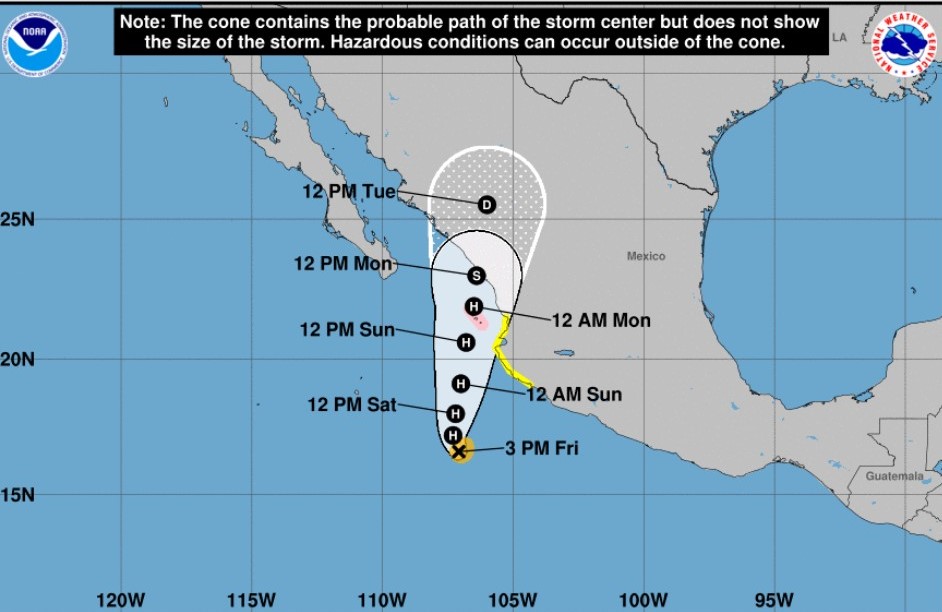
At the moment, unless you are captaining a ship in the Pacific off of the Mexican coast, that information may not be very interesting. But Orlene is not going to remain at sea forever. As you can see by the National Hurricane Center predictive map, between Sunday and Tuesday, Orelene will be having an impact on Mexico from about Puerto Vallarta to Mazatlan.

Even if it remains at category one strength, we learned here last year from Nora that even small hurricanes that present their right side to shore as they proceed up the coast can cause plenty of damage.

The prediction from Windy is that we will be spared the worst aspects of the storm. As it passes by us tomorrow, it will be well out to sea. What we will get is some thunderstorms, rain, and a few gusts.


My concern with Orlene is a bit more personal. I am supposed to board the Saturday afternoon Alaska flight to Los Angeles. Based on the predicted path, Orlene will be positioning itself between Manzanillo and Los Angeles just about the time the flight is supposed to arrive from Los Angeles -- and then leave.

Airlines are very reluctant to put their capital investment in danger by even getting in the proximity of winds that destructive. Twice last year, the flight was canceled on the day of departure because of hurricanes. Each time, they left the next day.

There is no way of predicting what is going to happen. Look at the odd path Ian took -- or Patricia in 2015.

The bright side is that if the flight is cancelled and we get sufficient rain here, I will discover if last week's earthquakes created any new cracks in the house.

It just goes to prove that when God closes a door, he often opens a water gate.
 

Monday, September 05, 2022

the torch passes


My mother, Marilyn Cotton died at noon today in a hospice facility.

Darrel, my brother, informed me of her death while I was waiting in Seattle for a flight to Redmond. It was not unexpected, but startling nonetheless. 

I am in Prineville now. Starting tomorrow, we will execute her burial wishes -- to be buried in Powers in a plot next to her first-born son, Craig.

But, for now, I wanted her friends and family to know that her soul has moved on into the presence of The Messiah, around whom she built her life.

When matters calm down, I will write more about her.

For now, we note her death.


Wednesday, August 31, 2022

a winner -- hands down


The question is not a new one.

People new to the area are often flummoxed at some Mexican custom or other. Noise for example. This question showed up on our local community Facebook page yesterday.

"Does anyone know why cannons are going off in Barra?"*

Of course, there are no cannons. The last cannons fired here involved pirates in the late 1500s. (The pirates won in a double-header.) What they are are the usual cohetes (the skyrockets that carry an M-80 wham). And the answer is always the same. A religious feast day is being celebrated.

This week's celebration is very special for Barra de Navidad because it celebrates divine intervention that saved the village from destruction. I am certain most of you know the story, but it is one that deserves re-telling.

The year was 1971. The night of 31 August-1 September to be exact.

A hurricane by the name of Lily was headed straight for Barra de Navidad. It was obvious the storm would demolish a good portion of the town if it maintained its projected path.

And Lily did maintain her path. She came ashore near Barra de Navidad with winds of up to 85 miles an hour.

With disaster on their doorstep, the residents of Barra did what came natural to people of faith, and for people who have suddenly discovered a faith they did not know they possessed. They congregated in the church -- and prayed. As the winds battered the walls, they sought deliverance from the storm. The sailors on Jonah's ship could not have prayed more fervently.

And then it happened. A miracle. A standard crucifix of Jesus on the cross stood above the altar. For no apparent reason, each of Christ's arms fell to his sides. And the storm abated.


It was like something out of the gospels. Mark 4:39 to be exact. "He got up, rebuked the wind and said to the waves, 'Quiet! Be still!' Then the wind died down and it was completely calm."

Ever since then, the congregants celebrate Jesus of the Cyclone (el Cristo del Ciclón) this time of year -- as a day of deliverance and remembrance.

As Ben Franklin once said in recounting a story about a fly reviving in a fifty-year old cask of Madeira, "Now, I do not know how scientific that tale is ... ." But it is an article of faith in these parts.

The story goes that the parishioners wanted to repair Jesus' miraculous shrug, but the priest informed them that God had caused the arms to drop and only God could restore them. The crucifix still stands in the church in its hands-down splendor.

This evening, the week's daily procession formed up on the main road into town. The guest of honor was carried ceremoniously to the church for evening mass.


A side note. After sparing Barra de Navidad, Hurricane Lily rumbled north like Attila the Hun to lay waste to Puerto Vallarta in the worst hurricane it had suffered in 20 years. Favors apparently have a limited jurisdiction.

So, that is why the non-cannons are sounding. To celebrate a miracle.

I talked to talk with Sara, a local realtor, who helps organize these affairs. She told me that Saturday will be a very special day -- involving the remnants of the cross that once stood in the shipyard that built the ships that left Barra e Navidad for The Philippines in 1564. As you might imagine, their is quite a tradition that has barnacled that small piece of wood.

Unfortunately, I will be flying north to Oregon on Saturday for my monthly check-in.

For those of you who are in town, I have been promised that this year's celebration will be something special.

Disfruta la fiesta. And look out for flying cannon balls.


* -- A friend from Alberta who lives here part-time refers to these questions as Canadrama -- closely related to their cousins Mexidrama and Ameridrama.


Monday, August 29, 2022

little orphan annie eyes


It had been some time since I played video poker on the Banamex ATM.

I usually get my pesos during work hours from the Intercam teller. But I recently found myself short of pesos on a Saturday night. The only option was to saunter down the street to Banamex and try my luck with one of its ATMs.

Too often, my card will not work or the machine does not have cash or it will charge my account and leave me as noteless as when I started my transaction.

I started with the machine on the left. It would not read my card. The next machine read my card, but was out of cash. Fortunately, the third machine turned out to be the Goldilocks option. It was just right.

Then it was my turn to be reduced to a cultural stereotype. I took a look at the notes the ATM had disgorged -- and my eyes rolled back so far there was nothing left but Little Orphan Annie whites.

You can see why for yourself.

Like most ATMs in the area, the Banamex machines regularly disgorge wads off 500-peso notes. There is nothing wrong with the notes -- other than the practical consideration. Merchants here have historically not been able to handle purchases with 500-peso notes. They do not keep that much change on hand. Often, it feels as if a wad off 500-peso notes is like having no money at all.

But what I received was even more daunting. 4000 pesos of my withdrawal were in an even more problematic denomination. 1000-peso notes.

This version of the 1000-peso note was issued in November 2020. I did not see the first one locally until almost a full year later, and I thought they would be as rare as ivory-billed woodpecker sightings in Manhattan.

I was wrong. They are now common issue from the Banamex ATM. I have no idea if the other ATMs in town are trying to save space by filling the bin with portraits of President Madero.

The appearance of the notes are a harbinger of another not-so-welcome phenomenon sweeping the country. Inflation.

For the past year, the cost-of-living has risen precipitously -- just as it has in other countries. At least, we in Mexico are not suffering as badly as the Turks or the Lebanese or the poor Venezuelans with their current 1198% rate. Compared with them, Mexico's official inflation rate of 8.15% is almost anemic.

But official rates do not always tell the real story. Food is a prime example. I have seen lists recently from local stores with incomes totting up 20% to 40% increases. Grocers verify those ranges. As do restaurant owners who have been forced to increase the price of their menu items. I seldom leave a local grocery store without leaving a full 1000-peso (or two) behind.

My neighbors tell me tales of despair of trying to stretch pay to cover increasing food costs. Because just like everywhere else, pay is not keeping up with the price increases.

I was talking with Antonio, the guy who keeps the sparkle in my pool, about the cost of food. As part of the conversation, he told me the chemicals that he supplies as part of his cleaning contract with me have shot higher than a cohete. Until he mentioned it, I had not even thought about how supply chain problems and cost increases had cut into his profit -- not to mention the cost of gasoline for his car.

The same goes for Dora, the magician who helps me clean my house. Both of them are feeling the pinch of local economics.

Wages here are a bit difficult for me. I come from a culture where workers will ask for a raise when they need one or feel that they deserve one. That is not the Mexican culture. Neither Dora nor Antonio have ever asked me to increase their wages. Over the years, I usually increase their rate of pay around the New Year. 

I decided not to wait. I cannot control inflation (and the Mexican government does not appear to have a comprehensive plan to do so nationally), but I do control the purse strings of the microeconomy of The House With No Name.

So, I have increased the wages of Dora and Antonio in an attempt to help them meet current cost-of-living challenges.

Sometimes, every little bit helps.

And it gives me somewhere wortwhile to spend those 1000-peso notes.  

Monday, July 18, 2022

it takes a pillage

The scene is inevitable.

In every murder mystery, the detective will assemble the cast -- usually in the parlor -- to reveal the who in the whodunit. Or, even more cleverly, as in The Last of Sheila, arranging them by name.

And, so it has been this season. The suspects blew in alphabetically: Agatha, Blas, Celia, Bonnie, Darby, Estelle.

Of course, those names are not the cast in a local Agatha Christie Revival. They are the string of hurricanes (and one tropical storm) that have slipped past Barra de Navidad this season.

From June to October, there seems to be at least one new storm being born in the Pacific off the coast of Central America. Most do not amount to much. They burn out in the formation stage. Even those that make it to hurricane or tropical storm status stay far enough out in the Pacific that we see only their tertiary effects. High waves. Some rain. Usually, not more than that.

However, if the pressure areas along the cyclone's path are just so (as Rudyard Kipling would say), we do get to feel one of Nature's shows of strength at its rawest. Last year's Hurricane Nora is a perfect example. A mere category one hurricane that, because of its path, caused a surprising amount of damage.

At the start of hurricane season, the National Oceanic and Atmospheric Administration (NOAA) predicts whether each region's hurricane season will be below or above average. The Atlantic received the bad news of an "above-normal" season. The Eastern Pacific (our region) the seemingly-better label of "below-normal:" 10-17 named storms, 4-8 hurricanes, 0-3 major hurricanes.

Mother Nature has an impish sense of humor. The bytes in the NOAA press release were still damp when something unusual happened in the Eastern Pacific. Hurricane Agatha struck. And she was unfashionably early. Not waiting for the season to begin in June, Agatha arrived in May -- earning herself the title as "the strongest hurricane on record to make landfall in May in the eastern Pacific."

For added novelty, the cyclone had formed in the Pacific and then crossed over into the Caribbean.

This may be the season for trans-storms. First there was Agatha. You may have noticed in the alphabetical list of hurricanes and storms that have already paraded past us, there seems to be a mistake. 
Agatha, Blas, Celia, Bonnie, Darby, Estelle. What is that extra "B" doing in the mix?

Bonnie was another exchange storm. But, she started in the Caribbean and then slipped across the isthmus into the Pacific before waltzing harmlessly past us completely oblivious to the fact that she was out-of-step with the other chorines and chorus boys. 

It is an odd year. I do not know what to make of NOAA's low-count prediction. The estimate was for 4 to 8 hurricanes. We have already had five (counting runaway Bonnie), and we are only six weeks into the hurricane season.

Fortunately, for our area, the effects have been minimal. Except for the fishers. The wave activity has played havoc with the local industry.

I enjoy the summers here. The heat. The humidity. Nature's power in storms -- especially, the thunder and the lightning. Surviving summers here is a reminder of how survival itself can be an adrenalin rush.

But weather is always a topic that draws me back to the keyboard -- when I can find a break in my walking routine. I will let you judge whether that is a good thing.

Tuesday, July 12, 2022

sleeping with the fishes?


That, among other queries, has come my way the past two months. Wondering about my unprecedented (and unexplained absence) from these pages.

It is a fair question. My last post was on 21 May when I pondered the mysterious lizard that had taken up residence in my kitchen. Since then, Mexpatriate has ceased to echo the pace of my life. 

But the fish have jolted me out of my reverie.

This afternoon I started a quick walk to the local Oxxo when I paused to pick up the trash and detritus that daily accumulates in the street in front of my house. Most of it is refuse that the guys on the garbage truck drop while toting off the neighborhood rubbish.

Amongst the styrofoam cups, potato chip wrappers, and dirty diapers was a small fish. It could not have been there long because it showed no signs of rot in the sun. Why, I asked myself, would one small fish be in the middle of the street on a Tuesday afternoon? Apparently, I had no answer because I didn't.

Well, it was not one. I soon saw another. Then three more. And five. Between my house and the house next door, there were thirty-one lost piscine souls resting eternally.

I have a friend who grew up in Brooklyn in the 1940s who believes that every odd thing discovered in a neighborhood is a message from the Mafia. I know exactly what he would have thought of the fish in the street. Fair warning. Of what? Well, something. And it could not be good.

Having turned in my aluminum foil hats some time ago, I tend to default to the analysis that Sigmund Freud famously did not say: "Sometimes a cigar is just a cigar." I sleep a lot better that way.

Who knows why the fish are there? Most likely a fisher had caught them at the beach, stuffed them in a bag, and, while walking or riding down my street,the bag decided to do its impression of Hansel in the forest.

But they were excuse enough for me to break into my walking schedule to write you a brief note to say the world goes on.

And, should I find another open period, I will probably share a bit more of what has been happening during the past five months.

For now, I am going to enjoy something the unschooled fish no longer can -- I am going to relish the gift of another day.   

Saturday, May 21, 2022

my lizard in hand


I say I live alone in Mexico.

I don't. There is always some new sentient creature seeking shelter at the inn.

When I returned home earlier this week my month-long sojourn, I discovered a new roommate living in my kitchen. Rather, living on the screen door in the kitchen.

The screens must hold some fascination for lizards because all sorts of varieties like to roost there. Iguanas. Mexican spiny-tailed lizards (often misidentified as black iguanas). Alligator lizards. Geckos.

Maybe they like the bit of breeze that manages to find its way into my patio. Though, I doubt that. As cold-blooded reptiles, they would normally be drawn by sunlight. But not in the house. They set their screens in the shade.

My theory is the lizards hang out on the screens for the same reason the geckos gather around the patio lights at night. It is a great place to hunt. Like a watering hole in the Serengeti. Kitchens tend to draw flies who also rest on the screen doors. Dinner on the wing.

That, of course, is all speculation. I am not privy to the wiles of the mini-Jurassic Park that surrounds me. Nor do I have any idea what type of lizard it is. Do you?

In silhouette, it could easily be confused with an iguana -- with those Sigourney Weaver-snatching claws. But as soon as it fell to the floor with the same sound a package of chitlins makes when it accidentally tumble to the kitchen floor, its iguana disguise was dropped.


With those brown spines, it almost looks like a cousin to a horned toad. Well, a horned toad that has spent a couple of months on a keto diet.

Matters became a bit more complicated when I caught sight of the other side of the lizard while he was once again pretending to be invisible on the screen door. He looks as if his mama could have been a lazuli bunting.


For the past week, the lizard and I have been living a peaceful coexistence. I have left the screen door open to let him escape to the brave new world outside of the kitchen. He is having none of it. Like a squatter evading his lease obligations, he hunkers down in what he now sees as his new home.

Dora is aware he is in the kitchen. But twice, while she has been cleaning the sills above the door, he has surprised her. This morning she nearly fell off of her ladder when she ran her hand over him.

So, in the kitchen he will stay. Probably until he shrivels up from a dearth of flies. I left out some lettuce and meat. He showed no interest. But I did manage to attract a long line of ants. He showed less gourmet interest in the ants than he did in the lettuce.

Now, I just need to remember to turn on the light in the night to avoid my toes turning him into lizard marmalade.

Wednesday, May 18, 2022

shooting the moon


The event had more titles than María del Rosario Cayetana Fitz-James Stuart y Silva.

"Super." "Flower." "Blood." And the Duchess of Alba equivalent -- "Super Moon."

It was all part of the hype that greeted Sunday night/Monday morning's total lunar eclipse. I use "hype" advisedly because I was every bit as gaga as everyone else who sat up lawn chairs to watch one of nature's most mysterious performances.

Being an amateur astronomer, I try not to miss any of these events. Comets. Planet alignments. Exploding novas. Though I am far more likely to see a 1979 Chevy aflame before I get to see a star perform a full Monty.

I knew exactly how to take full advantage of this lunar eclipse. I pulled my writing table and chair to the west side of the upper terrace. That would give me full range of fire from the moment the moon came over the horizon. My good camera and its telescope lenses were next. I set up the camera for a night shoot, and dug out my best pair of binoculars. Then I connected my laptop to the internet. I was fully-prepared to document every second of the evening.

About two months ago, I was listening to National Public Radio (what a leftist friend calls "Nazi People's Radio") on my ear buds while walking just outside Barra. The newsreader had just been exercising her particular brand of bias and bigotry when the tone of the broadcast made a sharp turn into something interesting.

She started interviewing a woman whose thesis was that, even though she was an advocate of technology, some recent inventions have isolated us from the natural world. Radio, for instance. Rather than being outside enjoying the daily sounds of life, we prefer to have a stranger read the newspaper to us. It was a good point.

Then the newsreader slathered on her own irony. She suggested that listeners turn off their radios or remove their earbuds (in my case) and indulge in the surrounding sounds. I did.

I cannot say what I heard was better than Bach, but it was better than NPR. Traffic noise. The shuffle of my shoes against the pavement. Birds. Children screaming and laughing. Music throbbing from the fitness center. It was life. The life I chose for myself as an immigrant to Mexico.

I thought of that little experiment as I reached for my camera on Sunday night just as the shadow of the moon started crossing the southwest corner of the moon. My intention had been to shoot each stage of the eclipse. Until I heard a little voice ask: "Why?"

I did not have an answer. The purpose of my tiny scientific station was not to memorialize the moment in photographs but to enjoy it as it was happening. And so I did. I sat and watched as the Earth's shadow slowly engulfed the moon turning it into the type of red that has fed the apocalyptic imagination of people the world over for millennia. 

For almost an hour, what had started as a full moon lighting my patio had turned into a shadowy presence. Until the shadow moved on and the moon revealed its true self bit by bit. Earning each of the titles it would bear Monday morning in newspaper stories. 

Super Flower Blood Moon of May 2022. And that could very well be the name of the substitute Sean Penn sends to next year's Academy Awards.

You may already have concluded that I did not pick up my camera during the evening. I was too busy being one with the night. Well, not really. I did use my binoculars -- a lot. And I knew that one of you would be doing a good job at the heavy lifting of astronomy photography.

And I was correct. I can always count on Vern Gazvoda to bring his camera to the party. He did.

With his permission, I share one of his shots. It is a great way to see what we all saw here on the Pacifc coast of Mexico.

Of course, seeing it in person was even better. Now, I will save my camera for my trip to South Africa.
 

Tuesday, May 03, 2022

sign here


I empathize with people who compose signs. Whatever they do, some fellow who thinks he is the next Quintin Crisp will come along to ferret out a bit of wit from the quotidian.

Today, that fellow is me.

Here is a sample from my meanderings of the last two months.

Bathrooms provide a wealth of writing material. Take the photograph ar the top. The sign is from a bathroom on the Explorer of the Seas (where I now am -- somewhere in the southern Caribbean.) Looking at the sign, I was tempted to stand around and wait. It looked like an exciting place.

I attribute that odd behavior to too many Buster Keaton films during my misspent youth.

But it was nowhere as interesting as the list of instructions on the mirror in the men's bathroom at the Georgetown, Grand Cayman cruise terminal. In very official bright red. 


And it just got better. I can only imagine that people who wash their feet in face basins may be a bit confused about how to use this odd toilet -- though they know it must be flushed.


Someone may have had a similar idea when they editorialized this pedestrian sign in the Yucatán village of Chichimila.


I will let the rest of you take this Rorschach test. I call it "Dolly Parton meets Me Too."


She apparently has a companion figure who works on the ferry at Playa del Carmen.


Directional signs are almost always a good source for mixed messages -- as is that sentence. This one in Puerto Vallarta puts the following information on equal footing: showing me the way home, diverting me to Old Town, or helping me find a realtor I had no idea I needed. The Eurasian collared dove appears to be equally confused.


The best signs are where the poster has done all the heavy lifting for me. Some fellow in 
Mérida has posted that he will glady offer a free service to anyone parking in front of his garage -- tire punctures.


This sign did not strike me as being a wit mine as it was surprising. I guess if cryptocurrencies exist, ATMs for the medium will be needed, as well. The juxtaposition of the jewelry store with Bitcoin made it that more fascinating to me. I always imagine that bitcoiners are also gold bugs.


When we were in Valladolid, the three of us drove past this house several times. I finally asked Dan to stop. There has to be an interesting story to go along with the wall. I did not inquire within, so I am free to take it from there.

This one I have saved for last because I see it on every trip to Prineville. It is so old and worn that it is hard to read, but it is displayed on the ice cream case of the Tastee Treet. Like everyone else, I tap the glass and watch the ice cream scurry about. And I always laugh.


I hope you do, as well.


Sunday, May 01, 2022

what's love got to do with it?


Prince Charles is Tina Turner. Or, at least he has done a credible impersonation.

In 1981, when The Prince of Wales and The Soon-to-be-and-then-not-to-be Princess of Wales consented to an interview about their engagement, the interviewer asked if they were in love. The Jug-eared (and apparently, ham-fisted) Wonder answered: "Whatever 'in love' means." Indeed. He may as well have asked the interviewer: What's love got to do with it?

British playwright Alan Bennett may have hit a dramatic home run in The Madness of King George when he gave Charles Fox a sentiment I share: "If a bunch of ramshackle colonists can tell him [the king] to go, why can't we?"

But, even this card-carrying republican can appreciate the princely sentiment. "Whatever 'in love' means."

A couple of weeks ago, our local pastor spoke to us about that elusive word -- love. How all other Christian virtues are based on that one word.

I found the sermon challenging. Not because the concept was new to me and not because I disagreed with anything my pastor said. Theologically, I agreed with every word.

The challenge for me is that that the meaning of the word is as elusive to me as it apparently is to the hapless prince and the lion-maned singer. We are three souls in search of meaning.

Sure, I have spent the last seven decades reading and hearing about love. Poems. Novels. Philosophical treatises. Movies. Some of the world's greatest literature centers on the concept. Where would Jane Austen and Fyodor Dostoevsky have been if they did not have love to bounce along with?

A few days after the sermon, I had dinner with my pastor, Al, and his wife, Sue. While we were discussing Sunday's sermon, I confessed a deep dark secret. Or, at least, one I do not talk about readily.

And, as Kurt Vonnegut might write, here is that deep dark secret. I cannot remember telling anyone that I loved them. Nor can can I remember anyone telling me they loved me. That I could believe.

We batted the topic back and forth -- readily conceding that, as in most discussions, we simply might be using words without an agreed-upon defintion. I am superlative-adverse. That may be part of the problem.

Here is the real dillema for me. To paraphrase my favorite Supreme Court justice, Potter Stewart: Perhaps I could never succeed in intelligibly [defining it]. But I know it when I see it. And I am daily surrounded by acts of love.

In his sermon, Al pointed us to Paul's utilitarian definition in 1 Corinthians 13:4-8:
Love is patient and kind, not jealous, not boastful,
not proud, rude or selfish, not easily angered, and it keeps no record of wrongs.
Love does not gloat over other people’s sins, but takes its delight in the truth.
Love always bears up, always trusts, always hopes, always endures.
Love never ends.  
"Love keeps no records of wrongs." That phrase seemed to sum up for me the very essence of "love." Reading it was an epiphany. At least, I felt I was learning to hold on the edges of love like Pauline dangling from a cliff. 

Or so I thought. 

As I was drafting this essay on an airplane over a month ago on my way to the Yucatán peninsula, I turned in my notebook to what I thought was the next blank page. Instead, of a blank page, I discovered the words you see in the photograph at the top of this essay.

The sight was physically wrenching. Startling. A stranger cared enough to say they loved me.

At first, I had no idea who would be so kind. I simply reveled in the thought. A meaningful thought.

As I sat there looking at my notebook, the mystery solved itself. I had left my notebook sitting on the table when I went to tend to billing matters at the restaurant. My pastor's wife was the source of the gift.

A true note of Christian love in action.

In the opening monolog of Torch Song Trilogy, Harvey Fierstein, as Arnold Beckoff, gives us his pithy insights on love.
And not once has someone said, "Arnold, I love you."

-- That I could believe.

And I ask myself, "Do you really care?"

You know, the only honest answer I can give myself is "yes."

I care.

I care a great deal.

-- But not enough.
For those of us who have struggled with the nature of love, we fully understand those conflicting phrases. "Yes. We care."

"But not enough."

As a result of Sue's gesture, I am not so certain that I can say that any more.

Friday, April 08, 2022

a tale of six cities


There are many faces of Mexico.

When I told friends I was on my way to the Yucatán Peninsula, the response was predictable. And varied.

"You will love it. We spent five days at an all-inclusive in Cancun. It was one of the best weeks of our lives."

"There is no better place to see authentic Mexico. How the Maya lived -- and how they live today. With the exception of Guatemala. It is more authentic."

"Don't miss Mérida. It is true Mexico. Its colonial and pre-Revolution architecture make it the 'Paris of the Yucatán.'"

And, you know what? They were all correct.

The debate (carried on mainly by people not born in Mexico) about what is truly "authentic" in Mexico amuses me because it says more about the prejudices of the participants than it does about Mexico.

There are many Mexicos. And each is as authentic as the last -- for one simple reason. Each place exists. And it is in Mexico.

So, here is a brief summary of the cities and towns Dan, Patti, and I visited during our expedition on The Peninsula. Each place is worthy of its own essay, but we will leave the details for the comments section.

Valladolid 


I already gave you a taste of our base camp in Valladolid for this trip in on the back of the snake. That was an essay about how modern Mexico reflects its past.

And Valladolid has quite a past. When the Spanish arrived in 1543, there was a Maya settlement, Saki, where Valladolid is now built. The Spanish used the stones of Saki to build their new city atop the ruins of the Maya town. Urban renewal by conquest.

The Maya did not appreciate being a conquered people. They rose in revolt in 1546 and 1705, and then havoc broke out in 1847 with the Caste War when the white and mestizo settlers abandoned the city in flight to Merida. The Maya killed half of the escapees in an ambush. That war continued until 1915 when the British agreed to stop arming the Maya -- all in a dispute over the oddly-named British Honduras.


That tension is reflected in the city's architecture. Churches on The Peninsula often look like fortresses. For good reason. In times of revolt, the churches served as arks. As refuges.

Even this tiny chapel looks more fortress than place of contemplation.


This was my third visit to Valladolid. In the past, I went there as do most tourists -- to use it as a base to visit the surrounding Maya ruins. But this time, I had the luxury of time to see the city for what it is. A destination in its own right.

It does not have the beautiful architecture of Mérida. But it does have a colonial core built around a town square that is as attractive as any other city of its size. It also has a certain air of contemporary quirkiness.


One of its more interesting attractions is Casa de los Venados, a grand home restored by an American couple, John and Dorianne Venator. They filled the house with Mexican art. Each of the rooms is based on a regional theme and decorated accordingly.

One of my favorite rooms was the formal dining room with faces of noted Mexican personalities painted on the backs of the chairs. It may be the only time that Porfirio Diaz, Miguel Hidalgo, and Cantinflas dined together.


Mérida


Mérida was familiar to the three of us, On my prior two visits to The Peninsula, I spent most of my time there. A few years ago, Dan and Patti auditioned The Peninsula as a possible retirement spot. They lived on the Gulf coast just north of 
Mérida.

Our visit to 
Mérida was brief. Our Valladolid hostess had a medical appointment there. So, we drove her to the city and decided to take a brief walkabout in what is one of the nice colonial restorations in Mexico.

That was the culture part of the trip. What we mainly did was eat an early lunch (or late breakfast) at one of the city's more famous restaurants: La Chaya Maya.


Everything I have eaten there in the past has been good. This time was no different. For the sake of irony, I chose lomitos de Valladolid -- a pork dish cooked in a tomato sauce that is a specialty in Valladolid.


Izamal

By reputation, Izamal was not new to me. But I had never visited. The city is renowned for its colonial architecture painted a bright yellow. The choice is stunning.

We came for two reasons. The first was Dan and Patti wanted to introduce me to this special part of The Peninsula. The second was for lunch.

Driving a total of four hours to eat lunch raises expectations. And they were met. The most famous restaurant in town is Kinich -- known for its regional Maya cuisine. My choice was poc chuch.


You may wonder why I tend to choose pork dishes on my taste tests. The answer is simple. Mexico's pork is some of the finest I have ever tasted.

MANI


We had an additional special stop on our trip to the ruins at Mayapan (finding my inner maya). Mexico has a program to honor and protect some of its heritage sites -- Pueblos Magicos. Magic towns. There are 132 of them strewn throughout the country.

The sardonic see them as a clever mechanism to lure tourists where they would not usually tread. And it works. The three of us were lured to the interesting little town of Mani because of its Magic Town designation.

The big draw is the church -- Iglesia de San Miguel Arcangel. I visited it twelve years ago. Like other churches on The Peninsula, it was periodically used as a place of refuge during Maya uprisings.

San Felipe


If I ever complete this series, I will tell you about our flamingo journey. On our way there, we stopped at the small fishing village of San Felipe to investigate the available boat trips.

We did not take one, but I was re-introduced to an interesting aspect of culture on The Peninsula. Geography makes The Peninsula a world apart from the rest of Mexico. Because of swamps, distance, and other obstructions, the area was effectively isolated. The first railroad and highway linking The Peninsula to the rest of Mexico were not built until the 1950s and 1960s respectively. Before that, commercial links were by sea.

As a result The Peninsula was linked closer with the Caribbean and New Orleans than with Mexico. That is why San Felipe has a distinct Caribbean look in its architecture.

Cozumel


My experience with Cozumel prior to this trip was as a cruise ship passenger. As a result, I saw it as a place for snorkeling and rinsing sand out of my swim suit.

Dan and Patti showed me it is far more than that. They ran a business and lived there long enough to establish an extensive commercial and personal network with people on the island. We have already discussed those contacts briefly in 
on the back of the snake.

What I once saw only as a tourist haven, I now see as a place that people call home. Much as people in Barra de Navidad see its touristy surface, while others see it as a place where they live and live nowhere else.

That thought came to me in an odd disguise while Dan and I were walking through the market where residents do their daily shopping. One of the small restaurants caught my attention. An Indonesian-Philippines eatery tucked in amongst the butcher and fish shops.


It was not there to feed tourists. Though I suspect some tourists might seek it out. It was there for cruise ship crew members looking for food from their homeland. Local and international folded into one big murtabak.

Is a murtabak folded and served in Cozumel authentically Mexican? Why not, we think of tacos al pastor as being "authentically" Mexican when they are simply a Lebanese 
shawarma tarted up with local ingredients.

That was the hook of this essay. What is authentically Mexican? The question, of course, is a tautology. If it is in Mexico, it has become Mexican. And it is authentic.

Like the pelicans of San Felipe. The Valladolid cuisine served in 
Mérida. The back streets of Cozumel with their pun-ridden restaurants. The helpful policeman in Mani handing out business cards to tourists. The Izamal shops selling foreign goods as local. Even the high-rise hotels of Cancun that suck in foreign hard currency and employ thousands of Mexicans.

Part of me wishes I had made the trip to Ukraine that this trek supplanted. But, at the end, Dan and Patty offered me two weeks of joy in a place that I will always enjoy visiting. 
       

Note -- The next (and perhaps last) installment of this series will be about wildlife on the peninsula. Or, at least, a specific type of wildlife. While going through my photographs of this trip, I realized I have some shots that I would like to share with you. If I have time (and due to family circumstances, that looks less likely), I will post them after the next installment.  Without comment. From me.