Monday, August 27, 2018

indiana steve and the hidden dome


If you want to shoot architecture photographs, San Miguel is a target rich environment.

Due to its near-death experience, the city has some of the best-preserved colonial architecture in Mexico. Most of it is simple to photograph. Stand back. Frame. Focus. Shoot.

But, because the buildings were not designed with photographers in mind, some are difficult to get just right. Cramped streets. Crowds. Odd angles.

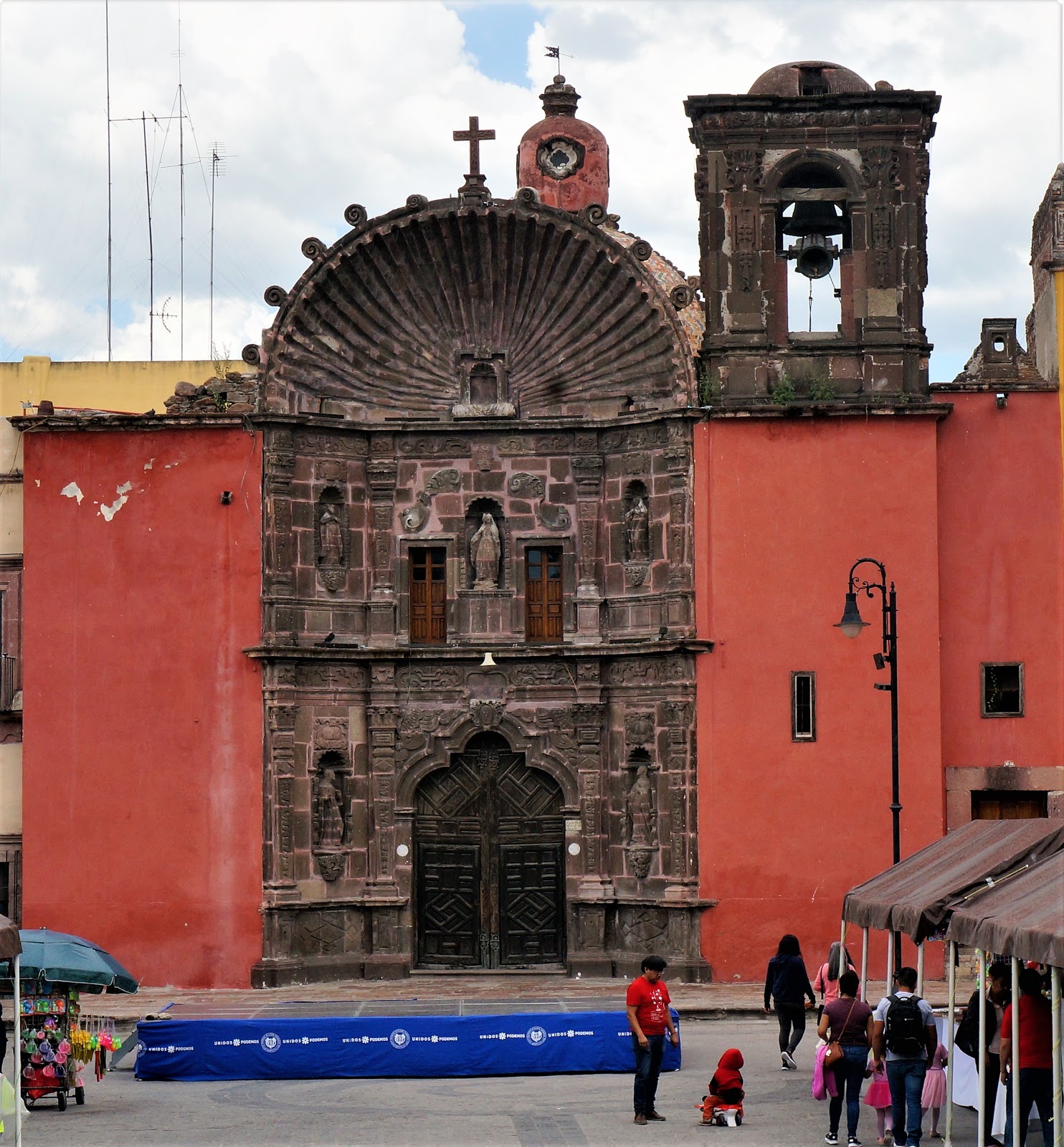
And then there is the grand prize of them all. The dome of the Templo del Oratorio de San Felipe Neri. Built in 1712, it is one of my favorite baroque churches in town. Probably, because it retains enough simplicity without giving in to the excesses of the Churrigueresque. The scallop shell facade gives the church an almost fantastical aura.

It is not the church that is hard to photograph, though; it is its dome. If you stand in a specific spot to the right of the church, you can catch the glimpse of color between the facade and the short bell tower. But, no matter where you stand in front of the church, you cannot see the full dome.


During past visits, I have wandered all around the surrounding blocks to find a good vantage point. And I had yet to find a place where I could see the dome's artistry.

I can see the dome when I walk down the street from Barbara's casita on the hill. But it is too far away and there is too much clutter to really appreciate it.


On this visit, I walked around the streets behind the church in vain. And I even walked into private spaces (a hotel) to see if I could catch a glimpse of the dome. I couldn't. (Barbara tells me that the dome is visible from the balcony of the hotel, but I did not feel comfortable climbing around on balconies in a place where I was paying no tariff.)

I had just about given up hope. Until yesterday. For some reason, while walking beside the much larger San Francisco church, I looked up. Usually, the space is filled with tourists trying to board trams, and my attention is directed toward wending my way through the crowd.

Not yesterday. The space was free of people. When I looked up, there it was. The dome I had been searching to photograph for years. Visible from a spot on a street I have walked hundreds of times.


As you can see, it was worth the wait. The colors. The design. Something about the combination makes me want to laugh and sigh.

Why is it so hidden? I suspect it is just bad planning on building placement.

Or maybe, since the church was built to glorify God, the architect had no concern whether we saw it or not. It was built for Him.


And that truly is beyond my pay grade.

Sunday, August 26, 2018

the priest and the altar boy


That is what my wag friend calls the statue in front of San Miguel de Allende's La Parroquia de San Miguel Arcángel church.

The statue honors San Miguel's first priest, Fray Juan de San Miguel, for his work evangelizing amongst the Otomí and Chichimeca tribes. It portrays him standing above an Indian who appears to be a supplicant with his hand raised.

Historical statues bear a heavy burden. They are created in one time to reflect a certain view of history. But, when viewed solely through anachronistic eyes of a later time, the original intent often goes missing.

Fray Juan's statue reminded me of the current dispute over a statue in San Francisco that is being removed, or, by now, may be gone. It depicts an Indian man sitting at the feet of a Catholic friar. A Spanish vacaro peers off into the distance -- as if wondering just when his turn will come to be erased from history.

Critics have labelled it with terms you would expect. Racist. Promotes genocide.  Disrespectful. Promotes human subjugation. The only slur missing is that it is a rather bad piece of art. But art criticism is not the point.

No one seems to be bothered one bit that the scene symbolically depicts not only an historical truth (that European settlers did defeat and subjugate the Indians), but an attitude that existed in the 19th century when the statue was cast.

I have always felt a bit queasy about statues depicting the tragedy of the American Indian. When I was young and we watched westerns that displayed interactions with Indians, my mother would express her indignation of how the Indians were treated.

So, I have some rather mixed feelings about the existence of the statues and their removal. The statues make me uncomfortable. But, trying to erase history bothers me just as much.

Let me be up front on the history issue. When it comes to destroying culture, we are all hypocrites -- or, at least, contradictory. That is certainly true of me.

When people raise the history defense, there are certain examples that are trotted out. Stalin airbrushing opponents out of photographs. The Taliban blowing up the Buddhas of Bamiyan. Islamic State destroying the treasures of Palmyra.

The reactions to those travesties were appropriate. Barbaric. A crime against culture. Abominable. An act of terrorism against all humanity.

But, we all seem to pick our favorite villains, whose cultural artifacts deserve no special protection. When the Soviet Union fell, and the captive nations were freed, one of the first targets were the statues of Stalin, Lenin, and Mark that stood rigidly in parks and squares. Down they came, along with their ideology, to be dumped into the dustbin of history.

I did not raise a peep. Instead, I was cheering on a people, who had lived in the darkness of tyranny and were now taking revenge on the ideology that had enslaved them in a system that was the moral equivalent of National Socialism.

At times, I wonder if we would be better off labeling statues we find offensive through post-modern eyes to promote some thought about our own feelings of otherwise objectionable art objects in public places. Of course, that takes all the adrenalin out of moral indignation.

And what about that statue of 
Fray Juan de San Miguel? Doesn't anyone object to it?
It turns out that they have. I learned on a walking tour that there was a movement to remove the statue in the 1960s -- for some of the same reasons the San Francisco statue came under attack. But, Mexico seems to have a kinder and gentler way of dealing with these issues.

Someone from the church pointed out the Indian is not in a conquered position beneath the priest. He has come as a supplicant. To be baptized by God's representative. The shell in the Fray Juan's hand is a baptism tool. The priest uses it to pour water.

With that explanation, the controversy went away. The Indian is still in an obviously inferior position. Even though it is legally a secular country, the majority of Mexicans are Catholic. And, even though the statue clearly takes the conservative side of the conservative-liberal division that has split the country since before Independence, it still stands in the square.

I am always amazed how Mexicans can spin a potential controversy into a consensus myth.

Unlike San Francisco, which will crate up its uncomfortable bit of history, Mexico lives with its own in the light of day. I suspect very few people who view the priest see any racial or religious significance in the piece. It is simply an interesting backdrop for the next selfie.

And maybe that is a healthier approach than trying to re-write history.


Friday, August 24, 2018

tending the garden


I am on a walking kick.

In an attempt to gain a modicum of control over my health, I have altered my diet. Nothing fancy.  I have simply followed the advice doctors often give patients. Your plate should be half vegetables (raw or cooked, salad), one-quarter starch, one-quarter protein (chicken, lean pork, fish).

But, for me, a change in my diet is not enough. I need exercise. And my exercise of choice is walking, as most of you already know.

I do not use my car much in San Miguel de Allende. The traffic is too horrendous. So, I get a lot of steps just touring around town on foot.


But, not enough. I supplement my tourist steps with a daily walk at San Miguel's small shopping mall. Including the perimeter of the parking lot, I walk a mile each lap.

Today, I changed my venue. Going in circles around a mall can be extremely boring. Especially, when there is a much better alternative.

And it is El Charco del Ingenio. The local botanical garden. It has miles of trails through one of the prettiest semi-arid gardens I have ever visited.

The down side of trying to get exercise in such an attractive place is fighting the temptation of stopping to enjoy everything, which would only defeat the purpose of a sustained walk.

So, I did, as I so often do in life, compromise. The first five miles, I walked as if i was meeting Harry Truman's stride. The second time around, I stopped to smell the cactus.

There are plenty of species here. Some are local. Some are rare and were rescued from their original homes.


San Miguel de Allende sits on the edge of a great desert. But it does not have a desert climate. I am visiting in its rainy season. It rains at 4 PM almost every day.

Those rains will soon cause all of the fields around here to bloom with flowers in a week or so. Mostly cosmos of various colors.

Today, the blooming flowers were just budding up for their pageant. I thought a little Georgia O'Keefe might warm up my prose


But the cactus were in their high reproductive season.
Every time I see a prickly pear in full fruit, it reminds me of Christmas. Or Mexico. Or maybe Christmas in Mexico. The fruit provide food for a wide variety of wildlife in the garden. Including ants.


The gardens stretch over a large variety of ecosystems. The main part of the garden is a plain on a mesa. But there is also a reservoir that once provided water and electricity to a fabric mill at the base of the canyon.


And then there is the canyon itself that is mainly dry at the moment. But it was roaring with overflow water earlier in the summer.


There is also a plaza that honors the traditional myths of the people who were here before Columbus showed up with his Spanish friends. This may look like a Christian cross.


 It is and it isn't. When the Indians were forced into changing religions, they managed to drag a lot of their pagan symbols into Catholic iconography. The cross and that big "X" are but two examples.

It is impossible to spend much time in a garden this large without getting a bit philosophical. There is a large section of agave in the garden -- including some that Felipe battles every year.


They come in all shapes and sizes. But almost all of them will periodically shoot up a huge chandelier of flowers . The stalk appears almost overnight and attracts birds, bees, and bats to pollinate the next generation of agave.


And, for some species, that act of reproduction will be its last contribution to its race. The plant blooms -- and dies.


I have yet to meet a gardener who does not have a realistic sense of both life and death. To have one is to do the other.

All pf my concern about my diet and my exercise was put into context this morning. It is important to live wisely. But, whether or not we eat that pizza or miss a few days of exercise, we are still going to die.

But, until that happens, there are gardens to enjoy -- as a realist. Because in every garden, there is a serpent. 


Thursday, August 23, 2018

lady in red


It is not a sight you see every day in San Miguel de Allende.


And never in Melaque.


Blonde. Lithe. Tall. In a tight red shift. Pink handbag. Pink scarf.


As she walked down the hill toward me, the sun lit her as if she were on stage. And she was. The eyes of every Mexican man on the street followed her every sway.


I was so entranced, I just watched her. It was not until she had turned a corner to walk up toward the
jardin that I remembered I had two cameras with me. I spun the dials on my Sony and brought it up to shoot just as she darted into a boutique.

I am a patient hunter. I skulked in the street for 3 minutes. 5 minutes. 10.

I could see her in the shop. How many necklaces and scarves can one person possibly fondle?

While I waited, my attention was diverted by a street musician playing an accordion. Primarily French tunes. Lots of Edith Piaf.


For a moment, his music transported me to Aix-en-Provence. The year was 2011. My friends Roy and Nancy were with me on a cruise, and we had stopped in town for just one day.

While Nancy was shopping, Roy and I were left to kick our heels. To put my time to better use, I started shooting character sketches.

Then I saw what would be the quintessential French portrait -- a beautiful, young woman dressed as if she was on her way to a chic 
soirée. I tagged along behind her trying to take surreptitious shots.

She strode into a party supply shop and stopped in front of the greeting card rack. I slunk around the corner to shoot a profile. At least, I thought that was how the story was going to end. She had a different ending in mind.

As I poked my head around the corner, she ambushed me with a decent bash from her handbag. I duly retreated.

Reverie is not a hunter's ally. While musing on France, The Lady in Red sashayed across the street to a dress shop, and disappeared somewhere in its fabriced bowels.

Having failed to bag a photograph for you, I went to lunch at Nicosia -- an experience you will hear more about. Later.

Something good came of all this, though. I was spared the ignominy of being handbagged on the streets of San Miguel de Allende.

But, I did not leave empty-handed. Let me introduce you to my unindicted co-conspirator -- The Accordion Man.


And, if you are so inclined, here is Edith Piaf singing one of my favorite songs. Of course, he played it.


Wednesday, August 22, 2018

when post cards ruled the earth


I admit it. I am often a conundrum.

I claim to be a modernist who favors almost all change. And then I start telling you about my love of poetry.

Poetry, of course, is not the problem. Lots of readers are fond of the art form that finds its core in condensed form.

It is the form in which I read it that outs me as a retroist -- if not an anachronism.

I like my poetry in a hard-bound book. It is not nostalgia that drives this preference. Poems simply work better on a printed page. The look of a poem is second only to the words it contains.

There is nothing new about that reality. But I thought of it afresh today while reading another section of Ted Kooser's Kindest Regards.

I turned the page to discover something I have not seen for a long time. A post card from the publisher. Asking me for my opinion on the book. The card is written in that unctuous publisher jargon that leads the reader to believe the publishing house really cares about what the reader thinks.

So, I will take out my fountain pen and write a few kind words. Even though the postage is prepaid, that will not work in Mexico. So, I will purchase a stamp and return the card to the good folks at Copper Canyon Press in Port Townsend, Washington. Thea fact that the publisher is small enough to be located in a town I know is incentive enough for me to take care in how I complete the card.

And, I will. Anyone kind enough to go to the trouble of including the card in my book deserves a response.

That whole process strikes me as being from a different era. When poetry was more widely-read and discussed and publishers cared about the works they provided to their readers. I am not certain it was a slower time. But we certainly seemed to take our time doing things precisely before moving on to the next.

What surprise me about the card was that it was there. I suspect I would not have even given a second thought if a similar card had appeared in my Spanish version of Jorge Castañeda's Mañana Forever? It didn't. But Mexico still has the pace of life that the postcard in my book symbolizes.

And that is just another reason, I enjoy living here. Whether I am an anachronism or not.


Tuesday, August 21, 2018

going mobil


For a moment, I thought I was in Duluth or Des Moines.

It was not the man who wears the star. But right there in the middle of San Miguel de Allende was a Mobil gas station. Sans Pegasus. But it was still a Mobil station, prepared to join the state-owned PEMEX in competition -- and, in the process, to possibly reform one of Mexico's most corrupt institutions.

I knew that NAFTA had opened the possibility of American and Canadian gas stations flogging fuel to Mexican motorists. And I had heard rumors for the past four years the Americans were on their way.

Those rumors flared when PEMEX started building new gas stations throughout the country. Some on facing street corners. Just like Starbucks.

Completely unreliable sources told me PEMEX was buying up land and building stations on what it thought would be property bought by the American competition. And it turns out those unreliable sources were more reliable than I thought.

The competition doors finally opened with President Peña Nieto's PEMEX reforms. What NAFTA had promised was one step closer to reality.

And then, what was only virtual became reality. Late last year, Mobil opened a handful of stations in Mexico's highlands. (As part of that deal, PEMEX also opened gas stations in Texas.) The Mobil station I walk past in San Miguel de Allende is part of that vanguard.

The 
Mexican government's hope is that a bit of competition will help turn an ossified PEMEX into a modern, efficient business.

I have no idea if it will work. To placate Mexican nationalist instincts, the reform law was larded down with "special protections" (such as limits on cutting gasoline prices) that almost guarantee competition will not exist.


President-elect Lopez Obrador (AMLO) has big plans for Mexico. He believes he can pay for all his poverty programs without raising taxes; enough money is lost through corruption that his programs can be financed with those anti-corruption savings.

He is probably correct. I have seen estimates that from 20% to 40% of Mexican funds are lost to the system's endemic corruption. The trick is finding the appropriate targets for that Augean cleansing.

Two institutions immediately come to mind. And both are political sacred cows. PEMEX and public education. I wish him the best of luck if he tackles either.

And what was it like to buy gasoline at the Mobil station? I don't know. I am always on foot when I pass it.

But, in just over a week, I am heading home. I just may give PEMEX a competitive shove.

Monday, August 20, 2018

the silent kiss

It was inevitable.

It happens every time I visit San Miguel de Allende. And the fact that I have been here for three weeks without it happening was a bit -- well, unnerving.

When you travel, there are experiences you can predict with confidence. The rabbit risotto at Enoteca Pinchiorri will be superb. There will be a car waiting for me at the airport if I stay at the St. James Club. It will rain in Dublin.

I have already told you about the various attractions that draw immense crowds of tourists to San Miguel de Allende. There is something for everyone here.

I, of course, anticipate the chamber music festival, some moderately good food, and a month of relaxation.

Last night I cooked up a pork loin with snow peas, basil, serrano chiles, onion, and pine nuts with a balsamic reduction. All of this was going to be served on a bed of whole wheat spaghetti. But, in my morning haste, I had grabbed a packet of gluten-free whole grain spaghetti. Because the spaghetti was as bad as it sounds, it made a quick trip to the garbage pail.

That left quite a pile of dishes to wash. By the time I had finished, I left them in the drainer to air dry and headed off to bed.

This morning, while cooking up my oatmeal, I began the small task of emptying the drainer. I picked up one bowl -- and there it was. What I had been expecting for the past three weeks.


A scorpion. Napping on the colander. Probably, resting after a night of eating cockroaches and other delectable insects. At least, the scorpion was making better use of the colander than I did last night.

On each of my visits to San Miguel de Allende I have seen scorpions. August is in the midst of the rainy season here. That brings out insects that attract the scorpions.

On one visit, I found nine scorpions in the casita. That was the trip where I first discovered scorpions can deliver the equivalent of a wasp sting with that tail they flail about when confronted.

I admire scorpions. They are wondrously-made killing machines. Everything about them works in their favor when seeking a feast.

But, as wondrously-made as they are, I do not need them lurking about in the casita. So, back to its maker it was sent.

Having seen my first scorpion, I will now revert to my usual techniques of avoiding another sting. Double-checking my shoes. Looking under the covers and sheets before I slip into bed. Shaking my clothes to knock off any unwanted hitchhikers.

Every time I write about scorpions, some people react as if IS terrorists are hiding in my house. They are just scorpions. For some reason, people never fear living places with yellow jackets. Or hornets. Or spiders. Or maybe they do.

The delights of living in Mexico far outweigh any perceived downside from scorpions, snakes, or giant huntsman spiders. For me, they are part of the fascinating mural that is now my home.

After all, they are merely inevitable.