
My presentation is done.
Yesterday afternoon, our Cultural Awareness classes, which will continue for the next five Thursdays at 5 PM at the Costalegre Community Church, began with my talk on Mexican history through its banknotes.
Several people have asked if I would post my notes. Notes are not too helpful -- other than to the presenter. So, here is a fleshed-out version of my presentation.
I will warn you that it is much longer than one of my usual essays.
Yesterday afternoon, our Cultural Awareness classes, which will continue for the next five Thursdays at 5 PM at the Costalegre Community Church, began with my talk on Mexican history through its banknotes.
Several people have asked if I would post my notes. Notes are not too helpful -- other than to the presenter. So, here is a fleshed-out version of my presentation.
I will warn you that it is much longer than one of my usual essays.
Who is that guy
in my pocket?
Who
wants to be a millionaire?
Well, if you do, you came to the wrong show.
The best I can offer is: Who is ready for a good story?
One of the joys of living in Mexico is being surrounded by tales of valor, love, and, inevitably, tragedy. Mexico is a land of stories.
It is no coincidence that the Spanish word “historia” has two meanings in English. The first meaning is exactly what it looks like. “History.”
But “historia” also means “story.” And that is what I would like to do today – tell you a bit of the history of Mexico through the stories of the men and women on Mexico’s banknotes.
I call it “Who is that guy in my pocket?”
So, imagine we are at your home on a blustery winter night. The fire is blazing. You have a mug of hot chocolate. And we are ready to share our favorite stories.
But, a narrator cannot tell tales in front of a blazing fire without a sweater. Give me a Mr. Rogers moment and I will slip into my role.
There, that’s better. [Editor's note: Yup. I really wore a sweater for an hour on a tropical Mexican afternoon. We all suffer for our art.]
Well, if you do, you came to the wrong show.
The best I can offer is: Who is ready for a good story?
One of the joys of living in Mexico is being surrounded by tales of valor, love, and, inevitably, tragedy. Mexico is a land of stories.
It is no coincidence that the Spanish word “historia” has two meanings in English. The first meaning is exactly what it looks like. “History.”
But “historia” also means “story.” And that is what I would like to do today – tell you a bit of the history of Mexico through the stories of the men and women on Mexico’s banknotes.
I call it “Who is that guy in my pocket?”
So, imagine we are at your home on a blustery winter night. The fire is blazing. You have a mug of hot chocolate. And we are ready to share our favorite stories.
But, a narrator cannot tell tales in front of a blazing fire without a sweater. Give me a Mr. Rogers moment and I will slip into my role.
There, that’s better. [Editor's note: Yup. I really wore a sweater for an hour on a tropical Mexican afternoon. We all suffer for our art.]
Now,
do me a favor. Dig into your wallet and pull out one of each denomination of Mexican
banknote. The possibilities are 20, 50, 100, 200, 500, and 1000 (if you are
unlucky enough to be stuck with a bill that large).
And if you look carefully, you might find three different versions of the 100, 200, and 500 notes. You are going to find them useful in a few minutes.
Together, they are a textbook of every era in Mexican history.
First, let me tell you a tale of the two men associated with Mexico whose names are known by almost everyone around the world. Neither one is on a Mexican banknote – and probably never will be.
This is their story.
The year is 1519. The Spanish conquistador, Hernán Cortes, fresh from Havana, lands on the gulf shore of what will become Mexico. He is searching for fame and glory, for land and treasure, and for souls to save for their Catholic Majesties, King Ferdinand of Aragon and Queen Isabella of Castile.
And if you look carefully, you might find three different versions of the 100, 200, and 500 notes. You are going to find them useful in a few minutes.
Together, they are a textbook of every era in Mexican history.
First, let me tell you a tale of the two men associated with Mexico whose names are known by almost everyone around the world. Neither one is on a Mexican banknote – and probably never will be.
This is their story.
The year is 1519. The Spanish conquistador, Hernán Cortes, fresh from Havana, lands on the gulf shore of what will become Mexico. He is searching for fame and glory, for land and treasure, and for souls to save for their Catholic Majesties, King Ferdinand of Aragon and Queen Isabella of Castile.

He marches his tiny army of 500 Spanish soldiers with 13 horses, and a handful of cannon into the interior of Mexico, where he lays siege to one of the then-greatest empires in the world – the Aztec, led by the second character in our story, the plumed emperor-god Moctezuma II. 200,000 people live in Moctezuma’s capital city (four times larger than London), and he has thousands of battle-hardened warriors under his command.

With his tiny army, Cortes captures the Aztec capital city, and completely destroys it. Moctezuma is dead, and the sun sets on the Aztec Empire. Within one year, the Spanish are on the Pacific coast. And Cortes is the undisputed ruler of Mexico.
A version of that tale appears in a lot of school history textbooks. The problem is that most of it is simply false because it leaves out a few very important details.
As is true of most things in life, the facts are far more complex. And more interesting.
1. Pre-Hispanic Mexico (18,000 BC – 1519)
Most
of those same textbooks about Mexican history start with the Spanish conquest
in 1519 – just as I did today. That cuts Mexican history short by about 20,000
years. The Spanish did not invade an unpeopled land. Tribes had settled in
Mexico for millennia before Cortes showed up.
Over those twenty thousand years, several civilizations grew up and were either abandoned or destroyed by other tribes. Some were far older and more magnificent than anything in Europe. They existed at the same time as other great civilizations. Ancient Egypt. Babylon. The Roman Empire.
Over those twenty thousand years, several civilizations grew up and were either abandoned or destroyed by other tribes. Some were far older and more magnificent than anything in Europe. They existed at the same time as other great civilizations. Ancient Egypt. Babylon. The Roman Empire.
We
know that these earlier civilizations existed because we can still visit their
impressive monumental cities.
Their scientific accomplishments were as admirable as their architecture. The Maya developed the concept of “zero” in mathematics. All of the tribal civilizations learned to use astronomical sightings to help tame the vagaries of seasons to assist in growing their greatest development – corn.
Corn. And chilies. And tomatoes. All were developed amongst the civilizations of Mexico. Every ear of corn, every chili pepper, every tomato grown in the world came from plants that grew only in Mexico. The story of how the Portuguese spread them around the world is a tale for another day.
Let me mention just one civilization because it once surrounded us here on the Costalegre.
The Western Mexico Shaft Tomb tradition, arising when the young pharaoh Tutankhamen was on the Egyptian throne. If you have visitors who want to see some of Mexico’s ancient ruins, you do not need to head off to Yucatan. We are surrounded by the remains of a civilization that was primarily nomadic, but which built monuments that can still be seen in Colima and just outside Guadalajara. The Colima state museum houses an interesting exhibit.
And so the cycle went millennia after millennia, century after century. Civilizations rose. Civilizations fell.
When Cortes arrived, there were about 150 tribes in what we now know as Mexico. Approximately 25 million people were living here in 1519. About the same number of people who live in modern Texas or three times the size of Quebec.
The most powerful tribe in 1519 were the Aztecs, who had built their capital city Tenochtitlan in the middle of a complex of five lakes in the Mexican highlands.
They did not call themselves Aztecs. Their tribal name was Mexica – the word survives as the name of the modern country. Through a series of alliances with other city-states around the lake, they had conquered or intimidated a large number of tribes, making them part of the Aztec Empire. And, as is true everywhere, building alliances also creates enemies.
OK. Someone show me the picture of an historical figure who lived before the Spanish conquest. His names is Nezahualcoyotl. And though he was part of the Aztec Empire, he was not a Mexica.
Their scientific accomplishments were as admirable as their architecture. The Maya developed the concept of “zero” in mathematics. All of the tribal civilizations learned to use astronomical sightings to help tame the vagaries of seasons to assist in growing their greatest development – corn.
Corn. And chilies. And tomatoes. All were developed amongst the civilizations of Mexico. Every ear of corn, every chili pepper, every tomato grown in the world came from plants that grew only in Mexico. The story of how the Portuguese spread them around the world is a tale for another day.
Let me mention just one civilization because it once surrounded us here on the Costalegre.
The Western Mexico Shaft Tomb tradition, arising when the young pharaoh Tutankhamen was on the Egyptian throne. If you have visitors who want to see some of Mexico’s ancient ruins, you do not need to head off to Yucatan. We are surrounded by the remains of a civilization that was primarily nomadic, but which built monuments that can still be seen in Colima and just outside Guadalajara. The Colima state museum houses an interesting exhibit.
And so the cycle went millennia after millennia, century after century. Civilizations rose. Civilizations fell.
When Cortes arrived, there were about 150 tribes in what we now know as Mexico. Approximately 25 million people were living here in 1519. About the same number of people who live in modern Texas or three times the size of Quebec.
The most powerful tribe in 1519 were the Aztecs, who had built their capital city Tenochtitlan in the middle of a complex of five lakes in the Mexican highlands.
They did not call themselves Aztecs. Their tribal name was Mexica – the word survives as the name of the modern country. Through a series of alliances with other city-states around the lake, they had conquered or intimidated a large number of tribes, making them part of the Aztec Empire. And, as is true everywhere, building alliances also creates enemies.
OK. Someone show me the picture of an historical figure who lived before the Spanish conquest. His names is Nezahualcoyotl. And though he was part of the Aztec Empire, he was not a Mexica.

One thing I really like about Mexican banknotes is the wide diversity of personalities portrayed on them. Nezahualcoyotl is on the 100-peso note because he represents the pre-Hispanic era of Mexican history – living in the early 1400s during the golden age of the Aztec Empire. He never saw Cortes arrive.
He
is on the note because he was a political leader. He was the Chief of the
city-state Texcoco, the second most powerful city in the Aztec alliance. But he
is also there because he was an artist. A poet.
One of his poems, translated to Spanish, is in small print under “Banco de Mexico” near the top of the 100-peso note. In English, it reads:
One of his poems, translated to Spanish, is in small print under “Banco de Mexico” near the top of the 100-peso note. In English, it reads:
“I
love the song of the mockingbird,
Bird of four hundred voices,
I love the color of jade
And the intoxicating scent of flowers,
But more than all I love my brother, man.”
That is not exactly the type of sentiment we popularly associate with the Aztec Empire.
When the Spanish arrived, the Aztecs were at the top of their game. The Maya were fading. And the Purepecha were waiting to see what would happen.
2. The Conquest (1519-1521)
“What would happen” was worse than any of them could have imagined.
Cortes allied himself with one of the tribes, the Tlaxcala, who hated the Aztecs enough to see that Cortes was the way to destroy their oppressors. The Tlaxcalans provided Cortes with thousands of warriors because the Tlaxacalans were a prime source of victims to use as human sacrifices to the Aztec gods. We might say their heart was in the fight.
Cortes, with his Indian army, Moctezuma’s belief that Cortes was a returning god, and the unpredicted secret and natural ally of smallpox defeated the Aztec – and then tribe after tribe, using the same divide and conquer tactic, until Cotes had nominal control over most of what we now know as southern Mexico and much of Central America.
As a result of warfare, disease, and slave labor, more than 95% of the 25 million tribe members living in Mexico when Cortes arrived were dead within two decades of the Conquest. Only 1 million Indians survived the transition.
Bird of four hundred voices,
I love the color of jade
And the intoxicating scent of flowers,
But more than all I love my brother, man.”
That is not exactly the type of sentiment we popularly associate with the Aztec Empire.
When the Spanish arrived, the Aztecs were at the top of their game. The Maya were fading. And the Purepecha were waiting to see what would happen.
2. The Conquest (1519-1521)
“What would happen” was worse than any of them could have imagined.
Cortes allied himself with one of the tribes, the Tlaxcala, who hated the Aztecs enough to see that Cortes was the way to destroy their oppressors. The Tlaxcalans provided Cortes with thousands of warriors because the Tlaxacalans were a prime source of victims to use as human sacrifices to the Aztec gods. We might say their heart was in the fight.
Cortes, with his Indian army, Moctezuma’s belief that Cortes was a returning god, and the unpredicted secret and natural ally of smallpox defeated the Aztec – and then tribe after tribe, using the same divide and conquer tactic, until Cotes had nominal control over most of what we now know as southern Mexico and much of Central America.
As a result of warfare, disease, and slave labor, more than 95% of the 25 million tribe members living in Mexico when Cortes arrived were dead within two decades of the Conquest. Only 1 million Indians survived the transition.
3. Colonial Period
(1520-1810)
That brings us to the period where Mexico was part of Spain’s colonial empire in the New World – the Viceroyalty of Nueva España.
Like many immigrants, the Spanish families that migrated from Spain tried to re-create a society that reflected the best of their homeland.
The colonial Mexican towns had a distinct Spanish feel. If you have been to San Miguel de Allende or Patzcuaro, you have seen it most clearly in the architecture. Town plazas. Churches. Private homes. Government buildings. You could be standing in a small town outside of Madrid.
Who can show me the face of an historical figure who lived during Mexico’s years as a Spanish colony?
That brings us to the period where Mexico was part of Spain’s colonial empire in the New World – the Viceroyalty of Nueva España.
Like many immigrants, the Spanish families that migrated from Spain tried to re-create a society that reflected the best of their homeland.
The colonial Mexican towns had a distinct Spanish feel. If you have been to San Miguel de Allende or Patzcuaro, you have seen it most clearly in the architecture. Town plazas. Churches. Private homes. Government buildings. You could be standing in a small town outside of Madrid.
Who can show me the face of an historical figure who lived during Mexico’s years as a Spanish colony?

Take a look at the front of the note. What do you know by simply looking at the portrait?
She is a woman, a nun, a writer.
Her name is Sor Juana Inés de la Cruz.
If any of you have taken a Spanish literature course, you will have read works written by Juana Inés. Especially, her poetry. She is acclaimed as one of the great writers of the Spanish Golden Age of Literature.
But she is an interesting choice to represent the Spanish colonial period in Mexico. First of all, she is a woman. In the 1600s being a woman gave a person very few social rights. Worse than that, she was born illegitimate.
She did have one leg up, though. Her mother’s family was very wealthy. Juana Inés grew up in the hacienda of her grandfather. And, in that hacienda, there was a library that would change Juana Inés’s life – and Spanish literature.
She learned to read and write Latin by the age of three. She composed music. By eight, she was writing poetry. In her teens, she was known as a philosopher. She even learned to speak and write Nahuatl (the language of the Aztecs).
The
chief road for a colonial woman to get ahead in life was to marry well. But an
illegitimate young woman who was far better-educated and more intelligent than
most of the men who would court her, was not prime marriage material.
She briefly served as a lady-in-waiting to the wife of the Viceroy of New Spain. But she found it stultifying. When courtiers would propose marriage, she turned them down. She showed absolutely no interest in becoming a man’s wife.
Instead, she became the bride of Jesus by taking the only other social road open to her. The church.
She became a nun. In her convent outside of Mexico City, she acquired a library and set up a salon where the intellectual elite of Mexico City could meet.
Her writings could be very biting.
If you have not read any of her poetry, you can do it right now. A couplet from her “Philosophical Satire” is on the 200-peso note. In the same place as the poetry on the 100-peso note.
“Hombres necios que acusáis
a la mujer sin razón,
sin ver que sois la occasion
de lo mismo que culpáis.”
In English:
She briefly served as a lady-in-waiting to the wife of the Viceroy of New Spain. But she found it stultifying. When courtiers would propose marriage, she turned them down. She showed absolutely no interest in becoming a man’s wife.
Instead, she became the bride of Jesus by taking the only other social road open to her. The church.
She became a nun. In her convent outside of Mexico City, she acquired a library and set up a salon where the intellectual elite of Mexico City could meet.
Her writings could be very biting.
If you have not read any of her poetry, you can do it right now. A couplet from her “Philosophical Satire” is on the 200-peso note. In the same place as the poetry on the 100-peso note.
“Hombres necios que acusáis
a la mujer sin razón,
sin ver que sois la occasion
de lo mismo que culpáis.”
In English:
“O
foolish men who accuse
women with so little cause,
not seeing you are the reason
for the very thing you blame.”
You can feel the acid dripping off of the couplet.
The church did not mind that this very intelligent nun was willing to write about feminism and controversial theology – even writing some rather explicit lesbian poetry. But the Bishop of Puebla was not going to allow her to attack the patriarchy – especially to call it incompetent and hypocritical.
He ordered her to get rid of her library, her compositions, and her musical and scientific instruments. She complied. Within a year, Juana Inés was dead – from the plague, contracted while attending her fellow stricken nuns.
Juana Inés is a noble figure. She seems almost modern. But she was an exception in the colonial period. There were other social tensions growing of which she was not a part.
Juana Inés’s sex and illegitimacy may have been a social handicap for her, but there was another that infected colonial life in Mexico
Spanish society was notoriously hierarchical. Being near the top of the pyramid mattered a lot to people who wanted to be successful.
The big social distinction in Mexico between people of European blood was whether they were born in Spain or whether they were born in Mexico. Men born in Spain had won the social lottery. All positions were potentially open to them.
That was not true of men born in Mexico of Spanish blood. The Spanish considered these criollos to be inferior to them. The criollos could serve in the church, but they could not be bishops. They could serve in the army, but they would never be generals. They could serve in government, but they would not reach the top of the greasy pole.
During the 300 years Spain ruled Mexico. Mexico was merely a Spanish possession, with the Spanish born in Spain riding herd on the rest of society. It was just a matter of time before the tension broke the order.
It happened when a group of criollos, who called themselves Americans (to distinguish themselves from Spanish-born Spaniards), decided enough was enough. In 1810, Mexico declared its independence from Spain.
4. War of Independence (1810-1821)
women with so little cause,
not seeing you are the reason
for the very thing you blame.”
You can feel the acid dripping off of the couplet.
The church did not mind that this very intelligent nun was willing to write about feminism and controversial theology – even writing some rather explicit lesbian poetry. But the Bishop of Puebla was not going to allow her to attack the patriarchy – especially to call it incompetent and hypocritical.
He ordered her to get rid of her library, her compositions, and her musical and scientific instruments. She complied. Within a year, Juana Inés was dead – from the plague, contracted while attending her fellow stricken nuns.
Juana Inés is a noble figure. She seems almost modern. But she was an exception in the colonial period. There were other social tensions growing of which she was not a part.
Juana Inés’s sex and illegitimacy may have been a social handicap for her, but there was another that infected colonial life in Mexico
Spanish society was notoriously hierarchical. Being near the top of the pyramid mattered a lot to people who wanted to be successful.
The big social distinction in Mexico between people of European blood was whether they were born in Spain or whether they were born in Mexico. Men born in Spain had won the social lottery. All positions were potentially open to them.
That was not true of men born in Mexico of Spanish blood. The Spanish considered these criollos to be inferior to them. The criollos could serve in the church, but they could not be bishops. They could serve in the army, but they would never be generals. They could serve in government, but they would not reach the top of the greasy pole.
During the 300 years Spain ruled Mexico. Mexico was merely a Spanish possession, with the Spanish born in Spain riding herd on the rest of society. It was just a matter of time before the tension broke the order.
It happened when a group of criollos, who called themselves Americans (to distinguish themselves from Spanish-born Spaniards), decided enough was enough. In 1810, Mexico declared its independence from Spain.
4. War of Independence (1810-1821)
Ironically (considering the role the French would eventually play in Mexico’s history), it was the French who gave the Americans their excuse to break away from Spain.
When the French emperor, Napoleon Bonaparte, put his brother on the Spanish throne in 1810, the Americans rose in revolt, joined by Indians and peons who had been abused by the Spanish system. It gave the criollos cover from charges of treason by providing plausible deniability to pretend they wanted independence to defend the deposed king.
It was a bloody affair where most of the Independence leaders died in battle or were executed as traitors.
Who can show me a hero of independence? Actually, there are two heroes on the currency. You have three possible notes.
Miguel Hidalgo on the 200- and 1000-peso notes, and Jose Maria Morelos on the 50.

Let’s take Miguel Hidalgo first.
He is portrayed on the 1000-peso note (that we fortunately do not see often here) and on the 200-peso note commemorating the bicentennial of Mexican Independence. I rather like that 200-peso note because its format is different than the other notes. It is printed in portrait rather than landscape.
He is portrayed on the 1000-peso note (that we fortunately do not see often here) and on the 200-peso note commemorating the bicentennial of Mexican Independence. I rather like that 200-peso note because its format is different than the other notes. It is printed in portrait rather than landscape.

But, let’s talk about Miguel Hidalgo – the man.
He is an improbable political hero. A criollo, he decided to take the church road to success. And things seemed to be going well for him. He became dean of the law school in Morelia. But, this seemingly traditionally-successful scholar priest had a rebellious side.
He was ousted when he revised the traditional teaching materials at the law school, scandalizing the rest of the teaching clergy. And there was a charge that often accompanies those who tend to be a bit edgy – allegedly, some funds went missing.
He also ran afoul of the Inquisition by having relationships with at least four women resulting in a brood of illegitimate Hidalgo babies. Rather than defrocking him for his deflowering behavior, the church sent him off to a remote parish church in Dolores, Guanajuato hoping they were rid of this bothersome priest.
In Dolores, he seemed to find his purpose by attempting to provide a better life for his Indian parishioners. He developed a scheme for his parishioners to plant grapes and olives. But both enterprises were a monopoly of the Spanish homeland. The government put an end to his plans along with other of his poverty-relieving schemes.
In 1810 he became involved in a plot to seek independence from Spain. At first, the idea was to create a more liberal regime within the Spanish Empire. But, the conspirators were forced to act early when their plan was discovered by the Spanish authorities.
On the morning of 16 September 1810, he rang the village church bell to assemble his congregants. He stood before them and called for independence -- the famous Grito of Dolores that is still re-enacted by governors and presidents across Mexico at midnight on 15 September. You can see the bell on the 1000-peso note.
Events started out well. Hidalgo’s mob of rural farmers joined up with a regular army commanded by Ignacio Allende of San Miguel. But Hidalgo was clearly in charge. He still hoped that the empire could be reformed.
Town after town around Dolores joined the conspirators. Inevitably, a series of massacres followed including the deaths of Spanish men, women, and children who had taken refuge in a granary in Guanajuato. The mob had taken Hidalgo’s cry of “Death to the Spanish” quite literally.
It was now obvious that this could not be a reform movement. Full independence was the only option left to them. It was victory or death.
Then the whole enterprise fell apart. Hidalgo was scandalized by the slaughter he had initiated. And he lacked any sense of strategy or tactics as a military leader.
While marching toward Mexico City, Hidalgo faltered. He decided instead to set up an insurgent government in Guadalajara. Within four months of declaring independence, his army was defeated and scattered by the government forces. The leaders went on the run.
The four leaders of independence were captured and executed. The heads of Hidalgo, Allende, and two other leaders were hung on the four corners of the granary in Guanajuato where one of the worst massacres occurred. They would remain there until the war ended -- 10 years later.

The man on the 50-peso note, Jose Maria Morelos, took over the leadership of the independence insurgency. Like Hidalgo, Morelos was a priest. But he was not a criollo. He was a mestizo – of mixed Indian and Spanish blood. He was also a distant relative of Hidalgo. Both were descendants of Cortes the Conqueror.
And he was another of those fecund priests who managed to father children despite his vow of chastity.
Unlike Hidalgo, Morelos proved to be an effective warrior-priest. For five years, he fought campaigns that wrong-footed the Spanish. He was finally captured in combat, and executed before a firing squad in 1815.
Not only is he on the 50-peso note. But if you go to Patzcuaro, you can see a monumental statue of him topping an island in the middle of the lake. You can even climb to the top of the statue for a great view of the land once ruled by the Purepecha empire.
Other American leaders took up the cause of Mexican independence. But the war simply dragged on – as wars of insurgency do.
It was not until one of the unlikeliest figures of Mexican history showed up that Mexico would gain its independence – not from an American leader, but from the commander of a Spanish army.

Agustin Iturbide was a criollo who fought for Spain in the war. He fought so cruelly against the insurgents that he was temporarily relieved of his command.
Events in Europe changed the course of his career. A liberal government had taken control of Spain and there was concern the king, Ferdinand VII, would not only be reduced to a constitutional monarch, but that he would be deposed.
Ever a loyal monarchist, Iturbide and many of the leaders loyal to the king, decided to declare for independence, and to invite Ferdinand to become king of Mexico.
Iturbide met with the leader of the American forces, and struck a deal that Mexico would be independent and Mexico would have a monarch.
Iturbide was a hero. Had he retired to his farm, he would be remembered as the George Washington of Mexican Independence.
Instead, he stuck around Mexico City and had himself named as regent for the king across the water. When Ferdinand, having beat back the liberal assault on his royal privilege, showed no interest in accepting the crown, Iturbide took the fatal step of having himself named as the first Mexican emperor.
But, like Hidalgo and Morelos, he ended his life in front of a firing squad.
He does not appear on a banknote.
5. Post-Independence (1821-1857)
Mexico had independence, but it did not have peace. Mexico would be torn by internal and external wars for another six decades.
Part of that dispute centered on how Mexicans would identify themselves.
There was a major political split between conservatives (who looked to Spain and Europe for political inspiration and favored a strong central government) and liberals (who looked north to the United States and to a mythical Aztec past for social and political ideals; they also favored de-centralized power – at least when they were not in power). Each group argued their position was the true Mexican identity.
These
battles were not merely intellectual. They were also physical fights for
political control.
6. War of Reforma
(1857-1861)
And that brings us to one of the least-known events in Mexican history, but one of the most important: the War of Reforma. If you were ever curious about where the street on the corner got its name, it is from this period of Mexican history.
One of the goals of the conquest was to convert the native Mexican tribes to Catholicism. In the process, like other Spaniards, the church acquired property – property that had formerly belonged to the tribes. By the 1850s, the church owned 25 to 40% of Mexican land. Churches, convents, and schools, of course. But also a tremendous amount of income-producing land.
Between 1857 and 1861 Mexico’s liberals and conservatives went to war with one another over the question of what type of nation Mexico would be. One of the big issues was church property and land reform – thus, the name "reforma." The conservatives defended the church. The liberals wanted land reform based on confiscated church property.
And this is when a very unusual man comes on stage. Perhaps, Mexico’s most-loved historical figure. The leader of the liberals. Mexico’s first and only full-blooded Indian president. Benito Juarez.
OK. Someone. Quick. Show me Benito Juarez. You have two possibilities. The 20-peso note and the new 500-peso note.
And that brings us to one of the least-known events in Mexican history, but one of the most important: the War of Reforma. If you were ever curious about where the street on the corner got its name, it is from this period of Mexican history.
One of the goals of the conquest was to convert the native Mexican tribes to Catholicism. In the process, like other Spaniards, the church acquired property – property that had formerly belonged to the tribes. By the 1850s, the church owned 25 to 40% of Mexican land. Churches, convents, and schools, of course. But also a tremendous amount of income-producing land.
Between 1857 and 1861 Mexico’s liberals and conservatives went to war with one another over the question of what type of nation Mexico would be. One of the big issues was church property and land reform – thus, the name "reforma." The conservatives defended the church. The liberals wanted land reform based on confiscated church property.
And this is when a very unusual man comes on stage. Perhaps, Mexico’s most-loved historical figure. The leader of the liberals. Mexico’s first and only full-blooded Indian president. Benito Juarez.
OK. Someone. Quick. Show me Benito Juarez. You have two possibilities. The 20-peso note and the new 500-peso note.
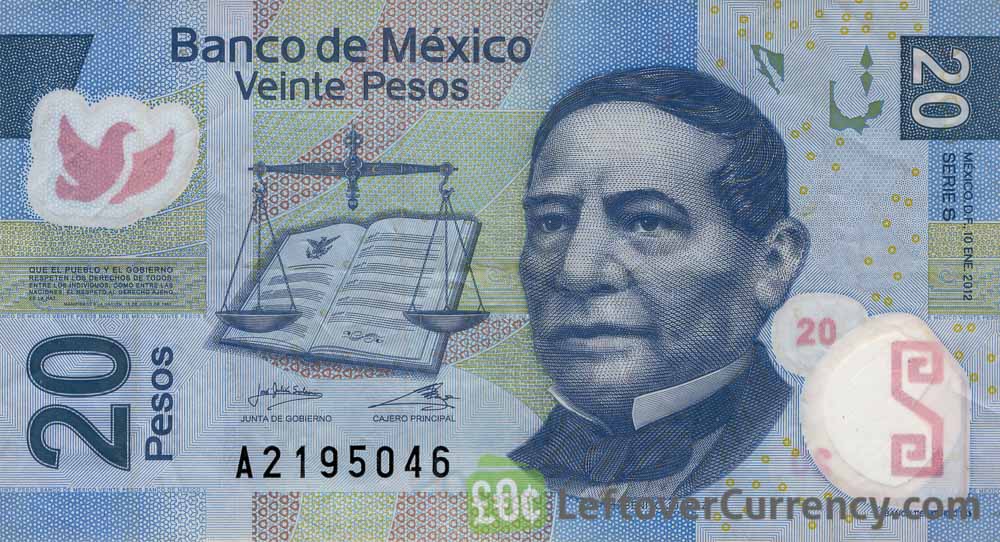
(Juat as a reminder, the 20-peso note is currently being withdrawn from circulation, and the new 500-peso note is replacing the Diego and Frida banknote. I have had several questions concerning how long the 20-peso note will be valid. There has been no official word. But local business owners say they are planning for one or two years. The Bank of Mexico will give due notice before they become little more than interesting souvenirs. At least, we hope the Bank will do that.)

Juarez is one of Mexico’s Horatio Alger stories. Born into poverty as a
Zapotec, he got a boost from a Franciscan priest who saw the young man had
great intellectual possibilities, and sponsored his schooling.
Rather than choosing the traditional route to success, the church, Juarez chose the law. He married well, and became active in the liberal cause in his home state. That eventually led to his appointment as Chief Justice of the Supreme Court.
When President Comonfort was forced to resign in 1858, the constitution designated the chief justice as interim president. An office Juarez would be elected to three times.
His terms as president were responsible for much of what we know as Mexico today. The church was stripped of its income-producing lands and some of its church buildings. The land was then distributed to the Indians from whom the church had taken the land.
Unfortunately, the reform did not last long. The new landholders eventually sold, or were forced to sell, their land to large landholders. When the next great land reform happened after the Revolution, the law entailed the Ejido holdings to prevent a similar failure.
Juarez also survived the years when another French emperor (Napoleon Bonaparte's nephew) put an Austrian archduke on the Mexican throne as Maximilio I.
Before we skip past the war of French Incursion, does anyone have a 500-peso note that pre-dates the Diego Rivera bill? We do not see them much anymore. They were last printed in 2005, but they still show up in change.
Do you have any idea who this man is?
Rather than choosing the traditional route to success, the church, Juarez chose the law. He married well, and became active in the liberal cause in his home state. That eventually led to his appointment as Chief Justice of the Supreme Court.
When President Comonfort was forced to resign in 1858, the constitution designated the chief justice as interim president. An office Juarez would be elected to three times.
His terms as president were responsible for much of what we know as Mexico today. The church was stripped of its income-producing lands and some of its church buildings. The land was then distributed to the Indians from whom the church had taken the land.
Unfortunately, the reform did not last long. The new landholders eventually sold, or were forced to sell, their land to large landholders. When the next great land reform happened after the Revolution, the law entailed the Ejido holdings to prevent a similar failure.
Juarez also survived the years when another French emperor (Napoleon Bonaparte's nephew) put an Austrian archduke on the Mexican throne as Maximilio I.
Before we skip past the war of French Incursion, does anyone have a 500-peso note that pre-dates the Diego Rivera bill? We do not see them much anymore. They were last printed in 2005, but they still show up in change.
Do you have any idea who this man is?

The note honors the man responsible for one of Mexico’s greatest military victories. His name is Ignacio Zaragoza, a liberal general who had served in Benito Juarez’s cabinet.
The year was 1862. General Zaragoza fought a defensive battle against a much larger French force at the first Battle of Puebla. And won decisively.
And I am willing to bet you know a few facts about that battle. In English, can anyone tell me the date of that victory? 5 May. And what is that date in Spanish? Cinco de Mayo.
Cinco de Mayo is not merely an invention of Corona beer to sell more bottles. It is a celebrated day in Mexican history. At least, in Puebla.
What it is not is Mexico’s Fourth of July. And we know that because we just learned about the day of Mexican Independence when Hidalgo sounded his grito. And it is? 16 September.
Like one of those tragic characters in a Greek play, the hero Zaragoza never had to make way for a more-diminished version of himself. Soon after his victory, he died of typhoid. At the age of 33.
Events in Europe forced the French emperor to withdraw his troops from Mexico, leaving Maximilio to defend his throne with the support of Mexican conservatives. Juarez’s liberal Mexicans prevailed, Maximilio was executed, and Juarez resumed his position as president and continued the liberal reform movement.
He probably stayed in office too long. Eventually, a young liberal general by the name of Porfirio Diaz revolted against him when Juarez declared he would once again seek reelection.
Juarez put down the revolt, but he died soon after. The next 40 years of power would belong to Porfirio Diaz.
7. Porfiriano (1876-1910)
At the time of Juarez’s death, Mexico was economically poorer than it had been on the day it gained independence, and Mexicans had been killing one another for over 60 years. The people were tired of it. And that is one reason they tolerated the longest period of one-man rule Mexico has ever experienced.
The man who ruled Mexico for that period was the same general who rose in revolt against President Juarez’s authoritarianism. Porfirio Diaz.

And though he was a liberal who opposed reelection, he was elected president for seven terms. I suspect Juana Inés would have had something to say about that level of male hypocrisy.
He was initially exactly what Mexico wanted -- summed up in the three words of his first political campaign:
Peace
Order
Prosperity
The last was the most obvious. Prosperity. Foreign investors moved in. Canadian-run mines. British-owned oil. American-constructed railroads. It was Mexico’s industrial revolution. Mexico started to become a wealthy country on foreign money and debt.
But Porfirio Diaz eventually abandoned his liberal instincts to preserve his dictatorship. Industrial growth came at the cost of a loss of Mexican political liberty. What had started as a liberal economy soon froze out competition and created very concentrated wealth.
You will not find Porfirio Diaz’s portrait on a banknote. But he did provide the reason for Mexico’s most violent war. What historians consider to be “the most important event in Mexican history” – the Mexican Revolution.
Order
Prosperity
The last was the most obvious. Prosperity. Foreign investors moved in. Canadian-run mines. British-owned oil. American-constructed railroads. It was Mexico’s industrial revolution. Mexico started to become a wealthy country on foreign money and debt.
But Porfirio Diaz eventually abandoned his liberal instincts to preserve his dictatorship. Industrial growth came at the cost of a loss of Mexican political liberty. What had started as a liberal economy soon froze out competition and created very concentrated wealth.
You will not find Porfirio Diaz’s portrait on a banknote. But he did provide the reason for Mexico’s most violent war. What historians consider to be “the most important event in Mexican history” – the Mexican Revolution.
8. Mexican Revolution (1910-1929)
In
1910, almost exactly 100 years after Mexico declared its independence, northern
Mexico rose in revolt against Porfirio Diaz. The immediate cause seems almost
trivial.
Porfirio Diaz said he would not seek reelection. When Francisco Madero, a wealthy northerner, believed him and ran for president, Porfirio Diaz changed his mind, had Madero arrested, and ran for another term – winning a transparently fraudulent election.
The Mexican people had had enough of him, and rose in revolution. Porfirio Diaz fled when the revolution began.
Madero was elected president and was then assassinated by one of his generals, who, in turn, became president and ended up in exile. A series of revolutionary leaders suffered the same fates – death or exile -- over the next ten years.
Porfirio Diaz said he would not seek reelection. When Francisco Madero, a wealthy northerner, believed him and ran for president, Porfirio Diaz changed his mind, had Madero arrested, and ran for another term – winning a transparently fraudulent election.
The Mexican people had had enough of him, and rose in revolution. Porfirio Diaz fled when the revolution began.
Madero was elected president and was then assassinated by one of his generals, who, in turn, became president and ended up in exile. A series of revolutionary leaders suffered the same fates – death or exile -- over the next ten years.
By the end of the revolution, 1,000,000 Mexicans were dead. Out of a total population of 15 million.
Note that number. 15 million people constituted the entire Mexican population in 1920. There were 25 million tribe members living in Mexico in 1519 when Cortes arrived. 400 years later Mexico’s population was only 60% of what it had been 300 years earlier. That is how cruel Mexico’s history had been to its citizens.
Who can show me a picture of a revolutionary leader? The man with the beard is President Venustiano Carranza.

This is a commemorative note issued in 2017 to
honor the centennial of the Mexican constitution.
In many ways, President Carranza typifies both the virtues and failings of the Revolution. After President Madero was assassinated, Carranza was a wealthy rancher who led the northern Mexican army to overthrow the general who had seized the government. He was successful, and became president.
Probably his greatest accomplishment was the ratification of the Constitution of 1917. That is the event commemorated on the 100-peso note. That constitution (with a few amendments) is still in effect.
There was not total agreement amongst the leaders of the Revolution of what the war was meant to accomplish. That is one of the great accomplishments of 1917. It gave the leaders an opportunity to re-create the political structure of the country -- and to agree on some very important points. Even though two major factions, those supporting the views of Pancho Villa and Emiliano Zapata, were excluded from the convention.
The 1917 constitution radically altered the way Mexicans thought about governance, the Catholic church, and the activity of foreigners within its borders. Among other things, the constitution --
In many ways, President Carranza typifies both the virtues and failings of the Revolution. After President Madero was assassinated, Carranza was a wealthy rancher who led the northern Mexican army to overthrow the general who had seized the government. He was successful, and became president.
Probably his greatest accomplishment was the ratification of the Constitution of 1917. That is the event commemorated on the 100-peso note. That constitution (with a few amendments) is still in effect.
There was not total agreement amongst the leaders of the Revolution of what the war was meant to accomplish. That is one of the great accomplishments of 1917. It gave the leaders an opportunity to re-create the political structure of the country -- and to agree on some very important points. Even though two major factions, those supporting the views of Pancho Villa and Emiliano Zapata, were excluded from the convention.
The 1917 constitution radically altered the way Mexicans thought about governance, the Catholic church, and the activity of foreigners within its borders. Among other things, the constitution --
- Established a system of free, mandatory, and secular education, thus restricting another traditional role performed by the Catholic church
- Set up the foundations for land reform through the ejido system
- Declared all mineral resources in the subsoil belonged to the state
- Provided for liberal labor rights
- Placed ownership of all property in the hands of the government and restricted foreign ownership of property near borders or on the coast
- Increased the restrictions on the Catholic church beyond those of Juarez's constitution
- Empowered the government to expropriate property -- land from the hacienda owners, and particularly property owned by foreigners
- Prohibited the reelection of any official -- especially, the president
Carranza was responsible for the death of several revolution leaders –
including Emiliano Zapata. It is with some justice, then, that he was
assassinated for attempting to maintain power beyond his single term in office.
There is one last note that we have not yet discussed. Who has a brown 500-peso note? The 500-peso note that will soon be withdrawn from circulation.
There is one last note that we have not yet discussed. Who has a brown 500-peso note? The 500-peso note that will soon be withdrawn from circulation.

This 500-peso note features the artists Diego Rivera on the front and Frida Kahlo on the reverse. Both were noted artists during their lifetimes – especially, after the Revolution. Frida, who some believe was the better artist, living in the shadow of her more-famous muralist husband.
If you have not been to the Frida museum in Coyoacán or have not seen Rivera’s murals in Mexico City, I strongly recommend that you go. In their work, you will find some of the Mexican soul.
So, there they are. The people the Bank of Mexico believes embody the soul of Mexico’s history and what Mexico wants to be.
But new banknotes are on the way. During the next three years, the Bank of Mexico will be issuing notes featuring the stories of some new and some old Mexican heroes.
The first has already occurred. The Bank is withdrawing the 20-peso note featuring Benito Juarez. But he is not forgotten. His portrait now graces the new 500-peso note.
Be very careful about confusing the two notes. I have seen people try to hand over a 500-peso note thinking it is a 20. The 500-peso note featuring Diego and Frida will be slipping into banknote oblivion at some point. But, probably not soon. After all the Zaragoza note is still in circulation and is legal tender.
This year will see a new 200-peso note honoring Mexican Independence featuring both Miguel Hidalgo and Jose Maria Morelos on the same note.
In 2020 a new 1000-peso note will honor heroes of the Mexican Revolution, and the Miguel Hidalgo 1000-peso note will be withdrawn -- eventually.
In 2021, Sor Juana Inés de la Cruz will move house to the 100-peso note.
And in 2022, the new 50-peso note will feature pre-Hispanic Mexico.
Somewhere along the line, the Bank will determine whether Mexico needs a 2000-peso note (featuring one of my favorite writers, Octavio Paz). If the note is issued, it will be a sure sign all is not well with the Mexican economy.
But new notes are always welcomed by me. Because it will be a good opportunity for me to update this talk in – say – another 10 years.
And we can gather again around the fireplace to sit upon the ground and tell sad stories of the death of kings. Could someone throw another log on that fire?
Thank you for your attention.


